
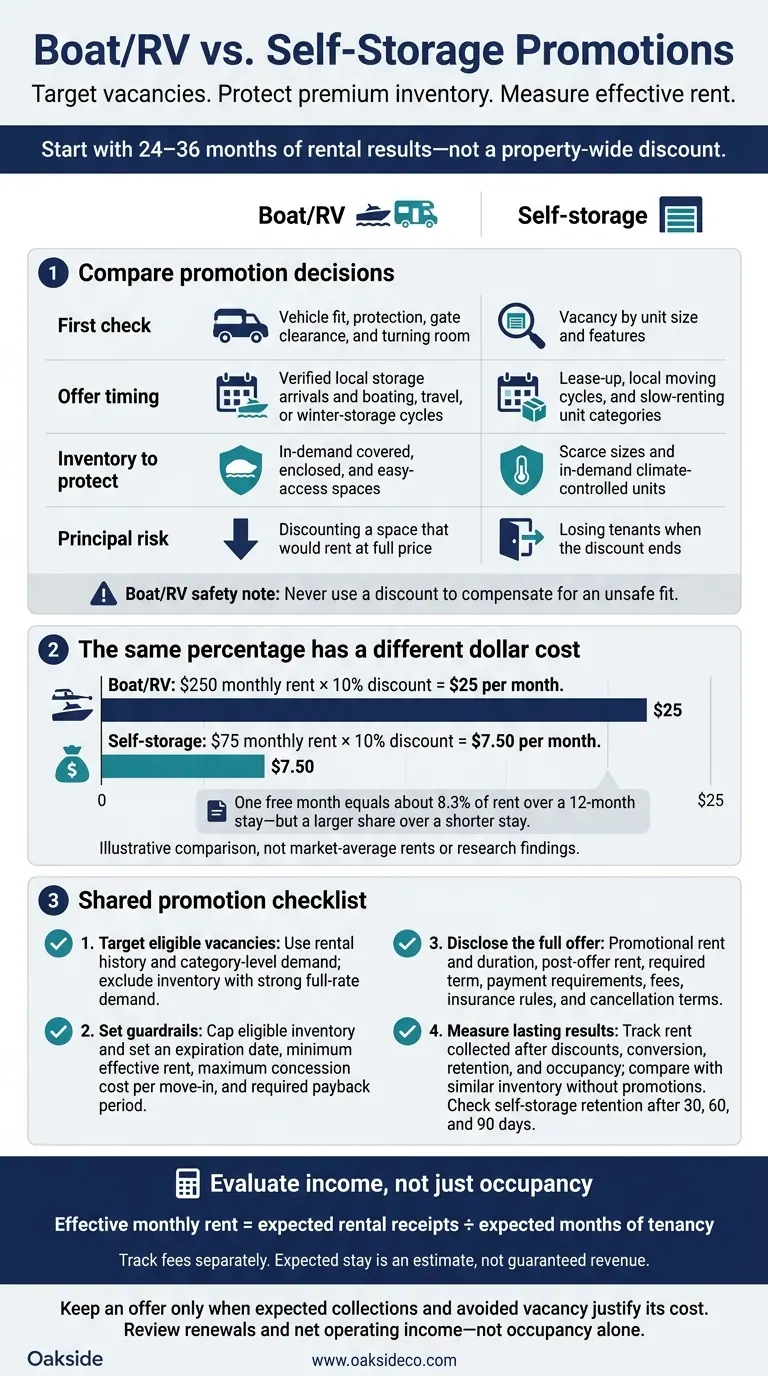
I’d discount slow-renting spaces - not the whole property. Start with 24–36 months of rental results, then target vacancies where an offer could bring in more rent than waiting. A 10% discount costs $25 a month on a $250 RV space, versus $7.50 on a $75 storage unit.
Here’s how I’d compare the two:
- Boat/RV: Confirm vehicle fit, protection, gate clearance, and turning room first. Time offers around local storage arrivals, and protect covered or enclosed spaces that rent without discounts.
- Self-storage: Use short move-in offers during lease-up or for slow-renting unit sizes and features. Match timing to local moves, and leave high-demand units out.
- Both: Cap eligible inventory, set an end date, disclose all costs and terms, and track rent collected after discounts, conversion, and retention - not occupancy alone.
Quick Comparison
| Factor | Boat/RV promotions | Self-storage promotions |
|---|---|---|
| First check | Vehicle fit and safe access | Vacancy by unit size and features |
| Timing | Local boating, travel, and winter-storage cycles | Lease-up and local moving cycles |
| Inventory to protect | In-demand covered, enclosed, and easy-access spaces | Scarce sizes and in-demand climate-controlled units |
| Main risk | Discounting a space that would rent at full price | Losing tenants when the discount ends |
My bottom line: <u>more occupied spaces don’t always mean more income.</u> I’d keep an offer only when collections and avoided vacancy justify its cost - and check whether those gains last through renewals and support net operating income and property value.
Boat/RV vs. Self-Storage Promotions: Protect Effective Rent
Target Discounts by Space Size and Protection
Price uncovered, covered, and enclosed spaces separately, based on how long each type has been vacant and its achieved rent. Treat 10-by-20-, 10-by-30-, and 10-by-40-foot labels as pricing buckets - not fit guarantees. Before setting a price, check total length, hitch, mirrors, roof height, door clearance, and turning room.
Boat/RV discounts should account for storage class and physical limits, not just vacancy. An uncovered space that’s been empty for months may warrant a concession. Scarce covered or enclosed spaces may support holding rent.
Before approving a discount, compare effective monthly rent with recent achieved rent and the cost of waiting for a full-rate tenant. Use the expected length of stay for that calculation; don’t treat it as guaranteed revenue. The price matters only if the vehicle fits both the space and the route into it.
Factor In Gate Access and Maneuvering Room
Better access can mean less need to discount. Check aisle width, turning radius, backing room, and gate clearance against the customer’s full towing setup. Electronic gates, personal codes, extended access, and proximity to lakes, marinas, highways, and recreation corridors can support demand.
Sell those features before cutting rent. Never use a discount to compensate for an unsafe fit. When access is strong, focus next on when to offer the promotion.
Time Offers Around Local Storage Seasons
Once you’ve confirmed fit and access, time the offer around local storage demand. In northern winter-storage markets, August through October is often the reservation window for storage running from October or November through April. Use the property’s booking history to decide when preseason reservations should open.
In warm-weather markets, winter recreation and summer heat can shift that window. Don’t simply reuse a northern fall promotion.
For winter agreements or six- or twelve-month incentives, spell out the possession date, payment schedule, minimum commitment, cancellation deadline, deposit refund rules, access conditions, and post-offer rent. Explain whether early retrieval changes the price and whether reserving a space immediately takes it out of available inventory.
Exclude spaces with strong full-rate demand. End the offer when you meet the reservation target - not when the calendar ends.
Choose Offers for Lease-Up or Vacant Units
During lease-up, offer the first month free, $1 first-month rent, or a short-term percentage discount to reduce upfront costs. At stabilized properties, save concessions for units that stay vacant. Use 70%–80% occupancy as a planning threshold, not a rule, for scaling back concessions. Schedule offers around local move-in peaks, then decide who qualifies.
Set clear eligibility rules for military members, seniors, and new customers. Specify exclusions for returning customers, transfers, added units, and renewals. Compare the total concession cost over the expected stay - not just the advertised discount.
Limit Discounts by Unit Size and Features
Limit each offer to specific unit categories. Separate small, standard, and large units, then group inventory by climate-controlled, drive-up, and vehicle-accessible features. Focus discounts on categories with longer vacancies or lower inquiry-to-rental conversion. Keep high-demand units off promotion, even when other categories lag. Track days vacant, conversion, and achieved rent per square foot for each category - not just facility-wide occupancy.
For each eligible unit category, set an inventory cap, expiration date, minimum effective rent, maximum concession cost per move-in, and required payback period. Review results weekly against similar units without promotions. Check retention after 30, 60, and 90 days, and drop discounts that reduce rent without getting units leased sooner.
Explain Move-In Costs and Rent After the Offer
Before the lease is signed, disclose the promotional rent, how long it lasts, the post-promotion rent, and the total move-in cost. Itemize administrative fees, applicable deposits, taxes, required locks, and insurance or protection-plan requirements.
State whether transfers, additional units, or combined offers are excluded. Explain that later rent changes follow the lease and local law. To protect effective rent, calculate effective monthly rent as expected rental receipts divided by expected months of tenancy. Track fees separately to keep concession costs clear.
The right promotion depends on the asset type, but demand, fit, and timing guide the decision. Boat/RV offers hinge on vehicle fit and seasonal retrieval dates. Self-storage offers depend more on unit mix and the pressure to fill vacancies.
Compare Demand and Seasonal Patterns by Market
Use local seasonal patterns to decide which asset type gets an offer first. A promotion that works in one market may fall flat in another because demand differs by asset type.
| Asset type and market | Demand drivers | Slower period | Goal | Offer timing |
|---|---|---|---|---|
| Self-storage: university | College moves and semester breaks | Between academic transitions | Bring in student move-ins | Before verified move-out and return dates |
| Self-storage: remodeling or downsizing | Local construction and household transitions | Gaps between projects or moves | Fill available unit sizes | Around confirmed project and relocation activity |
| Boat/RV: cold-weather market | Winterization and fall arrivals | Spring retrieval and departures | Fill winter inventory; replace spring departures | Before winterization deadlines or verified vacancy increases |
| Boat/RV: warm-weather lake, coast, or resort | Boating and travel cycles; parking constraints | Periods when vehicles are in use | Fill spaces between trips | Around recorded storage arrivals, not recreation activity alone |
| Boat/RV: retirement or snowbird market | Seasonal migration | Opposite the local storage arrival window | Retain seasonal customers | Before established arrivals, based on where vehicles remain |
For boat/RV properties, nearby activity doesn't necessarily mean storage demand. Once you've identified when demand slows, check what each asset type can actually sell.
Compare Space Requirements and Access Value
| Inventory factor | Self-storage implication | Boat/RV implication | Promotion decision |
|---|---|---|---|
| Size and fit | Customers can adjust belongings or choose another unit | The entire vehicle and trailer must fit | Confirm usable fit before setting concessions |
| Protection | Climate control sets units apart | Covered and enclosed spaces set inventory apart | Keep premiums unless results show price resistance |
| Access hours | Support moves and routine visits | Support early departures and weekend retrieval | Account for useful access in pricing before discounting |
| Gate reliability | Supports convenient visits | An outage can block retrieval | Fix access problems before testing price |
| Maneuverability | Loading areas affect convenience | Turning room can determine whether a space is usable | Confirm the towing path before pricing the vacancy |
A 10% discount costs more on a $250 RV space than on a $75 storage unit: $25 versus $7.50 per month. One free month equals about 8.3% of rent over a 12-month stay, but a larger share over a shorter stay.
Set Discount Amounts Using Property Results
After checking demand and fit, weigh the discount against the revenue gap left by the vacancy.
Compare category occupancy, local supply, leads, conversion, asking rates, and vacancy length. Low lead volume may justify a targeted offer. Strong leads with poor conversion point to a different first step: check fit and access before cutting the price.
Compare the concession over the expected stay with the rent loss and marketing costs avoided by leasing sooner. Keep the discount only when added rent exceeds the concession and vacancy cost.
Compare Promotion Choices by Asset Type
Keep self-storage concessions short and narrowly targeted. Use boat/RV incentives to address gaps in fit, access, or seasonal demand. Choose the offer based on whether the asset needs more tenants, seasonal fill, or protection for premium spaces.
| Asset type | Promotion option | Timing | Inventory to protect | Principal risk |
|---|---|---|---|---|
| Self-storage | Short move-in credits for eligible vacancies | Lease-up or local slowdown | Scarce sizes and high-demand climate-controlled units | Move-outs when full rent begins |
| Boat/RV: seasonal | Seasonal incentives only when fit and access are confirmed | Before verified seasonal storage arrivals or a documented slow period | Covered, enclosed, and easy-access spaces | Discounting spaces that would lease at full price |
Set Offer Limits and Track Results
During lease-up, make more units eligible. At stabilized properties, target specific vacancies. During seasonal slowdowns, discount only the affected categories. Give each offer an expiration date and disclose eligible inventory, promotion length, standard rent afterward, required term, payment requirements, fees, insurance rules, and cancellation terms.
Review results monthly during lease-up and at least seasonally otherwise. Track occupancy, effective rent, conversion, and post-promotion retention, comparing promotional tenants with those who received no promotion. Extend an offer only when expected collections and avoided vacancy justify the cost. Withdraw it when demand supports standard pricing.
Use effective rent to judge how promotions affect asset performance.
Link Promotion Results to Asset Value
Once an offer runs, assess lasting income - not just temporary occupancy. Review concession history by segment and season, effective rent, renewals, and net operating income after vacancy, concessions, and collection losses.
Oakside Co provides data-driven analysis and transaction support for self-storage and boat/RV dispositions, helping owners evaluate whether promotions improved effective rent and disposition value.
How do I calculate a promotion’s break-even point?
Weigh the discount, tenant acquisition, and administrative costs against the potential increase in net operating income. Review 24 to 36 months of data to see whether the promotion would add revenue - or simply replace revenue you would have earned anyway.
Track economic occupancy by dividing collected rental revenue by gross potential rent at current street rates. Factor in boat/RV seasonality and self-storage churn. Give the promotion a clear end date, and don’t stack discounts.
How should I time offers at a mixed boat/RV and self-storage property?
Time offers by unit class - not overall occupancy. Start offers when physical occupancy drops below 85%, increase discounts below 80%, and phase them out at 90%–95%.
For boat/RV spaces, offer longer-stay, prepaid, or retention deals in fall and winter. Use spring and summer offers to refill vacancies. For self-storage, run short-term entry offers in January–February; peak leasing runs May–August.
Set minimum stays and offer end dates, prevent discount stacking, and track both physical and economic occupancy.
How can I reduce move-outs when promotional rent ends?
Use targeted promotions instead of blanket discounts. Keep offers for new customers only, require stays of at least two to three months - or longer - and don’t allow offers to be combined. Make promotion end dates and the switch to standard rates clear.
Match incentives to the unit class: offer small introductory deals for open outdoor spaces and stronger incentives for enclosed units. Track economic and physical occupancy together so heavy discounting doesn’t hide pricing problems.