

Most storage expansion deals fail after closing, not at closing. I’d sum it up like this: if you don’t stress-test debt service, cost overruns, lease-up delays, and refinance risk before the first draw, you can end up with a project that starts with enough cash but still runs out of room later.
Here’s the short version:
- I’d treat the capital stack as a risk map, not just a funding list.
- A clean sources-and-uses sheet only shows the deal can start. It does not show it can survive a bad stretch.
- A project can pass a construction lender’s LTC test and still fail a takeout lender’s DSCR, debt yield, or occupancy test.
- Small misses can stack fast:
- 7% higher construction costs
- 4-month delay
- 70% year-one occupancy instead of 85%
- a refinance loan that comes in below plan
- DSCR can drop fast when interest-only ends. In the article’s example, $1.0 million of NOI on a $10.0 million loan falls from about 1.43x DSCR to 1.18x after amortization starts.
- Cost overruns usually hit in order: contingency, equity, then refinance capacity.
- Lease-up risk is not just about physical occupancy. If concessions, discounts, and bad debt drag down collections, economic occupancy can stay weak even when units look full.
- Refinance risk should be mapped before closing, with a backup for any payoff gap.
If I were reviewing this type of deal, I’d want four things in writing on day one:
- Monthly downside modeling
- A clear overrun funding waterfall
- Separate reserves for interest, operating shortfalls, and lease-up
- A refinance backstop if proceeds come in light
A few numbers from the article make the point clear:
- 88% of delayed projects in one 2025 review also had cost overruns
- Self-storage lenders may look for about 8% to 10% debt yield
- Reported lender screens in one market snapshot were around 1.36x DSCR and 9.8% debt yield
- A 14-month shortfall at $75,000 per month means at least $1.05 million of reserve need before any extra cushion
Below that, the article explains where storage expansion stacks usually crack and how I’d think about fixing the weak spots before they turn into a cash gap.
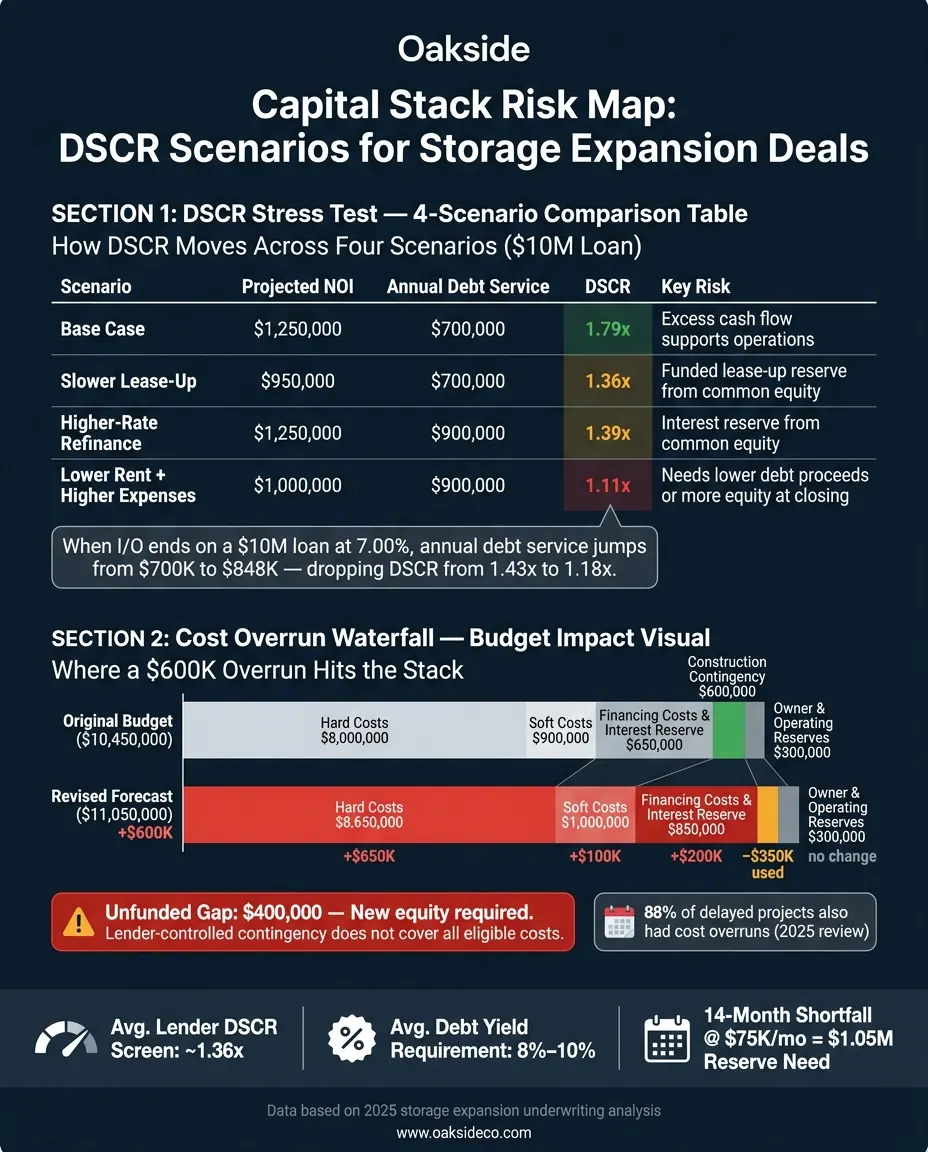
Capital Stack Risk Map: DSCR Scenarios for Storage Expansion Deals
DSCR trouble usually shows up at the worst time: when the interest-only period ends, lease-up takes longer than planned, or the takeout lender sizes the refinance at a higher rate. In those moments, thin coverage stops being a small underwriting issue and turns into a capital-stack issue. The debt schedule moves up, but property cash flow doesn’t keep pace.
That’s why DSCR needs to be tested against both the current loan structure and the refinance takeout.
What Causes DSCR to Fall Short
The most common trigger is the shift from interest-only payments to amortizing payments. Annual debt service climbs before NOI has had time to catch up.
On a $10 million loan at 7.00%, annual debt service goes from about $700,000 on an interest-only basis to about $848,000 once the loan amortizes. With $1 million of NOI, DSCR drops from 1.43x to 1.18x. That’s a sharp drop, and if the payment jump can’t be avoided, the capital stack needs to absorb it before maturity.
The deals that miss a projected 1.20x to 1.25x coverage target usually run into the same mix of problems: NOI comes in too high on paper, absorption takes longer than expected, and then rates or operating costs add more pressure. Even if occupancy stays in line, higher taxes and insurance can squeeze coverage.
It also helps to separate the tests clearly. In-place DSCR, stabilized DSCR, and refinance DSCR are not the same thing. A deal may look fine at stabilization and still fail the takeout because the refinance comes with a higher rate, a shorter amortization period, or a lower loan amount.
How to Restructure the Stack Around Weak Coverage
When coverage is thin, the answer is usually leverage and timing, not hope. The cleanest move is often to cut senior-loan proceeds. Less debt means less annual debt service, which helps both current DSCR and refinance DSCR without leaning too hard on future NOI growth. More common equity can help for the same reason: it lowers leverage for good.
Interest reserves should be sized to the downside lease-up case, not the base-case story. If the downside model shows a 14-month cash-flow shortfall at $75,000 per month in debt service, the reserve should be at least $1.05 million before adding any contingency buffer. That math needs to be plain and disciplined.
It also makes sense to phase debt draws around hard milestones, such as:
- certificate of occupancy
- occupancy thresholds
- trailing NOI
That approach limits interest carry on space that still isn’t producing revenue. Extension options should also be worked out before closing, with clear terms around reserves, defaults, and fees.
DSCR Stress Test by Scenario
The table below uses the same $10 million loan across four cases to show how DSCR can move. The base case assumes a 7.00% interest-only period. The higher-rate and lower-rent cases use a 7.75% amortizing refinance rate, which pushes annual debt service to about $900,000.
| Scenario | Projected NOI | Annual Debt Service | DSCR | Reserve Type | Gap Source |
|---|---|---|---|---|---|
| Base case | $1,250,000 | $700,000 | 1.79x | None | Excess cash flow supports operations |
| Slower lease-up | $950,000 | $700,000 | 1.36x | Funded lease-up reserve | Common equity |
| Higher-rate refinance | $1,250,000 | $900,000 | 1.39x | Interest reserve | Common equity |
| Lower-rent and higher-expense | $1,000,000 | $900,000 | 1.11x | Reserve sized to deficit | Lower senior debt or more equity at closing |
At 1.11x, the lower-rent, higher-expense case falls below the minimums many lenders want to see. That usually means the deal needs lower debt proceeds, more equity at closing, or a clear route to higher NOI before maturity. And when coverage stays thin while lease-up slips, the next place stress tends to show is the budget.
In a storage expansion, a budget overrun isn't just a construction issue. It's a capital stack issue. When costs move up, the pain doesn't hit every source of capital at once. It usually lands in a clear order: first contingency, then equity, then refinance capacity.
And in most cases, the first thing that breaks is the budget itself.
A lot of overruns begin below the surface. Site work, utility connections, stormwater management, and foundation conditions often come in light on the first pass, especially when the project has to tie into existing infrastructure. Tie-in work, utility upgrades, and hidden drainage problems can add hundreds of thousands of dollars before vertical construction even begins. Then the schedule slips, and that starts a second wave of pressure. A four-month extension can eat through soft-cost contingency with added interest carry and general conditions before any hard-cost increase is even counted. A 2025 academic review found that 88% of projects experiencing delays also experienced cost overruns. That number makes the link pretty clear: schedule risk and budget risk usually travel together. Material price volatility adds another problem. Steel, concrete, and electrical equipment can all be repriced between the day the budget is set and the day procurement happens. Every delay turns into added carry, which cuts into the equity cushion before lease-up.
Change orders are often where the budget starts to unravel. Each approved change order adds direct cost, but that's only part of the story. It can also extend general conditions, force work to be resequenced, and add more interest carry. So even if individual line items still look under control, the full budget can already be past contingency once those changes are stacked together.
Before closing, split the budget into five separate buckets: hard costs, soft costs, financing costs, contingency, and owner reserves. If those buckets get treated like one big pool, it's hard to see where the pressure is building. A project can appear fine on total budget and still be short on interest carry or costs the lender won't cover.
A written overrun waterfall should be agreed to before construction starts. That document sets the order of payment - who covers the first dollar of overrun, the next dollar, and the last one. The cleanest sequence starts with unused line-item savings and lender-controlled contingency. Then it moves to any remaining loan capacity the lender confirms is still open. After that, the sponsor funds lender-ineligible or elective costs. Then a dedicated equity reserve gets used. Supplemental debt, preferred equity, or mezzanine capital should come later, after the lower-cost options are gone, because high-cost capital at this stage puts more pressure on the refinance later.
Where scope is well defined, a fixed-price or guaranteed-maximum-price (GMP) contract can shift part of the cost risk to the general contractor. But a GMP doesn't solve everything. Exclusions, allowances, concealed-condition clauses, and owner-directed changes can all sit outside the guaranteed price, which leaves real exposure with the owner. That's why change-order controls matter just as much. Requiring sponsor and lender approval for any single change order above a set threshold - and tracking total exposure against remaining contingency in every monthly draw package - helps stop contingency from getting drained before anyone steps in.
Once that funding order is in place, the next issue is simple: how much of a gap the stack can still absorb.
Sources, Uses, and Remaining Gap
The table below shows how a budget can move when site and material problems hit in the middle of construction, using a $10,450,000 original budget.
| Budget Category | Original Budget | Revised Forecast | Change | Funding Status |
|---|---|---|---|---|
| Hard costs | $8,000,000 | $8,650,000 | +$650,000 | Partially committed |
| Soft costs | $900,000 | $1,000,000 | +$100,000 | Partially committed |
| Financing costs and interest reserve | $650,000 | $850,000 | +$200,000 | Loan reserve increase needed |
| Construction contingency | $600,000 | $250,000 remaining | ($350,000 used) | Lender-controlled |
| Owner and operating reserves | $300,000 | $300,000 | $0 | Sponsor-funded |
| Total uses | $10,450,000 | $11,050,000 | +$600,000 | Revised requirement |
| Senior construction loan | $7,300,000 | $7,500,000 | +$200,000 | Subject to lender approval |
| Committed sponsor equity | $3,150,000 | $3,150,000 | $0 | Funded/committed |
| Additional equity required | ** - ** | $400,000 | +$400,000 | Unfunded gap |
That $400,000 gap needs new equity because lender-controlled contingency only covers eligible costs. If delays add more carry or general conditions, the gap gets bigger before lease-up even starts.
If the overrun eats into reserve, the next test is whether slower lease-up can still support the refinance.
Once the construction budget is fixed, lease-up is usually where the next problem shows up. And this one hits more than occupancy. It affects liquidity, debt coverage, and whether a refinance can close at maturity. That matters because lease-up pace shapes both current cash flow and the size of the takeout loan at maturity.
How Slower Lease-Up Weakens the Stack
A common mistake is watching physical occupancy and missing economic occupancy. A property can show solid unit occupancy and still miss the NOI needed to cover debt service if it leans on concessions, discounted move-in rates, or higher delinquency. National same-store weighted-average occupancy reached 91.9% in Q2 2025, up 90 basis points from the prior quarter. The same report said move-in rates remained below move-out rates.
For an expansion project, the strain builds fast. Lower achieved rents cut effective gross income. Higher marketing spend pushes operating costs up. Bad debt reduces collected revenue even more. On paper, NOI may seem fine if you look only at physical occupancy. But at refinance, that same NOI can fail a lender’s DSCR or debt-yield test. Lenders are also using tighter standards, with reported average debt yields around 9.8% and average DSCR near 1.36x. If collected revenue falls short, the loan amount a lender will approve can shrink too.
How to Build More Runway Into the Deal
It helps to split reserves into separate buckets:
- interest carry
- operating deficits
- lease-up marketing
Each bucket should be sized to the downside schedule, not the base case. Then compare monthly actuals against both cases. That makes it easier to spot reserve burn before it turns into a cash crunch.
A longer interest-only period can ease early reserve burn during lease-up. But interest-only debt doesn’t solve the core issue; it just pushes principal repayment out. The loan still needs a realistic maturity date and clear extension terms. It can also make sense to release equity in stages at certificate of occupancy, delivery milestones, 60%, 75%, and stabilization so cash is not sitting idle. Distributions should stay on hold until the property hits agreed physical and economic occupancy marks, posts a set DSCR for two or three straight quarters, and keeps enough liquidity to cover debt service.
Lease-Up Reserve Burn and Exit Scenario Comparison
The table below shows how reserve burn can keep going even when physical occupancy improves, if economic occupancy is still lagging.
| Occupancy Milestone | Monthly EGR | Operating Expenses | Monthly NOI | Debt Service | Monthly Cash Flow | Reserve Draw | Remaining Liquidity |
|---|---|---|---|---|---|---|---|
| 60% physical | Lower | Elevated | Often negative or near zero | Required in full | Deficit | High | Reduced |
| 75% physical | Improving | Still elevated | May still trail debt service | Required in full or partly covered | Smaller deficit | Moderate | Tight |
| Stabilized (90%+) | Higher | Normalizing | Positive or near breakeven | Mostly or fully covered | Near breakeven or positive | Low or none | Improved |
Figures are illustrative. Replace them with property-level operating data and lender-confirmed debt-service amounts.
In the downside case, the project may still be drawing on reserves at 75% physical occupancy because economic occupancy - hurt by concessions and bad debt - has not caught up. Reserve burn doesn’t stop when the occupancy number looks better. It stops when collected revenue covers debt service.
When stabilization slips, the issue moves from operations to capital recovery. That’s when the matrix below helps test which exit still works within the reserve balance and maturity date.
| Exit Scenario | Timing | Underwriting Basis | Gross Proceeds / New Loan | Transaction Costs | Existing Loan Payoff | Remaining Gap | Ownership Impact |
|---|---|---|---|---|---|---|---|
| Refinance | At maturity or after stabilization | Current or stabilized NOI, sized to lender DSCR, debt-yield, and LTV tests | May be below the existing payoff if NOI is weak | Closing costs and required reserves | Existing payoff may exceed new proceeds | Possible capital gap | Ownership retained, but dilution is possible if the gap is filled with preferred equity |
| Loan extension | Before maturity | Current NOI | N/A | Extension fee and continued carry | Deferred, not eliminated | Reserves must cover the extra carry | No dilution; maturity risk is pushed forward |
| Supplemental equity | During extended lease-up | Downside NOI and updated refinance sizing | New equity closes part or all of the gap | Placement costs and new equity terms | Covered if combined with a refinance or bridge loan | Gap closed | Existing ownership is diluted or capital rights are reshaped |
| Sale | When refinance is not feasible | In-place NOI and market cap rate | Gross sale proceeds | Brokerage and closing costs | Existing loan is paid off from sale proceeds | Can still leave a shortfall or reduce sponsor proceeds | Ownership exits; lower valuation is crystallized |
Figures are illustrative. Payoff amounts should include any prepayment premium, defeasance, or interest-rate cap termination fee.
A sale becomes the rational move when reserves can’t support an extension or a refinance. The key is deciding early, before the reserve balance makes the choice for you. Owners should set a written trigger, such as a set reserve level or a no-refinance date, so the call gets made while there are still options on the table.
After you stress-test DSCR, cost overruns, lease-up timing, and refinance capacity, one point stands out: in a storage expansion deal, the capital stack is a risk-allocation tool, not just a pile of funding sources. Before closing, put every material risk into plain terms. Give it a dollar amount, a clear owner, a trigger, and a deal-term fix, not just a short note in a memo line.
The main way these deals go sideways is overlap. Overruns, delays, higher rates, and weaker NOI can all land at the same time. When that happens, cost overruns burn through contingency, delays extend carry, higher rates push up debt service, and weaker NOI reduces refinance proceeds.
Key Takeaways for Owners and Investors
Don't lean on base-case DSCR by itself. A base-case DSCR can make repayment capacity look stronger than it is when it assumes on-time completion, fast occupancy, solid rental rates, and flat interest costs. Run at least three cases: base, downside, and severe downside. Then pinpoint the exact quarter when coverage may breach the loan covenant.
Reserve sizing matters more than reserve labels. Interest, operating shortfall, and lease-up reserves should be sized to the downside schedule, not the optimistic one.
Each risk needs its own guardrail because no single reserve fixes every failure mode. Put a funding source behind each risk before closing, not after trouble starts:
| Risk | Primary protection | Required backstop |
|---|---|---|
| Thin DSCR | Lower initial leverage, interest reserve, cash sweep, or interest-rate protection | Sponsor equity or committed subordinate capital |
| Cost overruns | Hard- and soft-cost contingency, GMP contract where available | Contractual sponsor funding obligation |
| Delayed lease-up | Lease-up reserve, realistic stabilization covenant | Extension options and additional equity |
| Higher interest rates | Rate cap, fixed-rate takeout, or conservative rate stress | Additional interest reserve or equity |
| Refinance pressure | Early takeout plan, minimum NOI test, valuation sensitivity | Planned equity paydown or sale alternative |
Build the refinance plan before the construction loan closes. Name the expected takeout lender, the minimum DSCR, the maximum LTV, the interest-rate assumption, and the debt-yield requirement. Then model refinance proceeds under lower NOI and a higher cap rate. If the downside case leaves a gap between the maturity balance and the proceeds available, that gap needs a named funding source, not a hope that the market will cooperate.
Finally, write the waterfall, reserve triggers, and refinance backstop into the deal documents before day one. Sponsor support is not a backstop until it becomes a binding obligation with a defined call procedure, timeline, and consequence for non-performance. Owners who assign funding order and timing in advance keep more options on the table when the downside case shows up.
What is the biggest capital stack risk in a storage expansion?
The biggest capital stack risk in a storage expansion is the mix of construction delays and financing carry costs.
Here’s why that matters: when construction loan rates sit around 7% to 9%, even a small delay can get expensive fast. Extra time on the schedule means more interest carry, a slower path to stabilization, and tighter development spreads. That can eat into returns before the project even gets fully up and running.
To cut that risk, developers should plan for higher replacement costs, keep contingency allowances in the 5% to 10% range, and stress-test DSCR against slower lease-up periods.
It’s a simple idea, but an easy one to underestimate: a project doesn’t need to go badly off track to feel the pressure. Sometimes a modest delay is enough to turn a decent spread into a much thinner one.
How much reserve should a storage expansion deal carry?
Reserve needs change from one project to the next, and lenders don’t all play by the same rulebook.
A construction contingency of 5% to 10% of the total budget is common. But if the site has unknown soil conditions or a high water table, that cushion may need to be 10% or more. That extra room can help cover the kind of surprises that tend to show up once work begins.
Lenders may also ask for reserves at closing to cover taxes, insurance, and replacements. Replacement reserves are often modeled at about $0.25 per rentable square foot per year. Some loans also call for working capital reserves or 12 to 18 months of tax and insurance escrows.
When should I plan for a refinance gap?
Plan for a refinance gap if your debt is getting close to maturity, especially in a shaky rate market and even more so with floating-rate bridge debt. Refinance and take-out rates can change returns in a big way, so you need to model that risk on an ongoing basis.
This matters most when your timeline starts to slip or when market conditions may delay the stabilized occupancy needed to qualify for permanent financing. As Nolen Masserman, Managing Director at Oakside, notes, the core numbers must still work if material and labor costs rise.