

The best offer is not always the highest one. If I’m selling a self-storage or boat/RV property, I’d look past the top-line price and focus on deposit hardening, financing risk, approval steps, and closing time.
Here’s the short version:
- A $10,000,000 offer can be weaker than a $9,850,000 offer if the first buyer has a long refundable diligence period.
- Institutional buyers often have more layers of approval, more reports, and closing timelines that can run 60–120 days from signed LOI to closing.
- Private buyers can move with fewer internal steps, but deals often stall when equity is not in place, debt is not locked in, or partner consent is still pending.
- For sellers, the big test is simple: How much can the buyer still change, delay, or cancel after the PSA is signed?
If I had to screen offers fast, I’d use three checks:
- Price certainty: Will the buyer try to cut the price later?
- Closing certainty: Does the buyer have cash, debt, and authority lined up now?
- Timing certainty: Can the deal close by the stated date?
| Item | Institutional Buyer | Private Buyer |
|---|---|---|
| Capital source | Funds, large operators, public-company style capital | Individuals, family offices, local owners, sponsor groups |
| Deposit setup | Often staged hardening | Often one hardening date |
| Diligence scope | Broad review of title, survey, zoning, tax, insurance, site data, and records | Often narrower and driven by lender needs |
| Main deal risk | Committee approval, appraisal gap, fit with mandate | Unfinished equity, lender delays, partner approval |
| Financing path | Bank, life company, CMBS, agency, or private-credit debt | Local bank, credit union, SBA, portfolio, or private-credit debt |
| Common loan timing | Often part of a 60–120 day path | Often 45–90 days for bank debt; 60–90 days for SBA |
| Seller focus | Watch for soft deposit periods and approval outs | Verify cash equity, lender support, and who can sign |
Bottom line: I would judge each offer by the PSA, not the LOI. The seller usually wins when the deposit goes hard sooner, contingencies are narrow, and the buyer can prove funding and decision-making authority up front.
How Institutional Buyers Handle Deposits and Diligence
Institutional buyers usually place earnest money into escrow within 2–5 business days. From there, they run a broad review across title, survey, zoning, environmental, insurance, tax, and day-to-day operations. On self-storage deals, that often goes even deeper, with checks on software records, gate logs, bank deposits, and lien-sale history.
For boat/RV properties, the review tends to stretch further. Buyers will look at the unit mix, pavement and drainage, utility capacity, and whether each storage type on the site complies with zoning rules.
The big difference is how these buyers handle deposit hardening. Instead of one all-or-nothing date, they often use a staged schedule. Part of the deposit may go hard after an early diligence milestone, and the rest may harden when the full diligence period ends. For sellers, that detail matters a lot. The main issue isn't just how much diligence the buyer wants to do. It's how much room that process leaves to change the price or push back hardening.
How Private Buyers Handle Deposits and Diligence
Private buyers usually deal with fewer internal sign-offs, which can make them move faster. But their financing is often where the deal gets shaky.
They tend to use a fixed deposit, often $25,000 to $100,000 on smaller deals, with a 30–60 day diligence period tied to financing. On paper, a bigger deposit may look better. In practice, a smaller deposit can be stronger if financing is already lined up and the deadlines are tight.
That said, sellers can't stop at the dollar amount. If the PSA still gives the buyer broad walk-away rights, or if financing conditions are still unsettled after the deposit hardens, the seller is still exposed.
How Sellers Should Read Diligence Rights in the PSA
Sellers should pay closer attention to the hardening date than to the deposit amount. A large deposit that stays refundable can put a seller in a weaker spot than a smaller deposit that goes hard sooner.
It's also worth reading the PSA for terms that quietly stretch the soft-money period. Common examples include:
- automatic extensions if document delivery is late
- open-ended approval rights
- repair rights that let the buyer reopen price talks after inspections are done
That gets to the heart of it: the real question isn't only who offers more money. It's who gives up control sooner.
The table below shows how institutional and private buyers usually stack up on the main diligence terms:
| Deal Term | Institutional Buyer | Private Buyer |
|---|---|---|
| Hardening schedule | Staged: partial at an early milestone, remainder at diligence expiry | Single "cliff" date at the end of the diligence period |
| Required reports | Title, survey, zoning, environmental, property condition, insurance, tax, technology, and operations reviews | Core reports; scope driven by lender requirements and sponsor experience |
| Retrade risk | Tied to committee review, underwriting shifts, or data discrepancies | Tied to financing approval, inspection findings, or limited initial underwriting |
| Seller protection | Staged deposits, firm deadlines, defined extension conditions | Deposit increases, financing milestones, defined approval deadlines |
For stabilized assets, 30 days is often enough. Value-add deals or more complex boat/RV sites may need more time, but only when any extension is tied to a clear deliverable. Once diligence ends and the deposit goes hard, the next issue for sellers is debt approval and whether the buyer can get to the closing table.
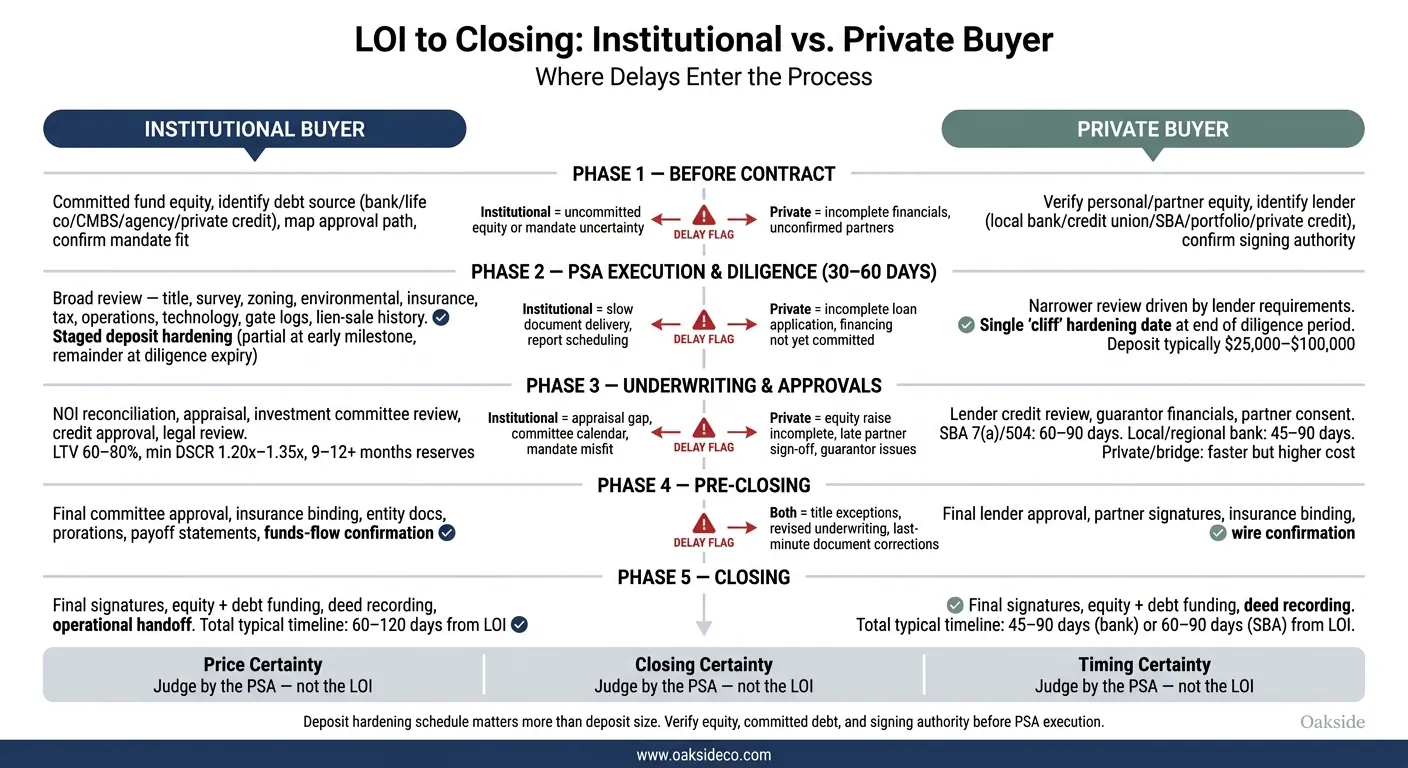
LOI to Closing: Institutional vs Private Buyer Timeline
Institutional Debt and the Approval Process
Institutional buyers usually bring committed equity together with debt from banks, life companies, CMBS, agency lenders, or private-credit groups. From there, the deal moves through a fairly layered path: underwriting, committee approval, legal review, credit approval, and funds authorization.
Lenders look closely at cash flow, sponsor strength, leverage, reserves, and third-party reports. Commercial loans often land in the 60%–80% LTV range, with a 1.20x–1.35x minimum DSCR and 9–12+ months of post-closing debt-service reserves, depending on the lender and the asset.
For self-storage, the review tends to zero in on occupancy trends, unit mix, street rates, and revenue per square foot. For boat/RV assets, lenders also look at paving and drainage condition, zoning, and seasonal revenue patterns. Because reports and approvals often run side by side, institutional deals commonly take 60–120 days from executed LOI to closing. That’s usually where the timeline starts to stretch.
Private Debt and the Approval Process
Private buyers often start with personal capital, operating cash, family investors, or syndication partners, then add debt from local banks, credit unions, SBA lenders, portfolio lenders, or private-credit groups. The path is often shorter than an institutional deal, but it can still slow down once guaranties and partner sign-offs enter the picture.
One of the clearest structural differences is recourse. Institutional debt is usually non-recourse. Private buyers, by contrast, often sign personal guarantees. That can hold up closing if guarantor financials are incomplete or if several partners need to approve the deal.
SBA financing brings its own timing. A 7(a) or 504 loan commonly takes 60–90 days from application to funding. Private-credit or bridge lenders can move faster on a clean deal, but that speed usually comes with higher pricing and shorter maturities. Local or regional bank financing typically takes 45–90 days, depending on borrower documentation, appraisal scheduling, and loan-committee availability.
For private buyers, delays usually show up after the decision has been made. The usual culprits are unfinished equity raises, late partner consent, and incomplete loan packages. You can see those differences most clearly in the stretch from LOI to closing.
The Execution Sequence From LOI to Closing
The table below shows where delays usually enter the process.
| Phase | Key Actions | Common Delay Source |
|---|---|---|
| Before contract | Buyer qualification, proof of funds, lender identification, leverage target, approval path | Incomplete financials, uncommitted equity |
| After PSA execution | Earnest money deposit, data-room review, inspections, title and survey work, environmental reports, loan package submission | Slow document delivery, incomplete loan application |
| During underwriting | NOI reconciliation, appraisal, lender credit review, title and zoning resolution | Appraisal gap, environmental finding, investment committee calendar |
| Before closing | Final approvals, insurance binding, entity documents, prorations, payoff statements, funds-flow confirmation | Revised underwriting, partner consent, title exception |
| At closing | Final signatures, equity and debt funding, deed recording, operational handoff | Wire delays, last-minute document corrections |
A standard commercial acquisition often breaks down like this:
- 2–3 weeks for PSA negotiation and execution
- 30–60 days for due diligence
- 2–4 weeks for financing mechanics and closing
When the buyer is ready, due diligence and underwriting usually happen at the same time. Title, survey, environmental testing, and appraisal can start while the lender reviews both the borrower and the property. A complete package at contract execution keeps the process moving. Missing financials or late reports usually push the closing date back, no matter who the buyer is.
Headline price is only part of the story. What matters is how much of that price actually makes it to closing. After diligence and debt terms, the next thing to look at is simple: does the buyer’s deal structure still leave the seller exposed to closing risk?
| Certainty Factor | Institutional Buyer | Private Buyer |
|---|---|---|
| Capital in place | Often tied to fund-level capital, but final internal approval may still be required | Strongest when verified cash equity and committed debt are both in place now |
| Buyer track record | Repeatable process, but mandate fit still matters for self-storage and boat/RV assets | Verified closings on comparable assets matter most |
| Seller remedies for default | Often limited to deposit retention as liquidated damages | Same structure; protection depends on deposit size and hardening schedule |
Earnest money often falls in the 1%–5% range, but the hardening schedule matters more than the opening percentage. A smaller deposit that goes hard after clear milestones can protect the seller more than a bigger deposit that stays refundable through a long diligence period.
Where Institutional Offers Gain or Lose Certainty
Institutional buyers often look stronger on paper. But paper strength and closing certainty are not always the same thing.
An institutional offer can still break after PSA execution if the asset falls outside the fund’s investment mandate, misses final investment-committee approval, or lands below the lender’s appraisal.
With self-storage and boat/RV assets, late-stage risk often shows up in the small stuff that suddenly becomes a big deal: rent-roll inconsistencies, gate-access data that doesn’t line up with occupied units, unresolved zoning, drainage issues, or insurance exclusions. That’s why sellers need to read the PSA closely. The key question is whether investment-committee approval is an actual termination right or just an internal step in the process. A signed LOI or a preliminary committee vote is NOT the same as unconditional funding.
Where Private Offers Gain or Lose Certainty
Private buyers can often move faster, but certainty comes down to whether equity and debt are already locked in. A private buyer with verified cash equity, a committed lender, and authority to act alone can offer more day-to-day certainty than a bigger institutional offer that still needs committee review. Fewer approval layers usually mean fewer ways for a deal to stall.
That said, certainty drops fast when the buyer still needs to raise equity, get partner sign-off, or place debt that is not yet committed. Sellers should verify three things:
- verified equity
- committed debt
- actual signing authority
The point is to look at what exists today, not what might come together later. Is the equity already verified, or does it still need to be raised? Is there an executed lender term sheet, or just a conversation? And if the buyer is proposing a seller note, that should not count as proof of closing until the buyer shows cash equity and clear repayment terms.
The best buyer isn't always the one with the top number. It's the one whose capital, approval path, and timeline line up with the asset you're selling.
Match the Buyer Structure to the Asset
Once you've weighed diligence, debt, and timing, the next step is matching the buyer structure to the asset's complexity. Buyer fit shapes economic certainty, execution certainty, and timing certainty - the same three tests that matter for every offer in this article.
A stabilized self-storage facility with steady occupancy, reconciled rent rolls, documented ancillary income, and little deferred maintenance usually fits institutional capital best. Why? Because clean data supports both price and closing confidence. A clean rent roll, accurate NOI, and documented ancillary income make it easier for that buyer to underwrite the deal and stick to the offer.
A value-add or expansion-focused property is a different story. Both institutional and private buyers may want it, but the better match depends on who can fund the business plan in practice, not just on paper.
That point matters even more for boat/RV assets. Expansion value only works if zoning, drainage, utility capacity, and entitlements are verified. If a buyer underwrites expansion before checking those items, you're not just getting upside potential - you're taking on more closing risk.
Use the matrix below to line up the asset type with likely buyer fit and the main diligence issue to watch.
| Asset Type | Typical Fit | Key Diligence Priority |
|---|---|---|
| Stabilized self-storage with clean data | Institutional | Rent-roll reconciliation, NOI accuracy, ancillary-income support |
| Value-add self-storage with operational gaps | Either; depends on capital plan | Lease-up assumptions, improvement budget |
| Boat/RV with expansion potential | Either; depends on capital plan and entitlement experience | Zoning, drainage, utility capacity, entitlement review |
| Smaller, simpler facility | Private | Proof of equity and lender commitment |
Conclusion: The Best Offer Balances Price, Terms, and Closing Certainty
After pricing and process, the last question is fit. Institutional buyers may bring more process discipline and deeper capital access. Private buyers may offer direct decision-making and a simpler approval path. What matters most is whether the offer holds up across three dimensions: economic certainty, execution certainty, and timing certainty.
If the gap in price between two offers is modest, the private offer may be worth a hard look - especially if it comes with a larger deposit, fewer contingencies, and a shorter, enforceable closing schedule. The PSA, not the LOI, controls the deal. Make sure it spells out every milestone, deadline, and remedy in writing before you sign.
For complex self-storage or boat/RV dispositions, Oakside Co can help structure the process and compare offers on price, terms, and closing certainty.
What should I verify before accepting a buyer's offer?
Check the buyer’s finances and how believable their terms are. In seller-financed deals, this matters a lot because you’re acting like the lender and taking on credit risk. You also want to make sure the offer is based on what the property actually earns, not just the asking price.
If the buyer wants to assume an existing loan, get written lender confirmation that your personal guarantee has been released. Otherwise, you could still be on the hook if the buyer defaults.
How can I tell if an earnest money deposit is strong?
An earnest money deposit is strong when it shows a buyer is serious and has the funds to get to the finish line. For the seller, it lowers risk because the deposit usually becomes non-refundable once the due diligence period ends.
When you're sizing up an offer, don't look at the deposit amount in isolation. Put it next to the full deal structure and the buyer's ability to get through due diligence without coming back and asking for major price cuts.
Which buyer type usually closes faster and with less risk?
Cash-heavy, low-leverage buyers - like family offices and regional sponsors - often close faster and with less deal risk than institutional buyers. The main reason is simple: they rely less on outside financing. That usually means fewer lender-driven delays and, in many cases, a shorter due diligence window.
Institutional deals tend to be more involved. They often include layered financing, more parties, and added legal coordination, which can stretch out the closing timeline.