


If you want second-lien debt on a stabilized storage property, the deal usually comes down to four things: senior lender consent, cash flow, combined leverage, and paperwork.
I’d sum it up like this: you may have room for junior debt if your property has steady NOI, your senior loan allows it, and the asset can carry total debt service at about 1.20x to 1.35x DSCR. But even when value looks fine, a senior-loan ban on junior liens or a tough intercreditor agreement can stop the deal.
Here’s the short version:
- A second mortgage is a junior lien on the real estate.
- Mezzanine debt is secured by the ownership interests, not the property itself.
- Lenders often price junior debt around 10% to 15%.
- Proceeds are usually sized by the lowest of:
- CLTV limit
- DSCR support
- senior-loan limits
- sponsor strength
- A simple formula is: max total debt allowed − current senior balance = room for junior debt
- Common slowdowns are:
- senior-lender approval
- intercreditor markup
- appraisal, title, survey, and insurance items
- missing borrower or property documents
A fast example: if a property is worth $10,000,000 and total leverage is capped at 75%, total debt cannot go above $7,500,000. If the senior loan is $5,500,000, the top-end room is $2,000,000 before DSCR or loan terms cut it lower.
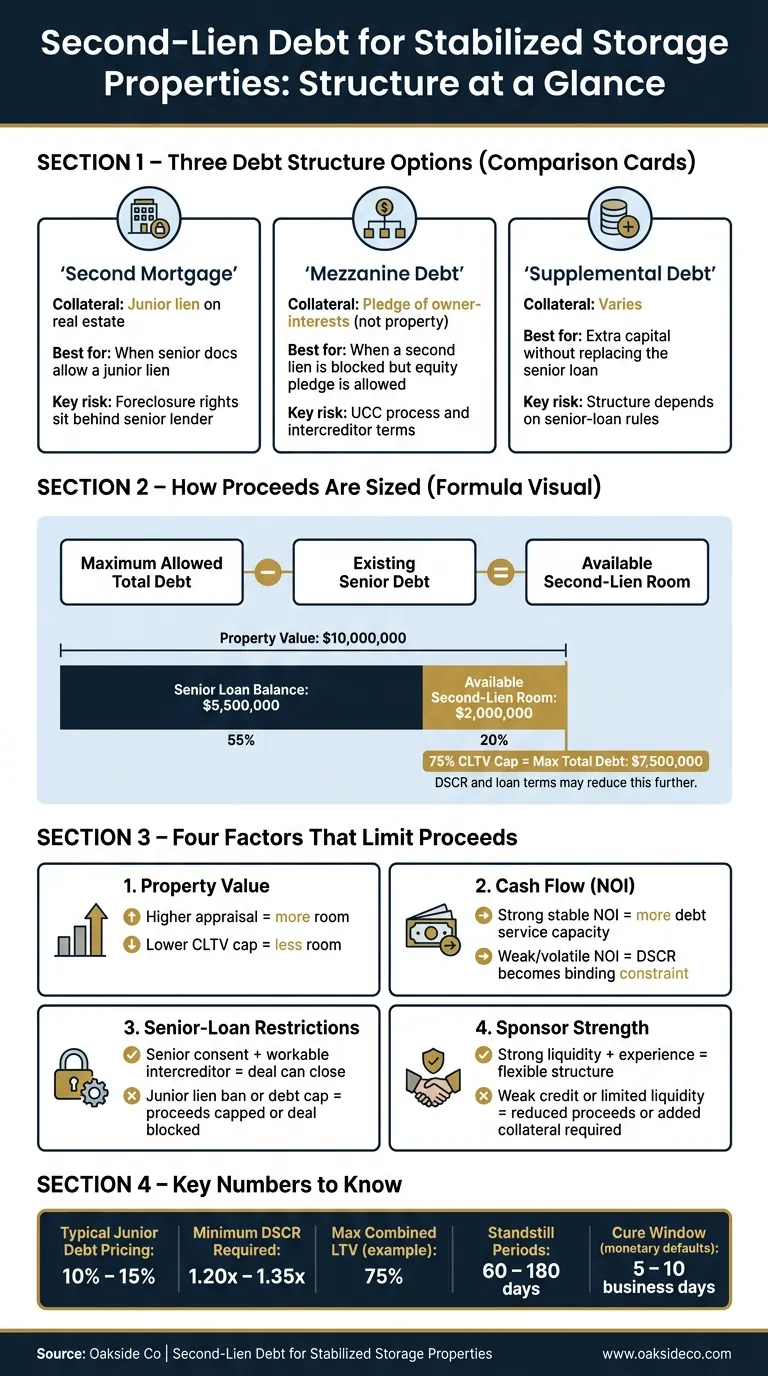
Second-Lien Debt Options for Stabilized Storage Properties: Key Metrics & Structure
| Option | Collateral | Main use case | Main issue |
|---|---|---|---|
| Second mortgage | Junior lien on real estate | When senior docs allow a junior lien | Foreclosure rights sit behind senior lender |
| Mezzanine debt | Pledge of ownership interests | When a second lien is blocked but equity pledge is allowed | UCC process and intercreditor terms |
| Supplemental debt | Varies | Extra capital without replacing the senior loan | Structure depends on senior-loan rules |
If I were screening a deal at the start, I’d first check the senior note, then NOI, then the use of proceeds, and then whether the closing file is clean enough to get to funding without delay.
Second-lien capital for stabilized storage properties usually comes from private CRE lenders, debt funds, specialty finance companies, mezzanine lenders, and private credit investors. Each one looks at the deal a bit differently. The right match depends on how much capital the owner needs, what the senior loan allows, and how the borrower wants the deal put together. In plain English, lender interest starts with three things: cash flow, leverage tolerance, and whether junior capital is even allowed under the senior loan.
Private CRE lenders usually prefer conservative leverage, steady in-place cash flow, and a clear path to repayment. Debt funds and private credit investors tend to offer more flexibility and higher leverage, but that usually comes with a higher cost and tighter terms, like added covenants, reserves, or cash control. Specialty finance companies can make sense for smaller loan amounts or deals tied to a specific asset type.
Sometimes the existing senior lender is the simplest path. If the senior loan allows a supplemental advance or future-funding tranche, that lender already knows the property and may move faster than a new lender. The catch is that supplemental debt may not be available during a lockout period, or it may be capped by the loan’s maximum leverage limits. So owners need to compare the full economics, timing, and flexibility of that option against bringing in a separate junior lender.
Mezzanine lenders usually take a pledge of ownership interests instead of a lien on the property itself. That can make mezzanine debt a good fit when the senior loan blocks a second mortgage. These lenders also want an intercreditor agreement that spells out payment rights, cure rights, standstill periods, and foreclosure rights.
Family offices, high-net-worth investors, and private equity firms may also provide mezzanine debt or preferred equity, especially when the deal needs speed, flexibility, or a structure that doesn’t fit a standard lending box.
What lenders look for before engaging
Before a lender spends time sizing a deal, they usually run through a short set of screens. It’s a quick gut check: is this property worth full underwriting, or not?
Economic occupancy comes first, not physical occupancy. Lenders want to know that units are rented and that tenants are paying. They’ll also look at revenue per square foot, rental rate trends, and new supply in the local market. A full-looking property doesn’t mean much if collections are weak. Underwriting follows the money.
Predictable NOI matters just as much. Lenders want a clean 12-month operating history that shows stable collections, controlled expenses, and consistent NOI. They’re looking for a property that performs the same way month after month, not one that swings all over the place.
Sponsorship is another hard screen. This isn’t just paperwork. Lenders look at the ownership team’s history with storage properties, along with liquidity, net worth, credit history, and any past defaults or contingent liabilities. A strong sponsor can help when a deal has a few rough edges, but it won’t make up for weak property cash flow.
Lenders also want a clearly defined use of proceeds. Capital improvements, allowed debt refinancing, or a documented expansion plan are usually easier to get through underwriting. Aggressive cash-out requests or distributions that NOI doesn’t support tend to cool lender interest fast. A request is much easier to underwrite when it lays out the exact amount needed, the exact uses, and the expected effect on revenue or expenses.
One practical note: review the senior loan documents before talking to lenders. Strong NOI and collateral value won’t help if the senior loan blocks junior liens, limits equity transfers, or requires consent for an intercreditor agreement. That review needs to happen up front, not after proposals come in. Those limits often determine how much second-lien debt a lender can size in the first place.
For stabilized storage properties, second-lien proceeds are not set as a flat percentage. Lenders look at value, cash flow, and the senior loan at the same time. Then they size the deal based on whichever test gives the lowest result.
The basic formula is simple:
Potential Second-Lien Proceeds = Maximum Allowed Total Debt − Existing Senior Debt
Here’s how tight that can get in practice. If a property is valued at $10,000,000 and the combined loan-to-value cap is 75%, total debt tops out at $7,500,000. If the senior loan balance is already $5,500,000, that leaves just $2,000,000 for the second lien before cash flow or loan structure cuts it down further.
Then pricing and amortization come into play. A $2,000,000 second lien at 12% interest-only means $240,000 in annual interest expense. If the loan amortizes, required payments go up, which puts more pressure on coverage. So even if value says $2,000,000 is possible, the property still has to carry the senior debt service and the new second-lien payments while staying above the lender’s minimum DSCR, often 1.20x to 1.35x for stabilized assets. If it can’t, the lender will trim proceeds, change the structure, or do both.
Pricing for mezzanine and subordinate debt usually lands in the 10% to 15% range. And like you’d expect, tighter coverage or higher combined leverage tends to push pricing toward the higher end.
The four main factors that limit available proceeds
The binding constraint is the one that matters most. Put plainly: if value supports a $2,000,000 second lien but cash flow only supports $1,200,000, the deal is closer to $1,200,000 before anything else gets in the way.
| Sizing factor | Supports more proceeds | Limits proceeds |
|---|---|---|
| Property value | A higher supported property value or lender-approved CLTV creates more room above the existing senior balance | A lower appraisal, conservative valuation, or lower CLTV cap reduces total permitted debt |
| Cash-flow coverage | Strong, stable NOI and limited amortization support more debt service | Weak NOI, volatile occupancy, high interest rates, or required amortization can make DSCR the binding constraint |
| Senior-loan restrictions | Express senior-lender consent and workable intercreditor terms allow the subordinate loan to close | A prohibition on junior liens, debt caps, or refusal to consent can cap proceeds or stop the transaction entirely |
| Sponsor strength | Strong liquidity, experience, and a credible repayment plan can support flexible structure and larger proceeds | Limited liquidity, weak credit, or no reliable repayment source can reduce proceeds or require additional collateral |
One thing trips people up all the time: even when the math works, the senior loan can still shut the whole thing down.
How senior-loan covenants can cap or block second-lien financing
Strong NOI won’t help if the senior note bans junior debt. Senior-loan documents often include due-on-encumbrance clauses, negative pledge covenants, or hard limits on total secured debt. So a senior lender may cap total debt at 75% LTV no matter what the second-lien lender wants to do.
And leverage limits are only part of it. The senior lender may also require the junior lender to accept payment blockage, standstill rights, and cure rights under an intercreditor agreement. If the second-lien lender won’t accept those terms, the deal can die there. Not because the property can’t support the debt, but because the lenders can’t agree on the ground rules.
Those limits also affect the underwriting package and the intercreditor terms needed to get to closing. Once proceeds are sized, lenders turn to the underwriting package and closing documents.
Once loan proceeds are set, the closing file becomes the thing that can hold up the deal. After the senior-loan limits are known, the next job is simple in theory but often messy in practice: keep the file clean. Missing items tend to slow second-lien closings.
The underwriting package lenders expect at the start
Most lenders want the first submission grouped into four buckets: property operations, borrower and sponsor materials, existing senior-loan documents, and third-party diligence. That setup helps them move from an initial look to credit approval without having to chase documents one by one.
For the property file, include a current rent roll dated within 30 days, a trailing 12-month operating statement, year-to-date results, and two to three years of historical financials. You’ll also want occupancy and collections data, delinquency and concessions reports, the unit mix and rental-rate schedule, a capital-expenditure history, real estate tax bills, insurance declarations, the property-management agreement, and any material service contracts. A property can look fine at a glance, but headline occupancy doesn’t always tell the full story. If concessions are heavy or delinquency is high, cash flow may be weaker than it first appears.
On the borrower side, lenders want to see exactly who stands behind the debt. That usually means formation documents, operating agreements, good-standing certificates, a full ownership chart, personal financial statements, the last three months of bank statements, a schedule of real estate owned, and a debt schedule. If the deal is expected to include guaranties, it helps to name the proposed guarantors early and show their financial strength upfront.
The existing senior-loan file matters just as much. Pull the executed loan agreement, promissory note, recorded mortgage or deed of trust, assignments of leases and rents, guaranties, amendments, reserve agreements, and any default or reservation-of-rights notices. Counsel should review these documents before term-sheet talks get too far along, with close attention to any rules on subordinate debt, transfers, distributions, pledged equity, and lender-consent rights.
Third-party diligence usually covers title, survey, zoning, environmental, appraisal, and insurance, plus storage-specific operating checks. Those checks often include physical unit audits, access-control and security review, lease-form review, tenant insurance arrangements, signage compliance, and flood-zone analysis. Once that work is done, the open items usually narrow to intercreditor terms, title matters, and final closing deliverables.
Key closing documents and what each one does
After diligence, the closing package depends on how the junior debt is set up.
| Document | Second mortgage | Mezzanine loan |
|---|---|---|
| Loan agreement | Governs covenants and defaults | Governs covenants and defaults |
| Promissory note | States principal, rate, and maturity | States principal, rate, and maturity |
| Mortgage / deed of trust | Creates the junior lien on the real estate; foreclosure procedures vary by state | Not used - collateral is equity, not real estate |
| Pledge and security agreement | Not applicable | Grants the mezzanine lender a security interest in the direct equity ownership of the property-owning entity |
| UCC financing statements | May cover personal property and fixtures | Perfect the mezzanine lender's interest in the pledged ownership interests under UCC Article 9 |
| Intercreditor agreement | Governs priority, cure rights, standstill periods, and enforcement limits between senior and junior lenders | Same; typically required before a mezzanine loan can close |
| Guaranties and environmental indemnity | Allocates repayment, completion, carry, and bad-boy liability to named guarantors | Same |
In many deals, the intercreditor agreement ends up driving the actual worth of second-lien capital. It sets the junior lender’s cure window for a senior default - often 5 to 10 business days for monetary defaults and 30 to 60 days for nonmonetary defaults - and it also sets how long the junior lender must wait before using its own remedies. Those standstill periods usually run 60 to 180 days. On top of that, payment-blockage clauses may stop junior debt service altogether while a senior default is still in place.
That’s why intercreditor terms aren’t just legal fine print. They hit the economics of the junior lien directly. After that, the closing timeline usually comes down to lender review, document markup, and title clearance.
Once proceeds and document requirements are set, the deal moves into closing. In a second-lien deal, that usually means moving from screening to sizing, diligence, document negotiation, conditions precedent, and then funding. This is the stage where the numbers, the senior lender's approval, and document control all have to line up. And yes, this is often where a deal that looked fine on paper starts to bog down.
The term sheet that comes out of early screening is preliminary. It is not a commitment. Terms can shift after diligence is finished and the senior-loan file has been reviewed. Owners should check the lender's assumptions before they accept any term sheet and treat it as the opening round of negotiation, not the last word. From there, timing usually depends less on pricing and more on approvals and document markup.
Where transactions typically slow down
The biggest choke point is usually senior-lender consent and intercreditor approval. Before the junior lender can fund, the senior lender has to approve the subordinate financing and sign off on the intercreditor agreement. That review can take a while. Owners are usually better off notifying the senior lender right after signing a term sheet instead of waiting until the documents are almost done.
Intercreditor negotiations can slow things down even more. Counsel for both lenders need time to mark up the agreement, and back-and-forth over deal terms can push closing out further. Third-party reports can do the same. Late appraisals, Phase I reports, and property condition reports are common causes of delay. Ordering those reports early helps. It also helps to ask the junior lender whether reliance letters on existing reports will work, since that can shorten the diligence phase.
Once those items are cleared, funding becomes more of a checklist. Borrowers should make sure the file is buttoned up before money moves, including:
- Executed documents
- Title
- Survey
- Insurance
- Authority items
- Recording requirements
Conclusion: Key underwriting and closing takeaways
For stabilized storage assets, the main gating items are senior consent, clean title, confirmed insurance, and final signed documents. A complete underwriting package and early coordination with the senior lender are usually what separate deals that close on time from deals that drift.
Oakside Co helps owners review financing paths and manage second-lien execution for self-storage and boat/RV assets.