


I start storage purchase price allocation with what you’re buying - not just the total price. Before signing, identify the assets and assumed liabilities, agree on valuation methods, and check the tax rules.
Here’s how I separate the 3 deal types:
- Single-asset sale: Divide one property’s price among land, buildings, site improvements, equipment, and any other acquired assets.
- Portfolio sale: Divide the price across facilities first, then allocate each facility’s share among its assets.
- Sale with management platform value: Separate real estate from transferred contracts, software, customer relationships, and other business assets. Don’t assign platform value to rights you aren’t acquiring.
The split affects buyer deductions, seller gain and depreciation recapture, and state and local taxes. Qualifying Section 197 intangibles generally amortize over 15 years. When Section 1060 applies, the parties generally use the residual method and file Form 8594.
Quick Comparison
| Deal type | Allocation steps | Main check |
|---|---|---|
| Single asset | Property → assets | Support land and depreciable-asset values |
| Portfolio | Portfolio → properties → assets | Explain property values and any portfolio premium or discount |
| Management platform | Real estate → business assets → residual goodwill | Confirm that contracts and other rights transfer |
My rule: <u>agree on the allocation process before signing</u>. Use supported market values, reconcile the allocation to closing records, and document tax-reporting differences. A preferred tax result isn’t a valuation method.
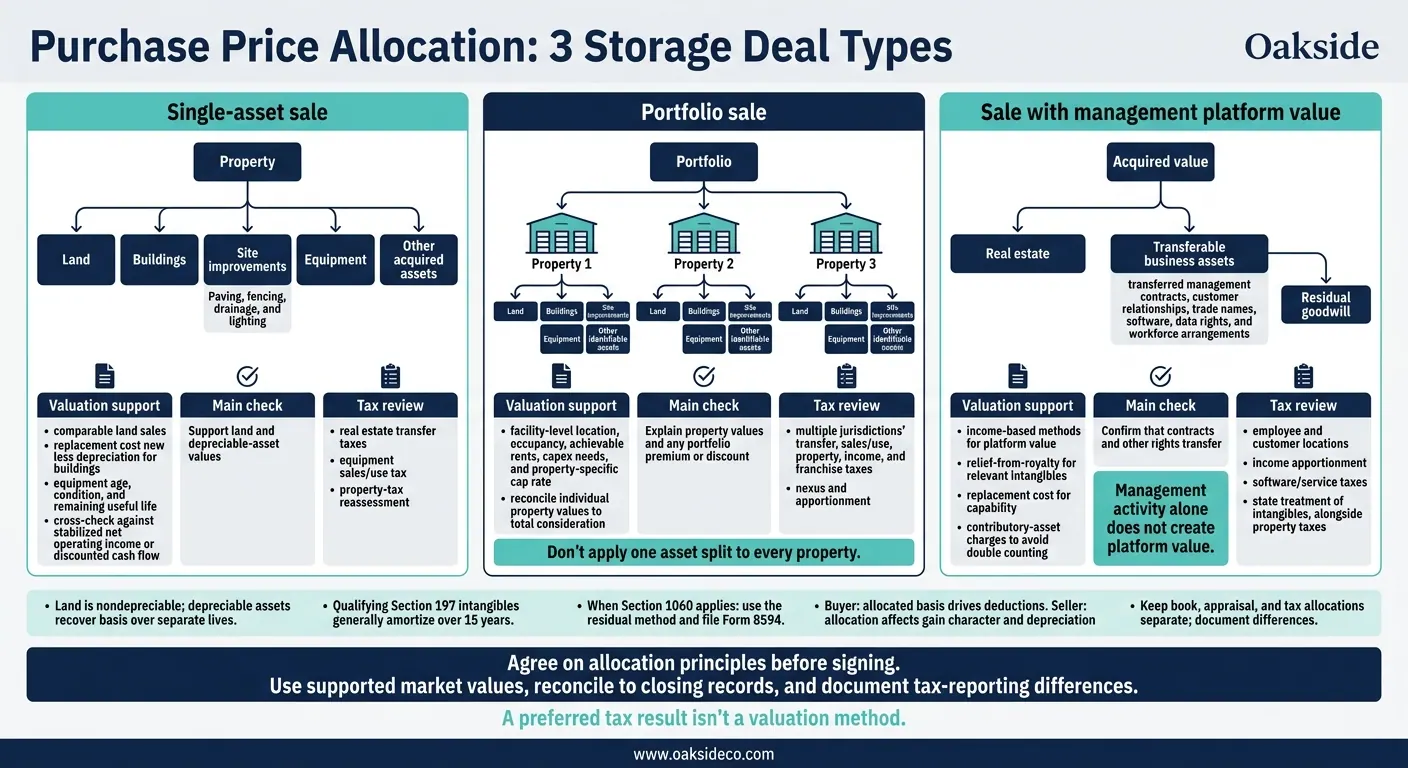
Purchase Price Allocation: 3 Storage Deal Types
Asset Mix and Valuation
A single-asset sale is the simplest allocation case because the discussion centers on one property’s land, improvements, and equipment. Split the price among land, buildings, site improvements, and equipment. Use comparable land sales to value the parcel and replacement cost new less depreciation to value the buildings. Value paving, fencing, drainage, and lighting separately. Inventory equipment by age, condition, and remaining useful life instead of including it in the building value.
Check those estimates against stabilized net operating income and cap rates or a discounted cash flow model. Construction cost does not determine allocable value. Review leases and contracts for value that can be identified separately, especially billboard or cell-site agreements. For month-to-month storage with market-rate rents, any lease intangible needs strong support.
Federal, State, and Local Taxes
Buyers usually want more of the price allocated to equipment and qualifying site improvements. Sellers usually want less ordinary-income recapture and more capital gain. Check sales and use tax, transfer tax, and reassessment exposure before settling on the split. Local rules can change the economics of an otherwise attractive allocation.
Documentation and Negotiation Risk
Before signing, agree on the valuation method and state whether the allocation is binding or appraisal-based. Keep the asset inventory, condition report, lease review, and valuation schedules to support basis and recapture positions. Reconcile deposits, prepaid rents, tax prorations, debt, and other assumed items to the closing statement. Don’t automatically treat them as price reductions.
Require consistent tax reporting and a process for resolving disputed values. Use independent valuation support - not a preferred tax outcome - to settle disagreements. Every material amount should trace back to the purchase agreement and supporting records. This framework gets more complex when one deal covers multiple properties.
A portfolio sale needs two levels of allocation: across properties, then within each property. That’s one more layer than a single-asset sale.
Asset Mix and Valuation
Allocate the price across the portfolio first, then within each property. Value each facility separately and reconcile those values to the negotiated portfolio price. Document how you distribute any portfolio-level premium or discount. Acreage, rentable square footage, or unit count alone shouldn’t determine the allocation.
Review three years of operating statements, current rent rolls, occupancy and delinquency reports, and condition reports. When pricing each facility, weigh its location, occupancy, achievable rents, capex needs, and property-specific cap rate. Look closely at high occupancy supported by deep discounts, weak collections, or temporary rent spikes.
Once you’ve priced each facility, use the same asset-allocation approach you’d use for a single-property sale. Split each property into land, buildings, site improvements, equipment, and other identifiable assets at fair market value. Account for differences in climate-control equipment, paving, gates, and security systems. Don’t apply one asset split to every property.
Federal, State, and Local Taxes
When the sale transfers a trade or business, report the allocation on IRS Form 8594 using the federal asset-class framework - not property addresses. Prepare a jurisdiction-by-jurisdiction schedule covering deeded real estate, personal property, assumed liabilities, transfer-tax bases, and required filings.
Federal allocations don’t automatically set local assessed values. Review each property’s exposure to reassessment.
Documentation and Negotiation Risk
Keep a property-level schedule showing normalized NOI, cap rate, capex deductions, and final allocated price. Specify whether immediate repair costs are reflected in value, price, or a seller credit. Don’t count the same costs twice.
Before closing, agree on where any portfolio premium belongs: the properties, identifiable intangible assets, a management platform, or goodwill. The agreement should address later price adjustments, audit cooperation, and responsibility for additional taxes or penalties. Form 8594 also asks whether the parties agreed to the allocation in a signed document. Any excess value still needs a clear basis: does it belong to the properties or to something beyond the real estate?
When a storage transaction includes operating assets, the allocation must separate the value of the business from the real estate.
Asset Mix and Valuation
Management activity alone does not create platform value. That value exists only when the buyer acquires separable operating rights or cash flows, such as third-party management contracts, recurring fees, technology, or a dedicated workforce. Separate the real estate from transferable operating assets, including contracts, customer relationships, trade names, software, data, and workforce arrangements.
Use income-based methods to value the platform and relief-from-royalty to value intangibles. Apply replacement-cost logic when valuing capability rather than revenue. Subtract contributory-asset charges to avoid double counting, and reconcile property income and operating-asset benefits in a single model.
Once those assets are identified, the tax analysis turns to amortization, reporting, and state treatment.
Federal, State, and Local Taxes
Qualifying Section 197 intangibles generally amortize over 15 years, but book and tax labels often differ. Maintain a book-to-tax reconciliation that shows each asset’s label, basis, and applicable life.
Map the locations of platform employees, customers, software, and revenue-producing activities. Check whether each state follows federal Section 197 rules, how management revenue is apportioned, whether software is subject to sales or use tax, and how state and local rules treat business intangibles. Federal classification does not control state tax treatment.
Tax treatment depends on how each intangible is labeled and assigned, so the purchase agreement must define those rights precisely.
Documentation and Negotiation Risk
List the rights being transferred: contracts and required consents, customer data rights, trademarks, software code and/or licenses, and workforce arrangements. Keep acquired rights separate from temporary transition services.
When platform value is material, support it with retention data, standalone expenses, royalty rates, and replacement costs. Resolve ownership and assignability before finalizing the allocation.
Once the allocation is set, each asset category affects basis, deductions, recapture, and state tax.
Start with the deal form: asset purchase or equity purchase. Asset purchases usually create new asset-level basis; equity purchases usually do not. Review elections and basis step-ups separately.
Allocated basis follows each asset’s recovery rules. Land is nondepreciable, while depreciable assets recover basis over separate lives. Qualifying Section 197 intangibles generally amortize over 15 years. Keep book, appraisal, and tax allocations separate.
The tax rules may stay the same, but the results depend on what each deal structure transfers.
| Deal structure | Buyer deductions in a taxable asset purchase | Seller tax concerns | Form 8594 requirements | State and local review |
|---|---|---|---|---|
| Single-asset sale | One property’s basis is divided among nondepreciable and depreciable assets. | The allocation between land and improvements affects gain character and recapture. | Determine whether the property and related assets constitute a trade or business. | Real estate transfer taxes, equipment sales/use tax, and property-tax reassessment. |
| Portfolio sale | Property-level basis and asset mix determine deductions across facilities. | Each property’s adjusted basis, holding period, and depreciation history. | Reconcile property-level allocations with acquisition-level reporting when Section 1060 applies. | Multiple jurisdictions’ transfer, sales/use, property, income, and franchise taxes; nexus and apportionment. |
| Deal with platform value | Tangible-asset depreciation plus qualifying intangible amortization. | Gain character for goodwill and other intangibles versus tangible assets. | Acquired goodwill or going-concern value can bring the transaction within Section 1060. | Employee and customer locations, payroll obligations, income apportionment, and software/service taxes, alongside property taxes. |
Section 1060 is not limited to platform deals. It generally applies to qualifying transfers of a trade or business when the purchase price determines buyer basis. Use the residual method and report the allocation on Form 8594. Later changes may require supplemental reporting.
Sellers calculate gain asset by asset: amount realized minus adjusted basis. Depreciation recapture can convert part of that gain to ordinary income. For equity deals, also check whether state law taxes controlling-interest transfers.
The purchase agreement, closing statement, and state filings need to support these tax positions consistently. Allocation records and negotiations should address that support.
Once the tax framework is set, document the allocation that supports it. The records you need depend on the deal structure.
| Approach | Advantages | Disadvantages | Required support | Negotiation issues | Record burden |
|---|---|---|---|---|---|
| Property appraisal plus asset schedule | Supports asset-level basis | Equipment records may be incomplete | Appraisal, asset register, cost support, closing statement | Depreciable basis versus seller recapture | Moderate |
| Portfolio-level reconciliation | Ties facility values to total consideration | Requires property-by-property reconciliation | Property values, purchase-price bridge, debt and working-capital schedule, asset registers | Where premiums or discounts belong | High |
| Separate real estate and business valuations | Separately supports business value | Depends on forecasts and intangible-asset evidence | Appraisal, business valuation, transferable cash flow projections, contracts, customer data | Whether the platform actually transfers and how much goodwill remains | Very high |
Use one signed allocation schedule. Put one person in charge - usually the transaction tax adviser or financial adviser - and have them maintain it through closing, tax-return preparation, and post-closing adjustments. Record each asset’s fair market value, tax class, and allocated consideration. Keep seller gain calculations and buyer depreciation schedules in supporting workpapers.
Tie that schedule to the purchase agreement, closing statement, wire records, asset registers, Form 8594 when required, and state filings. If book-tax or state-federal differences are intentional, document them. Don’t force every record to match.
Keep cash, debt, deposits, working capital, and assumed liabilities separate from the asset allocation. Debt payoff affects the seller’s cash proceeds. Debt assumption and other liabilities can affect total consideration and basis under applicable rules. Don’t count them twice.
Acquired cash and ordinary deposit accounts generally fall in Class I. Tenant security deposits, however, may represent transferred cash with an offsetting obligation. Identify receivables, prepayments, payables, payroll, repairs, and working-capital true-ups directly rather than burying them in real estate value.
Buyers generally want more depreciable or amortizable basis, while sellers resist recapture. Fair market value still limits the compromise. Section 1245 recapture can reach prior depreciation or amortization, limited by realized gain.
For earnouts and later price adjustments, define whether each payment is additional purchase price, services, interest, or another category. Track its payment date, triggering metric, recipient, asset allocation, and corresponding tax treatment. Update the schedule and tax reporting as needed.
Have independent valuation, tax, and legal advisers validate fair market value, asset classification, and state filings, and check that the final allocation matches the assets actually acquired.
Base the allocation on the assets that transfer - not the deal headline. Leave out operating value that doesn’t transfer.
Use this decision matrix:
| Deal type | Allocation layers | State and local exposure |
|---|---|---|
| Single-asset sale | Property to assets | Medium |
| Portfolio sale | Portfolio to properties; properties to assets | High |
| Sale with management platform value | Real estate, transferable business assets, identifiable intangibles, residual goodwill | Medium to high |
The deal form, assets acquired, and taxing jurisdiction determine the allocation.
Agree on allocation principles before signing. Include the valuation hierarchy, allocation method, reporting consistency, and dispute process in the purchase agreement. Have valuation, tax, and legal advisers review these terms together before either party signs - not after closing, when a disagreement may be harder to resolve.
When do I need a separate allocation appraisal?
A separate allocation appraisal is needed when parts of a deal require different tax treatment or separate valuations. For example, it can separate real estate value from the value of a management platform or business. This is especially relevant in portfolio sales or deals where business operations account for a large share of the value alongside physical assets.
The analysis helps allocate the purchase price accurately, avoid tax complications, and support a valuation that can stand up to institutional scrutiny.
How do I distinguish a portfolio premium from goodwill?
Look at where the added value comes from. A portfolio premium reflects the efficiency, scale, and coordinated integration of multiple facilities into a single operating platform. That platform can command a higher institutional valuation than individual assets.
Goodwill, by contrast, represents intangible business value, such as customer relationships or brand equity. It is separate from the physical property, remains a distinct non-real-estate component of the purchase price, and is subject to immediate taxation.
What if management contracts fail to transfer at closing?
If management contracts don’t transfer at closing, the storage facility could face disruptions to its day-to-day operations and projected cash flow. Institutional buyers rely on established management platforms, so a failed handoff can cast doubt on the sponsor’s ability to carry out the business plan.
The transaction structure needs immediate adjustment. Lenders need clarity on who controls operations to complete their underwriting, and that control also affects the final purchase price allocation.