
RV and boat storage construction financing must cover more than the build - it must carry the property until rental income supports repayment. Before closing, test whether the budget can withstand a 6–12-month delay and a 10%–15% cost overrun.
The borrowing limit depends on project costs, property value, rental income, and lender requirements. The lowest supported loan amount controls - not the amount needed to finish construction.
A sound financing plan connects:
- Site design and budget: Open, covered, and enclosed spaces have different costs, rents, and lease-up timelines.
- Debt and equity: Loan proceeds, sponsor cash, and approved partner funds must cover construction, reserves, and funding gaps.
- Funding terms: Draw rules, guarantees, deadlines, and extension conditions determine when funds are available and who covers shortfalls.
- Repayment: A refinance or sale must work with realistic income, rates, and property values.
Oakside Co can help assess value, income assumptions, and sale options. It does not provide or arrange construction financing.
RV and Boat Storage Construction Loan Sizing
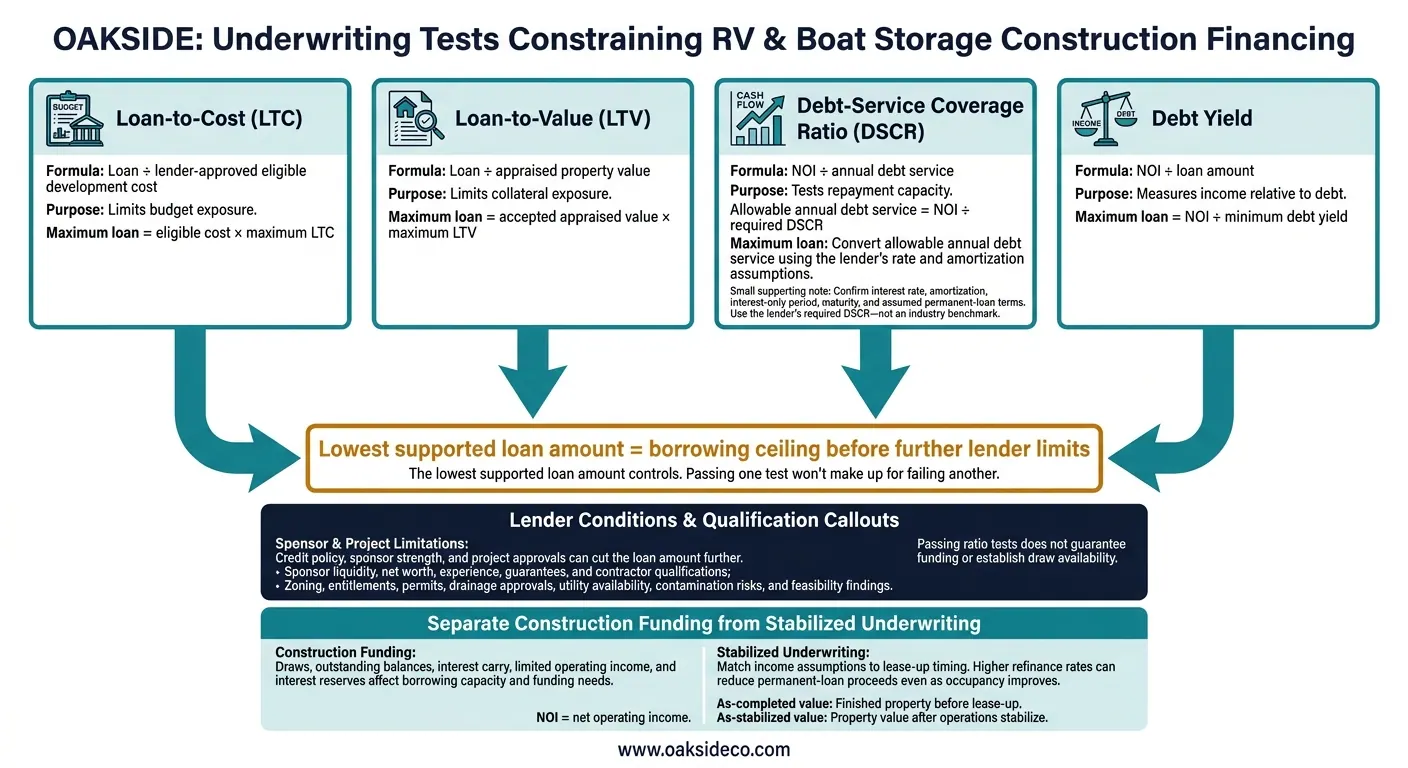
The strictest underwriting test sets the loan ceiling. Passing one test won’t make up for failing another. Credit policy, sponsor strength, and project approvals can cut the loan amount further.
Loan Sizing: LTC, LTV, DSCR, and Debt Yield
| Test | Formula and inputs | Purpose and maximum proceeds |
|---|---|---|
| Loan-to-cost (LTC) | Loan ÷ lender-approved eligible development cost | Limits budget exposure; maximum loan = eligible cost × maximum LTC |
| Loan-to-value (LTV) | Loan ÷ appraised property value | Limits collateral exposure; maximum loan = accepted appraised value × maximum LTV |
| Debt-service coverage ratio (DSCR) | NOI ÷ annual debt service; allowable annual debt service = NOI ÷ required DSCR | Tests repayment capacity; maximum loan = allowable annual debt service converted using the lender’s rate and amortization assumptions |
| Debt yield | NOI ÷ loan amount | Measures income relative to debt; maximum loan = NOI ÷ minimum debt yield |
These ratios work only when the income model matches the project’s lease-up timeline.
Model construction funding separately from stabilized underwriting. Draws, outstanding balances, interest carry, and limited operating income all affect how much you can borrow. As-completed value reflects the finished property before lease-up. As-stabilized value reflects its value after operations stabilize.
For DSCR sizing, confirm the interest rate, amortization, interest-only period, maturity, and assumed permanent-loan terms. Include interest reserves in construction underwriting, since the property may produce little or no NOI during development. Use the lender’s required DSCR - not an industry benchmark.
Projecting Rent, Occupancy, and Ancillary Income
Once the loan ceiling is set, lenders check whether projected NOI can support it.
Count income from legally permitted hookups, wash stations, dump stations, repairs, and other recurring tenant charges only when demand and pricing support those projections. Deduct the related utilities, labor, maintenance, insurance, and compliance costs. Refundable deposits and one-time setup fees don’t belong in recurring NOI.
Stress-test higher refinance rates alongside your lease-up plan. Permanent-loan proceeds can fall even as occupancy improves. Show how each scenario affects reserve usage, NOI, DSCR, debt yield, required equity, and permanent-loan proceeds.
Sponsor Qualifications and Project Approvals
Passing the ratio tests doesn’t guarantee the full loan amount. Each lender’s liquidity, net worth, experience, and guarantee requirements can limit proceeds. Document post-closing cash, contingent liabilities, relevant development experience, and the contractor’s qualifications. Check whether the lender requires a fixed-price or guaranteed maximum price contract, along with completion guarantees.
Unresolved zoning, entitlements, permits, drainage approvals, utility availability, or contamination risks can delay funding, trigger remediation escrows, or reduce value. Weak feasibility findings can also lower the income the lender accepts and increase required equity. Confirm which conditions must be met before closing and which must be met before the first draw.
Once the loan size is set, the next step is making sure the capital stack can carry the project through stabilization.
Debt and Equity Sources
Fund the project through stabilization - not just construction. The capital stack must cover development costs and carry costs until the property stabilizes. Without historical NOI, ground-up projects require stronger sponsor equity and liquidity.
| Capital source | Funding role and suitable uses | Cost and repayment order | Control, recourse, and risk |
|---|---|---|---|
| Senior construction debt | Approved development costs, funded through draws | Lower cost than equity; first-priority claim | Lender controls draws and budgets; recourse varies; delays may require more equity |
| Sponsor equity (cash and land credit) | Early costs, required equity, reserves, and overruns; land credit adds no new cash | First-loss exposure; generally paid last | Preserves control unless shared; cash reduces liquidity; land credit depends on lender valuation |
| Preferred equity | Funding gaps and additional equity | Preferred return; ahead of common equity but behind debt | Negotiated consent, control, and remedy rights |
| Joint-venture equity | Shared development funding and reserves | Negotiated profit share; behind creditors | Shared major decisions; capital-call, dilution, and buy-sell rights |
| Permitted subordinate debt | Lender-approved financing gaps | Higher cost; junior repayment | Recourse varies; payment, standstill, and transfer restrictions may apply |
Document how land receives credit: at cost, appraised value, or another agreed amount, net of liens. Also specify whether cash equity funds first, alongside debt, or up to a minimum threshold before loan advances begin. Time capital calls so cash is available when invoices come due.
Preferred and joint-venture equity agreements should spell out returns, distributions, major decisions, dilution, buy-sell rights, and remedies for funding shortfalls. Get senior-lender approval for subordinate capital, including payment-blockage provisions, standstill terms, cure rights, and transfer restrictions.
These commitments work only if the draw schedule matches the contractor’s billing cycle.
Construction Draws, Reserves, and Completion
Each draw requires a sworn payment application, invoices, approved change orders, a budget-to-cost report, proof of insurance, and stored-materials documentation. The lender or inspector verifies the work, updates title, and collects conditional and unconditional lien waivers before releasing funds, less retainage. Interest accrues on the outstanding balance - not the undrawn commitment, with interest-only payments during construction as agreed.
Size the interest reserve using expected draws, rates, and timing. Don’t simply multiply the full commitment by the maximum rate. Contingency is controlled budget money, not free cash. Before work begins, change orders should state the reason, amount, funding source, schedule impact, and required lender approval.
Document who covers overruns and when an equity cure is due. Final funding and retainage release may require a final inspection, paid invoices, lien releases, clear title, closeout documents, and certificates of occupancy where required.
Lease-Up, Loan Extensions, and Permanent Financing
During lease-up, reserve use and the maturity date determine whether the project can reach permanent financing without a forced extension. Allow enough time for construction, lease-up, and permanent-loan underwriting.
Extension provisions should spell out the notice deadline, fee, rate or spread changes, minimum reserve balance, updated appraisal, completion status, and absence of default. They should also state any required occupancy, NOI, DSCR, or debt-yield milestones. Extensions are not automatic.
Permanent financing may require completed improvements, qualifying occupancy, documented collections, clean title, final permits, insurance, financials, and minimum DSCR or debt-yield thresholds. Refinance proceeds depend on the new underwriting - not the original budget.
Run base, downside, and severe-downside cases. Include a six-month delay, occupancy 10 percentage points below plan, a higher refinance rate, and a 10% lower appraisal. Calculate reserve depletion, refinance proceeds, required paydown, and any remaining equity requirement. Bridge or transitional financing can cover a timing gap, but it cannot replace a sound permanent-financing or sale plan.
After sizing and lease-up underwriting, check that the closing documents match the budget, occupancy forecast, and repayment plan. This is the last document-and-condition checkpoint before funds move.
Loan Terms to Review Before Signing
Have counsel check that the term sheet, commitment, loan agreement, note, guaranties, and settlement statement agree. Confirm that funding obligations, notice and cure periods, and extension rights are enforceable - not dependent on later lender approval.
Treat the commitment as a funding contract, not a recap of the term sheet.
| Term | Borrower exposure | Verification point |
|---|---|---|
| Proceeds and sizing tests | Underwriting limits carried into the documents may reduce the commitment before funding. | Identify which limits in the signed documents allow proceeds to shrink and when they apply. |
| Rates, floors, and hedging | Floors, default rates, and hedges can increase costs. | Confirm the index, spread, floor, reset dates, default rate, and cap or swap requirements. |
| Fees | Charges reduce usable funds. | Confirm origination, unused-line, draw, inspection, legal, extension, and exit fees, plus payment dates. |
| Guarantees and recourse release | Payment, completion, carry, environmental, and bad-act guaranties create separate obligations. | Define their scope, release milestones, financial-support duties, and events that restore recourse. |
| Equity order and reserves | Closing conditions may require more cash. | Confirm the exact funding sequence, minimum reserve balances, replenishment duties, and permitted uses and releases. |
| Draws and budget changes | Budget changes can interrupt funding. | Identify reallocations that need lender consent and conditions that allow the lender to suspend advances. |
| Deadlines and reporting | Missed deliveries can trigger default. | Confirm delivery dates, reporting frequency, notice requirements, cure periods, and default remedies. |
| Income and occupancy tests | Forecast assumptions may become covenants. | Specify the binding occupancy metric, testing dates, and equity cure rights. |
| Insurance, site risk, title, and survey | Coverage, access, drainage, or lien issues can block funding. | Confirm policies, endorsements, site reports, easements, survey standards, and acceptance conditions. |
| Lockbox triggers | The lender may control operating cash. | Define activation events, permitted operating disbursements, and release conditions. |
| Maturity and refinancing | Paydowns and prepayment charges can complicate repayment. | Confirm enforceable extension rights, discretionary approvals, principal curtailments, prepayment terms, and any release prices. |
Counsel should also review cross-defaults, ownership-transfer restrictions, and lender remedies. A cross-default can apply even when this project’s payments are current. For each financial covenant, define the calculation, testing date, cure period, and consequence: a cash sweep, additional reserves, an equity contribution, or default.
Lender Submission Checklist
Once the economic terms are clear, check that the submission package meets the lender’s closing conditions. Group deliveries by the funding schedule for the RV and boat storage project:
- Before closing: Deliver site control and zoning/entitlement status, market analysis, sources and uses, a pro forma through stabilization, the construction schedule, and the exit strategy. Include sponsor and guarantor financials, tax returns, contingent liabilities, and proof of liquidity. Finalize plans, civil and drainage documents, the budget, the construction contract - including a guaranteed maximum price if specified - contractor qualifications, environmental and site assessments, title, survey, and entity authority documents. Confirm insurance, utility commitments, contractor licenses, bonds, permits, and equity and reserve deposits due at closing.
- Before first advance: Deliver any permits, insurance, utility commitments, licenses, bonds, and equity or reserve funding expressly deferred under the closing documents. Include the first draw package.
- Before later draws: Deliver payment applications, invoices, lien waivers, inspection reports, budget updates, approved change orders, and proof of required reserve replenishment. Include the certificate of occupancy or equivalent final approval in the completion requirements, along with final lien releases and closeout documents.
Let the lender set appraisal engagement and acceptance requirements. Before ordering third-party work, confirm the required as-is, as-completed, and as-stabilized values, report age limits, updates, and reliance letters. Assign an owner and due date to each closing item. Verify wire instructions separately before funding.
Once you’ve sized the loan and tested lease-up, check whether the capital stack still works at maturity. Choose the product mix that supports the lowest viable loan ceiling. Confirm that stabilized NOI covers post-construction debt service, then compare the applicable LTC, LTV, DSCR, and debt-yield limits. The lowest supported test sets your borrowing ceiling.
Plan enough equity to cover contingency, interest carry, taxes, insurance, operating deficits, reserves, and lease-up costs. Stress-test a 6–12-month delay and a 10%–15% cost overrun, and secure extra liquidity before you need it urgently. If the project can’t withstand delays, overruns, and slower absorption, reduce leverage before closing.
Match your refinance or sale plan - and a workable fallback - to the loan’s maturity. Underwrite repayment using realistic NOI, rates, valuation, and transaction costs.
Oakside Co’s Advisory Role
Oakside Co is a national commercial real estate advisory firm specializing in self-storage and boat and RV assets. Its valuation and NOI analysis can help owners review project assumptions, normalize NOI, assess completed-value assumptions, and evaluate potential sale decisions.
Services include transaction management, investor-network access, and disposition support. They do not include construction lending, construction-financing arrangement, or funding guarantees.
Should I phase construction to reduce financing risk?
Building in phases can help manage development risk by matching capital needs to leasing progress. But it takes close coordination with your lender.
Keep enough funds in reserve to cover interest payments, and use a stressed debt service coverage ratio of 1.35x to 1.50x. More equity gives you room to handle uneven cash flow, while debt brings fixed payments and tighter covenants. Before committing, get written confirmation from your lender about eligible costs and lending requirements.
How do I choose between covered and uncovered storage?
Weigh construction costs against target rents and site limits. Enclosed boat and RV storage typically costs $40–$75 per square foot, while covered canopy shells cost $18–$35 per square foot. Higher construction costs need rents that justify the added expense.
Check zoning for outdoor use, wind-load requirements, drainage, turning radii, and overhead clearance. Focus on rentable space - not just total area. Choose the option that fits your revenue model and keeps project costs attractive to lenders.
What if my refinance cannot repay the construction loan?
A capital shortfall occurs when stabilized net operating income is too low to meet permanent financing requirements. Slower lease-up or weaker rents can leave you needing more equity or additional liquidity to cover the gap.
To reduce this risk, keep adequate interest reserves and use conservative underwriting assumptions. Test a 1.35x–1.50x debt service coverage ratio (DSCR), income shortfalls of 10%–20%, stabilized occupancy of 85%, and downside occupancy of 70%.