


A boat and RV storage exit should meet the owner’s cash needs - not just deliver a high sale price. Start with a one-page plan covering the departure date, cash needed at closing, retirement income, and any role after the transfer.
Before choosing a sale, family handoff, partial sale, or lease:
- Check the value. Gather three years of financial records, verify income and expenses, and compare recent sales.
- Calculate what stays. Deduct taxes, debt payoff, and closing costs; weigh delayed payments against the risk of nonpayment.
- Check the buyer or successor. Verify funding, management skills, and a written training plan.
- Plan the transfer. Define what is included, assign review deadlines, and document deposits, account access, and support limits.
The final test: Can the deal fund retirement, and can the next owner run the property? Legal and tax advisers should review the terms before any commitment.
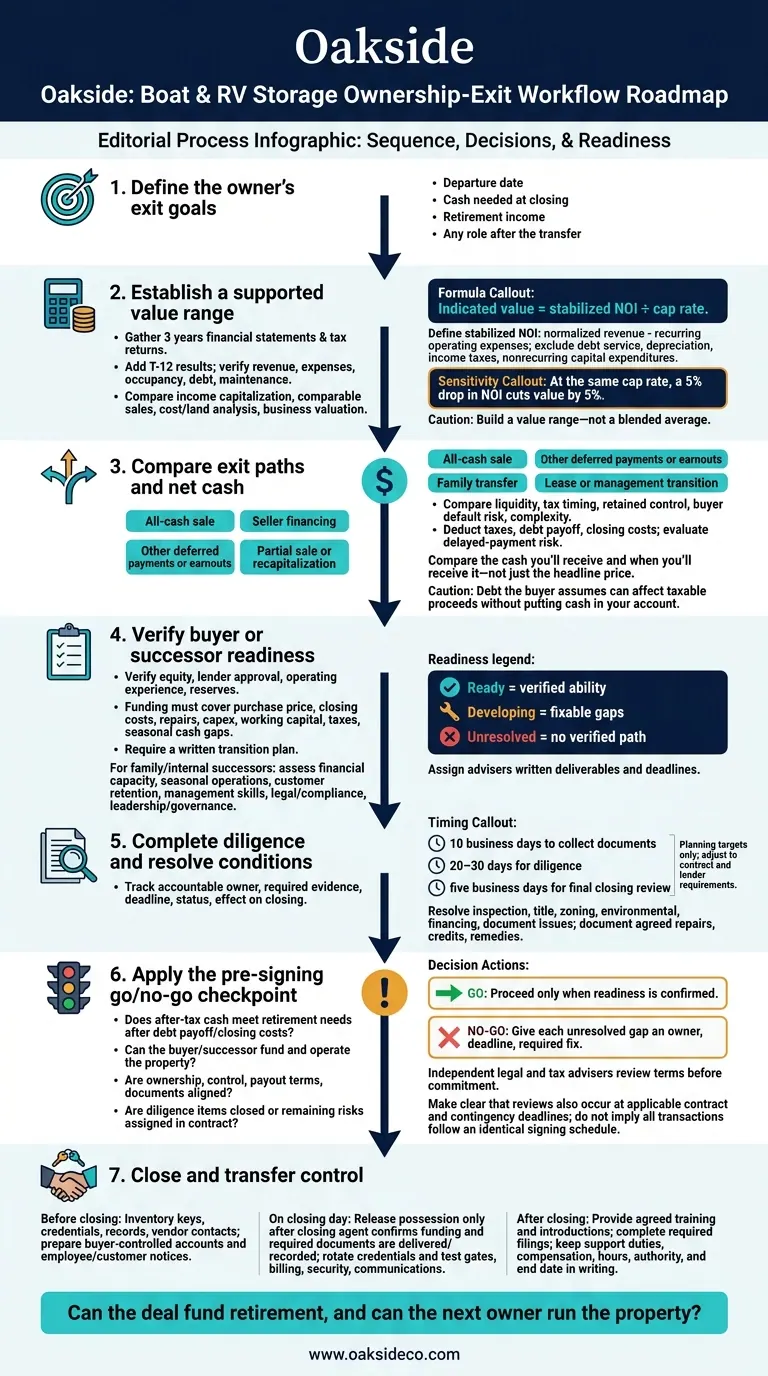
Boat and RV Storage Exit Roadmap
Gather Records and Estimate Property Value
Start with a valuation file that includes three years of financial statements and tax returns. Reconcile reported revenue with bank deposits. Add trailing-12-month results, current and historical rent rolls, collections, expenses, improvement invoices, maintenance needs, debt statements, and property records.
Keep physical occupancy - the spaces occupied - separate from effective occupancy, which accounts for discounts, unpaid rent, and other revenue losses. Back every expense adjustment with records, and normalize only documented, one-time owner items.
Calculate stabilized net operating income (NOI) by subtracting recurring operating expenses from normalized revenue. Exclude debt service, depreciation, income taxes, and nonrecurring capital expenditures.
Indicated value equals stabilized NOI divided by the cap rate. Use cap rates supported by market data, then test changes in both income and rates. At the same cap rate, a 5% drop in NOI cuts value by 5%. Account for deferred maintenance, too. Use the methods below to build a value range - not a blended average.
| Method | Data needed | Strength | Limits and supporting analysis |
|---|---|---|---|
| Income capitalization | Stabilized NOI, rents, expenses, market cap rates | Ties value to recurring earnings | Sensitive to assumptions; use sensitivity analysis and discounted cash flow when lease-up or major capital work matters |
| Comparable sales | Recent sales, property details, occupancy, financing terms | Checks value against closed deals | Verify terms and adjust for location, condition, zoning, covered spaces, and expansion rights |
| Cost or land analysis | Land sales, replacement costs, depreciation, zoning, utilities | Tests replacement economics and expansion potential | May differ from income value |
| Separate business valuation | Ancillary revenue, margins, equipment, contracts, goodwill | Separates operating value from real estate | Avoid counting the same income twice |
Use that range to compare how each exit structure affects your net cash and timing.
Compare Sale and Succession Terms
Compare the cash you'll receive and when you'll receive it - not just the headline price. For deferred payments, spell out interest, maturity, collateral, guarantees, default remedies, and any performance conditions. A higher promised price may not make up for the risk of nonpayment.
For family transfers, get an independent valuation where appropriate. Document discounts, gifts, compensation, and governance instead of relying on informal expectations.
Match the deal structure to your liquidity needs, desired control, and risk tolerance.
| Exit structure | Liquidity | Tax timing | Retained control | Buyer default risk | Complexity |
|---|---|---|---|---|---|
| All-cash sale | High at closing, subject to escrow and holdbacks | Generally concentrated near closing | Usually low after closing | Limited post-closing payment exposure | Lower |
| Seller financing | Down payment, then scheduled principal | May defer eligible gain; recapture generally due in sale year | Limited by deal documents | Payment risk remains; security depends on negotiated collateral | Moderate to high |
| Other deferred payments or earnouts | Delayed or contingent | Depends on payment character and applicable rules | May require continued involvement or performance conditions | High, especially when tied to future results | High |
| Partial sale or recapitalization | Moderate; owner retains equity | Depends on the legal structure and allocation | Higher retained control | Exposure to future operating and financing risk | High |
| Family transfer | Often low immediate liquidity | May involve gift, estate, income, and basis consequences | Often retained informally unless governance is explicit | Family conflict and successor-performance risk | High |
| Lease or management transition | Usually limited upfront liquidity | Depends on whether the transaction is a sale, lease, or service arrangement | Ownership generally retained | Counterparty and operating risk remain | Moderate to high |
After comparing terms and timing, calculate taxes and debt payoff for the most likely path.
Estimate Taxes, Debt Payoff, and Net Proceeds
Compare asset-sale and equity-sale outcomes, including entity-level taxes. Calculate adjusted basis using cost, improvements, and depreciation allowed or allowable. Separate capital gains from depreciation recapture.
Model debt payoff or assumption, fees, lender charges, repairs, prorations, transfer taxes, federal and state income taxes, and applicable local taxes. Debt the buyer assumes can affect taxable proceeds without putting cash in your account. Recapture generally remains taxable in the sale year, even when you receive installment payments.
Section 1031 generally applies to qualifying business or investment real property - not business interests, goodwill, or most personal property. A properly structured deferred exchange generally requires identification within 45 days and completion within 180 days, subject to applicable rules and adviser confirmation.
Have your CPA, attorney, and estate-planning advisers test installment eligibility, related-party rules, debt relief, and taxable cash or other nonqualifying consideration. Review gifts, trusts, charitable transfers, and successor ownership before signing.
Use the net-proceeds model to screen buyers or successors before due diligence begins.
After modeling net proceeds, check whether the buyer or successor can fund the deal, pass diligence, and run the property from day one.
Check Buyer Funding and Ability to Close
Get a signed confidentiality agreement before sharing nonpublic financial statements, customer lists, occupancy data, employee information, lease records, or proprietary operating procedures.
Ask who the buyer is, how ownership is structured, why they're buying, and what relevant experience they have. Confirm their acquisition timeline and who can approve the deal. Request proof of available equity, lender support, references, a sources-and-uses schedule, proposed earnest money, the expected closing date, and any required investment-committee or partner approvals. Prequalification is only a screening step; verify final lender approval before granting exclusivity.
Verify equity, debt capacity, operating experience, and readiness to close. Funding must cover the purchase price, closing costs, repairs, capex, working capital, taxes, and seasonal cash gaps, with reserves for delays and overruns. Identify every financing, appraisal, environmental, title, survey, zoning, insurance, and lender-approval condition. Give each one a deadline.
Require a written transition plan that addresses employees, customer deposits, prepaid storage, access control, security, maintenance, and uninterrupted collections.
Check Family and Internal Successor Readiness
Apply the same diligence standard to an heir or insider. Family intent alone doesn't show that someone can run the property. Complete this transfer-readiness matrix with the successor and update it quarterly. Mark verified ability as Ready, fixable gaps as Developing, and areas with no verified path as Unresolved.
| Readiness area | Rating criteria | Evidence required | Responsible party and corrective action |
|---|---|---|---|
| Financial capacity | Ready: verified equity and reserves; Developing: preliminary financing; Unresolved: no verified funding plan | Tax returns, personal financial statement, lender terms, and a 12-month cash-flow forecast | Successor and lender: verify financing and seasonal reserves before transfer |
| Seasonal operations and customer retention | Ready: manages independently; Developing: needs oversight; Unresolved: no operating experience | Seasonal staffing plan, renewal procedures, and collections records | Owner and successor: complete a full operating season under supervision |
| Management skills | Ready: manages people and budgets; Developing: limited responsibility; Unresolved: no demonstrated performance | Operating budget, vendor renewal, maintenance plan, and performance reviews | Owner and successor: assign supervised decisions and measurable checkpoints |
| Legal and compliance | Ready: understands obligations; Developing: needs training; Unresolved: responsibilities unknown | Compliance calendar covering zoning, insurance, safety, employment, and abandoned property | Successor and attorney: close training and documentation gaps before control transfers |
| Leadership and governance | Ready: written authority; Developing: draft rules; Unresolved: conflicting expectations | Decision rights, compensation terms, voting rules, and dispute procedures | Owner, successor, and attorney: approve governance and a fallback plan |
Put training milestones, market-based compensation, and authority over borrowing and major spending in writing. Set an end date for the retiring owner's support, and name an interim manager in case the successor cannot perform or loses financing.
Equal treatment doesn't require equal ownership. Separate pay, ownership returns, and benefits for heirs who don't work in the business.
Once the buyer or successor has a verified path forward, put adviser responsibilities in writing.
Assign Roles to Your Advisory Team
Oakside Co can support market analysis, buyer outreach, and transaction management. Give the appraiser, attorney, CPA, lender, and estate-planning counsel written deliverables and deadlines so the exit plan moves into documents, approvals, and closing actions.
Once the buyer or successor passes screening, put diligence tasks, closing conditions, and handoff dates in writing. With advisers assigned, the work moves from analysis to checking records, preparing documents, and closing - the final test of whether your retirement or family handoff plan works.
Set Due Diligence Tasks and Deadlines
Create a tracker that gives each task one accountable owner, required evidence, a deadline, status, and its effect on closing. Plan for 10 business days to collect documents, 20–30 days for diligence, and five business days for final closing review. Adjust those dates to fit the contract and lender requirements.
| Responsible party | Required work and evidence | Deadline |
|---|---|---|
| Seller | Upload records, disclosures, customer contracts, insurance claims, permits, and lien information; arrange inspections | Document-delivery date |
| Buyer | Inspect pavement, drainage, fencing, roofs, lighting, gates, cameras, utilities, and fire-safety systems; verify permitted uses and expansion rights; submit written objections | Applicable diligence deadlines |
| CPA | Reconcile collections, deposits, financials, allocation, and prorations | Before settlement approval |
| Attorney | Resolve title, survey, zoning, contract, and closing-document issues | Before contingency deadlines |
| Lender | Complete underwriting, required reports, insurance review, and funding conditions | Financing deadline |
| Closing agent | Verify payoffs, title requirements, signatures, funds, and recording instructions | Final readiness review and closing |
Record every defect, its estimated cost, and the agreed repair, credit, or other remedy. Get written confirmation of permitted uses; vacant land is not automatically buildable. Review contamination risks, tanks, and neighboring uses. A Phase I environmental assessment generally does not include chemical sampling unless separately required.
Use a secure data room with staged permissions, access logs, and version control. Release sensitive records only when needed and legally permitted. Keep maintenance and collections running, and limit inspection access so customers aren't disrupted.
Clear each item before the contract moves to closing.
Finalize Deal Terms and Closing Documents
Have counsel confirm whether the transfer is an asset or entity-interest sale, then attach a complete asset-and-liability schedule. Document the price allocation. When Form 8594 is required, the buyer and seller should report consistently.
Spell out earnest-money refundability, inspection and restoration rights, objection and cure dates, financing conditions, and termination rights. Negotiate representations, warranties, survival periods, indemnity limits, and the rules for releasing escrow funds or holdbacks.
For seller financing, require counsel-reviewed collateral documents, perfected liens, lien priority, guarantees, reporting duties, default remedies, and senior-lender consent.
Build the closing checklist around debt payoff or assumption, lien releases, title and insurance, assignments and consents, prorations, prepaid rent, customer deposits, and refunds. Include customer credits and lawful confidentiality and noncompetition terms. Check that every repair credit and holdback appears in the settlement statement.
Independently verify wire instructions through a trusted phone number - not contact details supplied in an emailed change.
After signing, move directly to transferring control and setting limits on post-closing support.
Transfer Control and Set Support Limits
Before closing: Inventory keys, gate remotes, alarm codes, camera access, software permissions, domains, websites, phone numbers, records, warranties, utilities, and vendor contacts. Set up buyer-controlled banking, payments, payroll, and service accounts. Schedule employee notices about reporting lines and payroll, plus customer notices about payments, access, privacy, and emergency contacts.
On closing day: Release possession only after the closing agent confirms funding and all required documents are delivered or recorded. Sign the transfer inventory, rotate administrator credentials, and remove seller access that's no longer needed. Verify that gates, billing, security, and customer communications still work.
After closing: Provide scheduled system training, vendor introductions, seasonal operating guidance, final meter readings, and required tax, entity, and permit filings.
Keep customer records secure and limit access. Give post-closing support a clear scope and end date. Attach a transition-services schedule covering duties, compensation, expenses, hours, response times, decision authority, an end date, and dispute procedures. Exclude management duties and revenue guarantees that weren't agreed to. Log requests and completed work, keep a final transaction file, and give every unresolved item an owner and deadline.
After valuation, screening, diligence, and handoff planning, prepare a written go/no-go memo before signing. Confirm ownership, control, and payout terms. Check that records, comparable properties, and pricing support the deal price - and that after-tax net proceeds meet your retirement target after debt payoff and closing costs.
Proceed only with proof that the buyer or successor can fund and operate the property. Funding and documents must align, and every diligence item must be closed or any remaining risks assigned in the contract.
Do not commit while gaps remain unresolved. Give each gap an owner, a deadline, and a required fix before approving the commitment.
For a property-specific exit plan with Oakside Co, gather current financials, debt details, ownership documents, and your target transition date. Then have independent legal and tax advisers review the structure and documents and confirm readiness before you sign.
How early should I plan my boat and RV storage exit?
Start planning your boat and RV storage exit 12 to 24 months before listing your property. Use that time to stabilize cash flow, organize financial records, and fix maintenance or compliance issues that could lower your sale price or complicate due diligence.
Tax planning should start years before the sale to help avoid unexpected liabilities at closing. Getting an early start also gives you time to define your financial goals, build an advisory team, and align the deal structure with those goals.
What if my sale proceeds won't fund retirement?
If the proceeds from your sale won’t cover your retirement needs, review other options before committing to an exit. Start tax planning years before the sale to help avoid surprises at closing.
An installment sale can spread payments over time. A deferred sales trust may offer tax deferral and investment diversification, though its tax treatment requires careful review. Combining cost segregation with bonus depreciation may also improve cash flow.
How can I transfer ownership fairly among my children?
Start early with a coordinated team: a CPA, an M&A attorney, and a wealth advisor. Together, they can help align your transition goals with legal and tax requirements. A sound valuation and a well-planned ownership transfer structure help support a fair, clean handoff.
Begin tax planning years before the transfer to help avoid unexpected tax bills and limit tax exposure for both you and your children.