

Seasonal demand helps determine when to change self-storage rates - not what to charge. Compare 24–36 months of monthly leasing data by unit size and type before adjusting prices. Summer moving demand, college schedules, weather, and local events can affect each category differently.
A sound rate review checks three things:
- Demand: Occupancy, inquiries, move-ins, move-outs, and days vacant.
- Revenue: Rent collected after discounts and collection losses - not just advertised prices.
- Retention: Renewal terms, notice rules, and the cost of replacing tenants.
Review new-lease rates separately from tenant increases, track results after each change, and use monthly patterns - not peak-season revenue - to build budgets and assess self-storage investments.
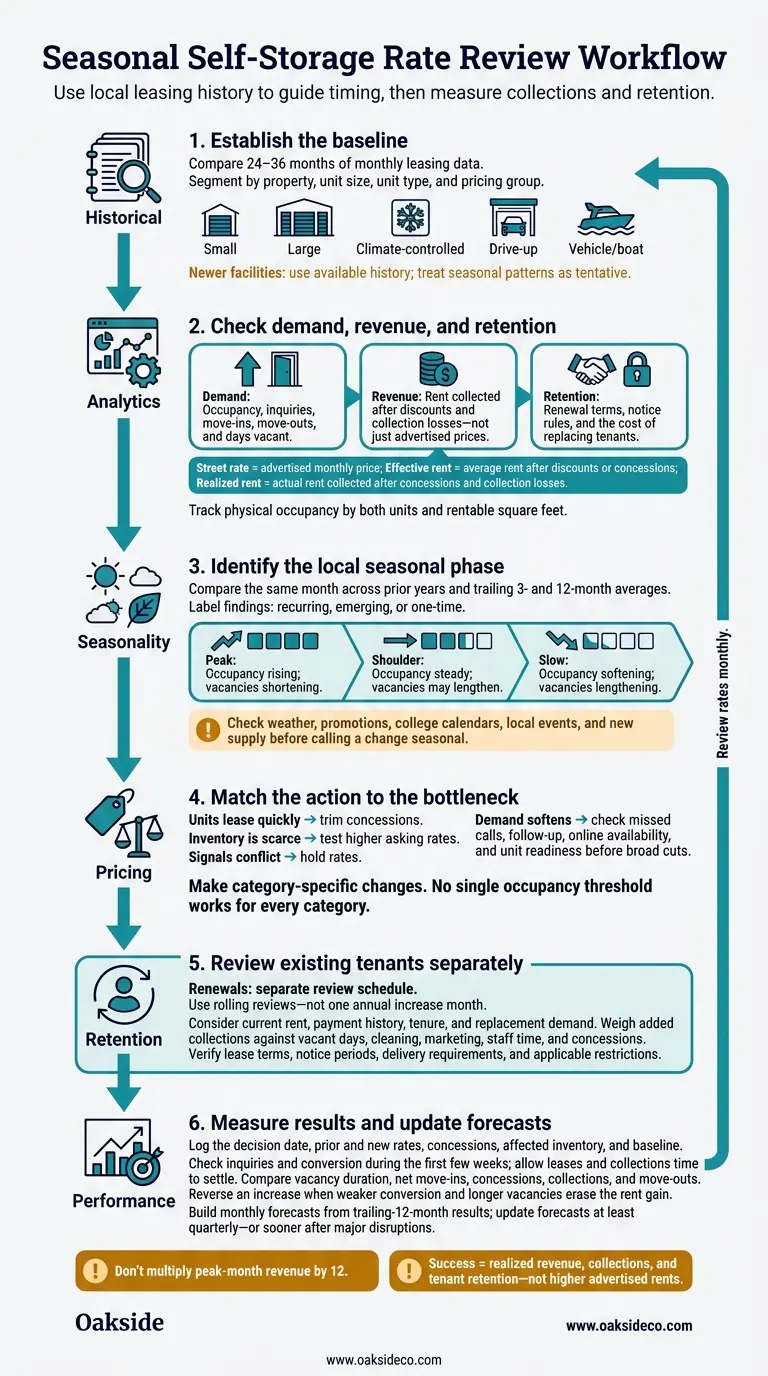
Seasonal Self-Storage Rate Review Workflow
Price by unit category, not property-wide averages. Small, large, climate-controlled, drive-up, and vehicle or boat spaces can respond differently to local supply.
Then use each category’s seasonal patterns to set asking rents, concessions, and renewal timing.
Street Rates, Effective Rent, and Realized Rent
| Measure | Definition | Pricing use |
|---|---|---|
| Street rate | Advertised monthly price for a vacant unit. | Set and test asking prices for new leases. |
| Effective rent | Average rent over the lease period after discounts or concessions. | Compare promotions on equal terms. |
| Realized rent | Actual rent collected after concessions, delinquency, write-offs, and other collection losses, measured consistently. | Check whether pricing decisions improve revenue. |
A higher asking rate doesn’t guarantee higher collections. Longer vacancies or deeper discounts can wipe out the gain. Use the same measurement period and collection method for comparisons, and leave out unrelated fee income.
Pricing for Peak, Shoulder, and Slow Seasons
Use monthly leasing data for each category to assess its seasonal phase. No single occupancy threshold works for every category. Look at vacancy depth, days vacant, conversion, and local supply together.
| Phase | Occupancy and days vacant | Concessions | New-lease action | Existing-tenant review |
|---|---|---|---|---|
| Peak | Occupancy rising; vacancies shortening | Reduce where demand supports it | Test increases in the tightest categories. | Keep reviews on a rolling schedule. |
| Shoulder | Occupancy steady; vacancies may lengthen | Selective | Hold rates where leasing is healthy; make small category-specific changes where demand softens. | Watch retention and recent move-outs. |
| Slow | Occupancy softening; vacancies lengthening | Targeted | Improve follow-up, listing quality, and targeted concessions before making broad cuts. | Weigh turnover risk and replacement costs carefully. |
Keep new-lease pricing and renewal pricing on separate schedules.
Rate Reviews for Existing Tenants
Review rates on a rolling schedule rather than grouping increases into one month. Consider current rent, payment history, tenure, and replacement demand. Weigh expected added collections against turnover risk and replacement costs, including vacant days, cleaning, marketing, staff time, and concessions.
Before sending notices, check lease terms, renewal provisions, required notice periods and delivery methods, and any pricing restrictions or emergency orders. Record the proposed rent, notice date, effective date, and delivery confirmation. Verify the procedure with counsel and check applicable state rules; don’t assume the same notice period applies everywhere.
Monthly records help you check whether seasonal demand supports higher rates - or is just short-term noise.
Review closed-month leasing and property records on the same day each month. Keep records consistent by property, unit size, unit type, and pricing group. Newer facilities should use all available records and treat seasonal patterns as tentative until they have more history. Document any changes in definitions so they don’t look like changes in demand.
Occupancy, Revenue, and Leasing Metrics
Track move-ins, move-outs, net move-ins, vacant units, days vacant, lease-up time, street rates, effective rent, realized rent, concessions, delinquency, skips, auctions, and bad debt. Measure physical occupancy by both units and rentable square feet. Unit occupancy alone can hide weak leasing in larger spaces. To make useful monthly comparisons, define each volume and revenue metric the same way every month.
Define economic occupancy as collected rental revenue divided by gross potential rent for that month. This keeps rate decisions tied to collections, not just asking prices. State whether potential rent uses current street rates or a documented alternative, and exclude ancillary income. A higher denominator can lower economic occupancy even when collections don’t change. Also track monthly rental revenue per available rentable square foot.
Demand Signals and Tenant Retention
Track inquiries, lead sources, answered calls, response times, scheduled move-ins, and completed move-ins. Use a consistent conversion formula, such as completed move-ins divided by qualified leads, and give leads time to lease before judging results.
Review move-out reasons and average length of stay by unit type. Before cutting rates, check missed calls, follow-up, online availability, and unit readiness. Keep dated operating notes on housing turnover, college calendars, weather, and self-storage market trends to help explain month-to-month changes.
Once your data is consistent, separate recurring seasonal patterns from one-time shocks before changing rates.
Seasonal Patterns vs. One-Time Changes
Compare each month with the same month in prior years and with trailing 3- and 12-month averages. Label findings as recurring, emerging, or one-time.
| Observed signal | Supporting data to check | Pricing response |
|---|---|---|
| Small-unit leasing is strongest from May to August | Same-month inquiries, move-ins, vacancy duration, and occupancy across years | Test higher small-unit asking rates or reduce concessions as availability tightens. |
| Small units lease quickly while large units remain vacant | Size-specific inquiries, conversion, days vacant, and square-foot occupancy | Price large units separately. Small-unit demand doesn’t establish pricing power for large units. |
| Move-ins fall during severe weather | Cancellations, access interruptions, inquiries, and weather dates | Use a limited response and reassess after the disruption. |
| Leasing increases during a major promotion | Promotion dates, concession costs, effective rent, and subsequent leasing | Separate promotion-driven volume from recurring demand before increasing asking rates. |
| Conversion weakens after nearby new supply opens | Opening dates, requested unit sizes, lead handling, and move-out reasons | Test targeted category changes rather than a property-wide rate cut. |
Use monthly signals to judge when a property can support a rate change.
A Monthly Rate-Review Worksheet
Use this worksheet to set a baseline, pinpoint the local seasonal phase, and record the demand behind a proposed rate change.
| Worksheet field | What to record |
|---|---|
| Review period and category | Review month and date; unit category and unit size |
| Historical baseline | Same-month physical and economic occupancy in prior years; trailing-12-month averages |
| Current leasing position | Physical and economic occupancy, available units, average days vacant |
| Rent and collections | Street rate, effective rent, concessions, collections, and bad debt |
| Leasing pace | Move-ins, move-outs, net move-ins, conversion, and leasing velocity |
| Near-term demand | Reservations, inquiry trends, and seasonal phase |
| Property-specific thresholds | Occupancy, available units, days vacant, and concession limits that trigger review |
| Proposed action | Hold or change asking rates; reduce, remove, or add targeted concessions |
| Decision record | Rationale, effective date, affected inventory, separate existing-tenant review, and follow-up date |
Match the action to the bottleneck. Trim concessions when units lease quickly, increase asking rates when inventory is scarce, and hold rates when signals conflict. Review existing-tenant increases separately, with their own retention analysis.
Then track whether the change improved occupancy, conversion, and collections.
Tracking Results After Rate Changes
Keep a change log that records the decision date, prior and new street rates, effective rent, concession terms, affected inventory, occupancy, available units, and any operating changes made at the same time. Specify whether the rate change applied to new move-ins, existing tenants, or both.
Check inquiries and conversion during the first few weeks, then give leases and collections time to settle. Compare vacancy duration, net move-ins, concessions, collections, and move-outs against the recorded baseline.
Reverse an increase when weaker conversion and longer vacancies erase the rent gain. Review results sooner if demand shifts sharply.
Using Seasonal Data in Budgets and Underwriting
The same monthly data can guide earnings forecasts - not just rate decisions. Use local seasonal patterns to shape rate timing and underwriting assumptions. This approach is a core component of operating self storage facilities profitably.
Build monthly forecasts from trailing-12-month results, with separate assumptions for occupancy, effective rent, concessions, bad debt, and operating expenses. Calculate net operating income before capital reserves, then budget reserves separately.
Don't multiply peak-month revenue by 12. Distinguish short promotions from persistent discounting, and test the seasonal low point before changing the unit mix or expanding.
For acquisitions, investor reports, and disposition materials, provide monthly physical and economic occupancy, effective rent, concessions, move-ins, move-outs, collections, and NOI. Support those figures with rent rolls and explanations of unusual months. Use the history to explain normalized earnings and valuation assumptions, rather than treating a seasonal high as permanent performance.
Oakside Co provides data-driven self-storage and boat and RV asset analysis and transaction support.
Use 24–36 months of monthly, category-level leasing data to check whether seasonal demand repeats before changing rates. Let that data - not assumptions - guide your timing.
Adjust rates only for unit categories with stronger demand. Review new-lease pricing separately from renewals because payment history, notice rules, and turnover risk affect the numbers. Then check whether the changes improved leasing, collections, and tenant retention.
Review rates monthly and update forecasts at least quarterly - or sooner after severe weather, school-calendar shifts, or major employer moves. Measure results by realized revenue, collections, and tenant retention, not higher advertised rents.
How should I price units when seasonal demand signals conflict?
When seasonal signals conflict, review 24 to 36 months of monthly data instead of relying on a single metric. High physical occupancy can mask weak demand when street rates stay flat, heavy discounts persist, or the gap between physical and economic occupancy grows. These patterns point to weak demand - not just a seasonal slowdown.
Review RevPAF and unit-level occupancy together to judge whether pricing power is under pressure or moving through a temporary seasonal cycle.
How can I test seasonal rates with limited leasing history?
Review available monthly occupancy and rental rates by unit type to spot seasonal patterns. Track web inquiries, reservations, and conversion rates to gauge current demand. During peak periods, test higher street rates and watch how inquiries respond.
Compare economic occupancy with physical occupancy to check whether discounts or concessions are masking results. Test boat and RV storage rates separately, since demand for each often follows different, weather-dependent recreation cycles.
How do I calculate whether a rate increase offsets vacancy costs?
Weigh the projected revenue gain from existing tenants against revenue you could lose from move-outs and the time units sit vacant. Focus on economic occupancy - the revenue you actually collect after accounting for concessions and delinquency - not just physical occupancy.
Review 24 to 36 months of monthly performance data to separate seasonal slowdowns from deeper demand problems. During peak leasing months, you have more room to increase rents with less risk of prolonged vacancies.