
SBA loans can fund eligible self-storage and boat-and-RV projects - but eligibility does not guarantee approval. Before committing funds, confirm the business structure, owner eligibility, occupancy rules, required equity, and cash needed through construction and lease-up.
The two main options serve different needs: 7(a) loans generally offer up to $5 million and may cover approved working capital. 504 financing mainly covers fixed assets, so lease-up cash needs separate funding.
A lender-ready plan should address:
- Eligibility: Ownership, operating control, leases, guarantees, and SBA occupancy rules - not customer rental rates.
- Project funding: Land, construction, fees, contingency, verified equity, and cash reserves.
- Repayment: Rent and demand assumptions, monthly projections, and tests for delays or lower income.
- Property checks: Appraisal, contamination review, zoning, permits, and site or conversion limits.
- Execution: Closing conditions, construction draws, cost overruns, final records, and loan reporting.
Get written confirmation from the lender before making nonrefundable commitments. For 504 financing, confirm requirements with the Certified Development Company (CDC) as well.
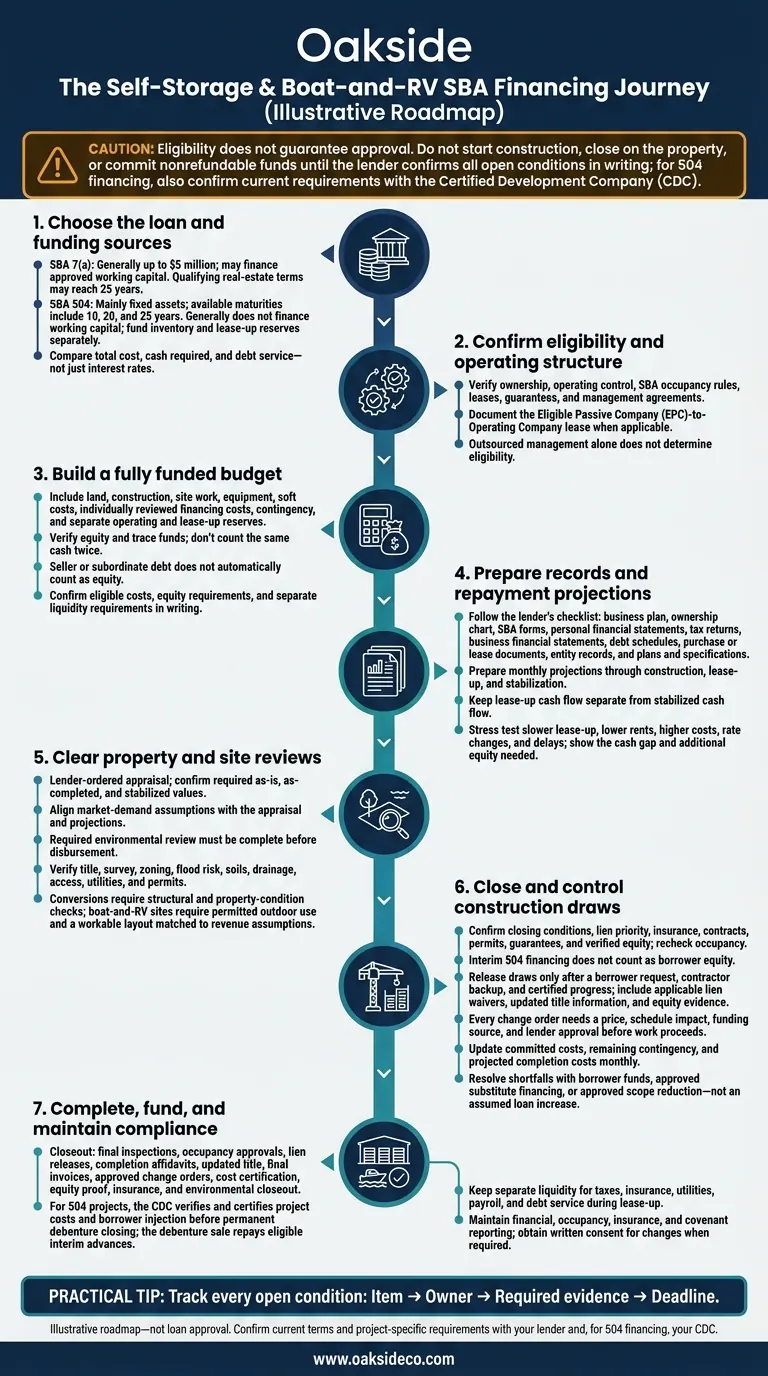
SBA Storage Development Financing Roadmap
Match your loan to the acquisition, construction, expansion, or conversion budget. Include completion and lease-up costs before signing any financing-contingent contract. Get written confirmation of eligible costs, required equity, and any separate liquidity requirements.
Compare SBA 7(a) and SBA 504
Start with how the financing works. SBA 7(a) offers more flexibility, while SBA 504 mainly funds fixed assets. Compare total cost, cash required, and debt service - not just the interest rate. Confirm current terms with your lender and Certified Development Company (CDC).
| Issue | SBA 7(a) | SBA 504 |
|---|---|---|
| Structure | A lender makes the loan, and the SBA guarantees part of it. | Combines borrower equity, a third-party lender, and a CDC-supported debenture. |
| Real estate and construction | Can finance acquisition, construction, and eligible improvements. | Can finance acquisition, construction, and eligible fixed improvements. |
| Equipment | Equipment, furniture, fixtures, and supplies may qualify. | Covers qualifying long-term equipment, generally with at least a 10-year useful life. |
| Working capital | May finance approved working capital. | Generally does not finance working capital. Fund inventory and lease-up reserves separately. |
| Occupancy test | Confirm the owner-occupancy test that applies to the structure. | Confirm the owner-occupancy test that applies to the structure. |
| Limits and terms | Generally capped at $5 million; qualifying real-estate terms may reach 25 years. | Available maturities include 10, 20, and 25 years. |
| Rates and fees | Negotiated with the lender, subject to SBA maximums. Verify current fees. | Check third-party loan pricing separately from debenture pricing and CDC/SBA fees. |
| Equity | Required equity depends on the transaction, borrower, project type, and lender underwriting. | Get a project-specific calculation, especially for new or special-purpose projects. |
| Collateral | The lender generally takes security interests in financed assets and available fixed assets under SBA collateral rules. | Project assets and required guarantees support the 504 structure. |
| Prepayment | Loans with maturities over 15 years may carry SBA prepayment penalties during the applicable early years. | The debenture generally carries a declining prepayment premium during an initial period. Check the third-party loan separately. |
| Unsuitable uses | Passive real estate, speculative projects, and unsupported reserves. | Passive real estate, speculative projects, working capital, inventory, and nonqualifying short-lived assets. |
Once you choose the loan structure, document ownership, leasing, and control.
EPC Leases, Guarantees, and Management Contracts
Put the EPC-to-Operating Company lease in writing and confirm its control provisions. Cover rent, term, renewals, maintenance, taxes, insurance, and default rights. Have counsel align the lease with the loan documents, including assignment of rents, access rights, and lien subordination.
Ask the lender to separate required entity and owner guarantees from added lender conditions, such as completion guarantees.
Outsourced management alone does not determine eligibility. Submit the management agreement for review of fees, termination rights, bank-account control, pricing authority, reporting, and authority to bind the business. The documents should show operating control and repayment support.
Then turn the documented structure into a fully funded sources-and-uses budget.
Build the Budget and Verify Equity
Map every dollar of cost, equity, and reserves to your loan choice. The hypothetical budget below separates project costs from operating liquidity. Review construction interest, financing fees, and contingency individually - don't assume they qualify.
Your loan structure determines which costs can be financed, which require equity, and which reserves need separate funding.
Category Use or funding source Amount Use Land or property acquisition $1,200,000 Use Building construction or conversion $3,000,000 Use Site work, paving, drainage, landscaping $450,000 Use Utilities, access controls, cameras, security $275,000 Use Architecture, engineering, permits, legal, other soft costs $325,000 Use Eligible construction interest and financing fees $150,000 Use Construction contingency $300,000 Use Separate operating and lease-up reserve $250,000 Total uses $5,950,000 Source SBA 7(a) or eligible 504 proceeds $4,500,000 Source Borrower cash equity $1,100,000 Source Equipment financing or other approved source $200,000 Source Subordinate or seller debt, if permitted and fully documented $150,000 Total sources $5,950,000
Trace equity through bank statements, wires, canceled checks, invoices, and a funds-flow schedule. Don't count the same cash twice. Seller or subordinate debt does not automatically count as equity. Get written approval for any credited amount and required subordination.
Reconcile fixed-price or guaranteed-maximum-price contractor bids with the budget. Document who pays for overruns, and leave out unapproved future phases. Break soft costs into individual fees, then model taxes, insurance, payroll, marketing, concessions, and interest through stabilization. Use those figures to document equity, support draws, and set repayment assumptions.
Once the loan structure and sources-and-uses are set, the lender moves on to documents, reports, and site approvals.
Borrower Records and Repayment Projections
With the budget set, prepare the borrower records and projections using the lender’s checklist. The package should include the business plan, ownership chart, SBA forms, personal financial statements, tax returns, business financial statements, debt schedules, purchase or lease documents, entity records, and plans and specifications. Before submitting, check that names, ownership percentages, dates, and the requested loan amount match across documents. Unsigned forms and conflicting records can delay underwriting.
Provide monthly projections through construction, lease-up, and stabilization. Support assumptions for unit mix, rents, concessions, ancillary income, expenses, occupancy, and debt-service coverage. Keep lease-up cash flow separate from stabilized cash flow. Stress test slower lease-up, lower rents, higher costs, rate changes, and delays. Show the cash gap and additional equity needed under each scenario.
Once the borrower file is complete, the lender reviews value, demand, and environmental risk.
Appraisal, Market Demand, and Site Contamination
The lender should order the appraisal. Confirm whether it needs as-is, as-completed, and stabilized values. New construction or substantial renovation requires completion value. SBA guidance also says the lender may not rely on an appraisal prepared more than 12 months before the application date.
Ask whether the lender requires a separate feasibility study to assess demand, existing supply, planned development, and achievable rents. The study, appraisal, and projections should use matching assumptions for unit or parking-space mix, space counts, rents, and lease-up and stabilization timing.
Before work begins, confirm the environmental review scope, approved providers, lender reliance requirements, and deadlines for updates. Review prior industrial, fuel, agricultural, or auto-service uses closely. A Phase I Environmental Site Assessment may lead to sampling, tank closure documentation, or other lender-approved follow-up. The required environmental review must be complete before disbursement. Track report dates, unresolved findings, and closing conditions.
With value and risk documented, check whether the site can legally and physically support the plan.
Site Approvals and Conversion Checks
Verify title, survey, zoning, flood risk, soils, and drainage. Confirm legal access, available utilities, and a workable layout before closing and construction draws.
For conversions, obtain structural and property-condition reviews covering roof and floor loading, fire protection, code compliance, accessibility, required permits, and hidden defects. Account for the findings in both the budget and schedule.
For boat-and-RV storage, confirm that outdoor use is permitted. Show space dimensions, drive aisles, turning radii, overhead clearance, and paved-surface specifications in feet and inches. Match the approved layout to the revenue model, and correct any parking-space count that exceeds what the site permits or can physically accommodate.
Once due diligence is complete, the deal moves from approval to funding and execution.
Work through each checkpoint: underwriting, report acceptance, site and permit review, approval, closing, draws, final certification, and repayment. The lender handles underwriting and draws; the CDC handles 504 approval and debenture processing. At each later step, confirm that the project still matches the approved structure.
Closing Requirements and Equity Verification
Before signing, ask the lender and title company to confirm lien priority, title exceptions, hazard and builder’s-risk insurance, permits, construction contracts, and any required bonds. Check that the signed EPC lease matches the approved terms, assignment rights, subordination, and renewal language. Signed guarantees, management contracts, and related-party terms must also match underwriting. Recheck the occupancy test at closing.
Document borrower equity with bank statements, wires, canceled checks, settlement records, and invoices. Interim 504 financing does not count as borrower equity. Have the lender and CDC confirm the final injection requirement, including any increase for a startup or special-purpose or limited-market property. For 7(a), confirm the project-specific requirement - don’t apply the 504 percentage.
After closing, attention turns to certified draws and budget control.
Construction Draws and Budget Controls
Release draws only after a borrower request, contractor backup, and certified progress. Each applicable draw package should include lien waivers, updated title information, and proof of the required equity injection. Document retainage, stored-material payments, contingency releases, and final completion evidence in writing.
Before work proceeds, every change order needs a price, schedule impact, funding source, and lender approval. Update committed costs, remaining contingency, and projected completion costs monthly. Self-construction and related-party contractors require independent pricing support and closer oversight.
Cover shortfalls with borrower funds, approved substitute financing, or an approved scope reduction - not an assumed loan increase. Resolve any funding gap before submitting the final certification package.
Common Financing Problems and Fixes
Approved proceeds don’t automatically cover change orders, interest, delays, or funding gaps. If the structure, reports, or budget assumptions no longer hold, address the funding impact before proceeding. For 504 financing, final records support the interim lender’s certification of advances before debenture issuance.
| Problem | Financing impact | Required evidence | Action |
|---|---|---|---|
| Passive-business classification | Ineligibility | Operating structure, lease, management agreement | Correct the ownership, lease, and operating model before closing |
| Occupancy shortfall | Reduced proceeds or ineligibility | Floor plan, owner-use calculation, leases | Increase owner use, revise scope, or change financing |
| Defective EPC lease | Closing blocked | Signed lease, assignment, subordination | Amend the lease and obtain required approval |
| Appraisal gap | More equity or less debt | Accepted appraisal, revised budget | Add equity, reduce costs, or renegotiate price |
| Contamination finding | Funding delayed or denied | Environmental reports and approved resolution | Fund required cleanup or revise the project |
| Equity shortage | Closing or draws blocked | Proof of funds and updated budget | Inject verified cash or resize the project |
| Weak repayment capacity | Lower proceeds or decline | Updated cash-flow and debt-service analysis | Reduce debt, increase liquidity, or phase construction |
| Conversion surprise | Unfunded costs | Inspection findings, revised plans and bids | Revise scope and fund the contingency |
| Cost overrun | Draw interruption | Change orders and cost-to-complete forecast | Add equity, value-engineer, or obtain approved financing |
| Delay | Higher carry; permanent funding delayed | Revised schedule and carry budget | Resequence work, extend interim financing, and fund carry |
| Ineligible cost | No SBA reimbursement | Classified invoices and eligibility review | Use borrower funds or substitute eligible costs |
Completion, Lease-Up, and Loan Compliance
When construction ends, shift from draw control to closeout and repayment readiness.
Closeout package: Submit final inspections, occupancy approvals, lien releases, completion affidavits, updated title, final invoices, approved change orders, cost certification, equity proof, insurance, and environmental closeout.
Permanent takeout funding: For 504 projects, the CDC verifies and certifies project costs and borrower injection before permanent debenture closing. The debenture sale repays eligible interim advances. Check payment dates in each note: construction interest, senior-loan payments, and debenture repayment may follow different schedules.
Compliance during lease-up: Keep separate liquidity for taxes, insurance, utilities, payroll, and debt service. 504 financing is not general-purpose working capital. Maintain financial, occupancy, insurance, and covenant reporting throughout lease-up to show continued compliance and repayment capacity. Get written consent, when required, before ownership transfers, new liens, major management or lease changes, or major alterations.
After the risk review, treat readiness as a lender checkpoint - not approval. Before submitting the deal, verify eligibility, occupancy, structure, budget, equity, reports, projections, and construction controls.
Create a final condition matrix that lists every open item, who owns it, the evidence needed, and the deadline. Do not start construction, close on the property, or commit nonrefundable funds until the lender confirms all open conditions in writing; for a 504 loan, also confirm current requirements with the CDC. Use this matrix as the lender’s final go/no-go file.
Oakside Co provides advisory support for self-storage and boat-and-RV transactions. SBA eligibility, approval, and final conditions come from the lender and, for 504 loans, the CDC.
Can I qualify without storage operating experience?
You can qualify for an SBA loan without prior storage operating experience. Lenders will review your liquidity, net worth, track record, and the property’s projected performance to judge whether you can carry out your business plan.
You’ll need a clear, data-backed lease-up and management plan, plus underwriting that accounts for slower leasing or lower rents. Professional advisors can help you prepare lender-ready materials.
How much cash should I keep beyond my down payment?
Set aside cash beyond your down payment to cover operating shortfalls, debt service, and lender-required reserves. New developments often take 18 to 36 months to reach stabilized occupancy, and your cash cushion needs to cover that period.
Lenders frequently require 12 to 18 months of tax and insurance escrows, plus interest reserves for construction and lease-up. Plan your cash needs around the property’s downside case, not optimistic projections.
What happens if lease-up takes longer than projected?
A slower lease-up can leave a property without enough cash flow to cover debt payments. Lenders typically stress-test 18- to 36-month lease-up periods and size loans based on downside scenarios - not optimistic projections.
Nolen Masserman, Managing Director at Oakside, advises sponsors to keep adequate interest reserves and use a stressed debt service coverage ratio of 1.35x to 1.50x to guard against potential net operating income shortfalls of 10% to 20%.