


I build a storage value-add capital stack to fund the purchase, improvements, and cash needs through exit - not just closing. My first check: separate cash available today from future loan draws. A $400,000 loan holdback can’t pay closing bills.
For self-storage and boat/RV projects, I work through five questions:
- Debt: What can current income support, and when must the loan be repaid?
- Improvements and reserves: Can funding cover upgrades, overruns, and lease-up taking 6–18 months longer than planned?
- Equity: Who funds shortfalls, controls major decisions, and gets paid first?
- Closing: Do lender approvals, guarantees, draw rules, and actual cash match the budget?
- Exit: Will a refinance, recapitalization, or sale cover debt and investor payments if results fall short?
My rule: <u>test the cash gap before committing</u>. That means checking weaker rents, higher costs, and lower exit proceeds - not relying on future income to pay today’s bills.
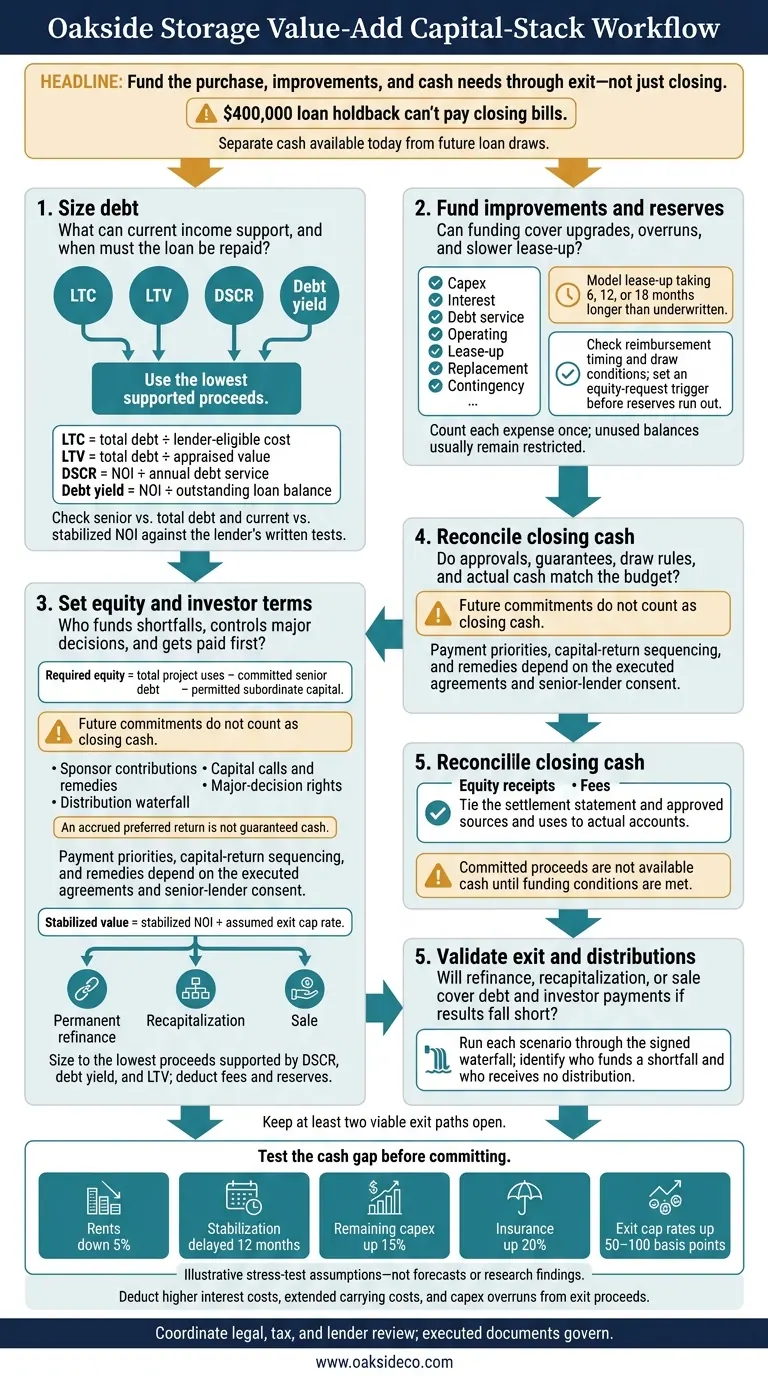
Storage Value-Add Capital Stack: From Funding to Exit
Size debt around the property’s tightest constraint: income, improvement costs, or lease-up timing. Once those limits cap borrowing, allocate the remaining funding need to capex, reserves, and equity.
Compare Acquisition and Construction Loans
| Financing | Proceeds and permitted use | Pricing and repayment | Recourse and closing requirements |
|---|---|---|---|
| Senior acquisition loan | Purchase financing for stabilized or largely occupied assets; sized to income and collateral | Fixed or floating; confirm amortization, maturity, and prepayment costs | Guarantees vary |
| Bridge debt | Acquisition, approved capex, and reserves for a turnaround | Often floating and interest-only; interest-only payments do not extend maturity; requires a workable refinance or sale plan | Verify guarantees, extension fees, notice deadlines, minimum paydown, and financial tests |
| SBA financing | 7(a): up to $5 million for eligible acquisitions, real estate, improvements, equipment, and working capital; 504: eligible fixed assets funded through a first mortgage, CDC/SBA second mortgage, and borrower equity | 7(a): eligible real estate terms up to 25 years; 504: CDC/SBA maturities of 10, 20, or 25 years, with separate first-mortgage terms | Verify eligibility, owner occupancy, guarantees, borrower contribution, and interim funding needs |
| Seller note | Negotiated purchase-price financing, subject to senior-lender consent | Negotiated interest, amortization, and maturity | Document collateral, recourse, subordination, payment restrictions, and standstill terms |
| Construction facility | Approved hard and soft costs funded through controlled draws | Usually draw-based; confirm the interest-only period, maturity, and extensions | Verify completion guarantees, permits, contracts, and draw conditions before closing |
Compare total borrowing cost - not just the quoted rate. For floating-rate debt, check the index, spread, floor, reset schedule, and rate-cap terms. For fixed-rate debt, check yield maintenance or defeasance costs. Get closing schedules and extension conditions in writing.
For SBA financing, confirm current eligibility, operating structure, owner-occupancy rules, guarantees, and permitted uses directly with the SBA and lender. Don’t assume passive ownership or leasing arrangements qualify.
A self-storage or boat/RV repositioning may need different capital at acquisition, during construction, and at stabilization.
Test How Much Debt Cash Flow Can Support
LTC = total debt ÷ lender-eligible cost; LTV = total debt ÷ appraised value; DSCR = NOI ÷ annual debt service; debt yield = NOI ÷ outstanding loan balance.
Use the lowest proceeds supported by the lender’s written LTC, LTV, DSCR, and debt-yield tests. Check whether each test uses senior or total debt and current or stabilized NOI.
Calculate coverage using actual collections, normalized expenses, and stressed interest rates. Stabilized income may support future advances or refinancing, but it doesn’t pay today’s debt service.
Check zoning, access, utilities, permits, and construction duration, too. These limits can reduce loan proceeds or require more reserves and additional completion requirements.
Fund Improvements and Lease-Up Costs
Separate hard costs - roofs, doors, paving, drainage, utilities, and climate-control equipment - from soft costs, technology, financing fees, and contingency. Put delays into the model as a specific number of months, and keep enough cash to pay bills before reimbursements arrive. Back up costs with trade bids and set contingency based on risk.
Draw procedures should spell out inspections, invoices, lien waivers, retainage, change-order authority, reimbursement timing, and completion tests. Model monthly cash flow through stabilization, including construction delays and lease-up running 6, 12, or 18 months longer than underwritten. Set an equity-request trigger before reserves run out.
After sizing debt, assign every dollar of the shortfall to a specific reserve: capex, carry - interest, debt service, and operating costs - or lease-up. These reserves cover the period before operations and collections stabilize.
| Reserve | Funding source and control to document | Permitted use | Release conditions to negotiate |
|---|---|---|---|
| Capex | Loan holdback or equity; usually lender-controlled when financed | Approved physical improvements | Invoices, inspections, lien waivers, and proof of completion |
| Interest | Loan proceeds or equity; control set by loan documents | Loan interest during construction or lease-up | Scheduled interest payments within the approved budget |
| Debt service | Equity or permitted loan proceeds; often lender-controlled | Scheduled principal and interest | Defined payment shortfalls and lender approval |
| Operating | Equity or permitted loan proceeds; control varies | Payroll, taxes, insurance, utilities, and other operating costs | Approved operating budget and reporting |
| Lease-up | Equity or permitted loan proceeds; control varies | Marketing, payroll, concessions, and other stabilization costs | Documented spending and agreed leasing milestones |
| Replacement | Equity or recurring property cash flow; often restricted | Future replacement of worn components | Eligible work and supporting invoices |
| Contingency | Equity or approved loan allocation; control varies | Unforeseen approved project costs | Approved change orders and an updated cost-to-complete budget |
Align reserve labels in the budget. If labels overlap, count each expense once; unused balances usually remain restricted.
Any remaining funding gap moves to sponsor equity and subordinate capital.
Once debt and reserves are sized, the remaining funding gap becomes the equity stack. Required equity equals total project uses minus committed senior debt and permitted subordinate capital. Spell out each sponsor’s cash contribution, when it must be funded, and how unfunded commitments will be handled. Future commitments do not count as closing cash.
Compare Equity and Subordinate Capital
| Capital type | Payment priority | Return profile | Control | Downside exposure | Flexibility |
|---|---|---|---|---|---|
| Sponsor/common equity | Residual, behind debt and preferred claims | Residual profits, promote, and fees if permitted | Day-to-day management, subject to reserved matters | First-loss capital; execution risk; possible dilution | Negotiable economics; future capital may dilute ownership |
| Limited partner common equity | Usually pari passu with sponsor common equity unless subordinated | Pro rata distributions under the waterfall | Negotiated major-decision rights | Equity-loss exposure and illiquidity | Most flexible economically, but fully exposed to performance |
| Preferred equity | Usually senior to common equity and junior to senior debt | Contractual preferred return, return of capital, and possible participation | Protective approvals and possible control remedies | Unpaid accrual and loss-of-capital risk | May be structured without a mortgage lien, but can restrict distributions |
| Mezzanine debt | Below senior debt and above equity | Interest, fees, and repayment at maturity | Covenants; sometimes equity-pledge remedies | Repayment and default risk; may accelerate or trigger enforcement remedies | Adds leverage, but can be expensive and require extensive lender consent |
| JV/shared-equity structure | No fixed payment rank; depends on the governing agreement | Contractual allocation of cash flow and profits | Shared or delegated governance | Allocated by ownership and negotiated protections | Highly customizable, but documentation can be complex |
Get written senior-lender consent before subordinate capital closes. Use the intercreditor or recognition agreement to document payment blocks, default notice, cure rights, standstill periods, and enforcement rights. Compare the total economic cost - not just the stated rate. Include accrued returns, exit fees, and participation rights.
With the capital types set, define how cash flow and profits move through the stack.
Define Waterfalls, Capital Calls, and Control Rights
Write the waterfall in an order the model can reproduce. Start with operating expenses, approved reserves, and senior loan obligations. Next, pay permitted subordinate debt or preferred-equity obligations as their documents require. Then return contributed capital, pay accrued but unpaid preferred return, and apply any negotiated sponsor catch-up. Split residual profits according to return hurdles, then apply any final promote tier.
Define how the preferred return works: simple or compounded, current-pay or cumulative, based on contributed or unreturned capital, and calculated before or after fees. An accrued preferred return is not guaranteed cash. Keep sponsor duties and fees separate from investment returns, and require approval for affiliate conflicts. Work with counsel to align tax allocations, capital accounts, and tax distributions. A tax-defined guaranteed payment is not the same as a preferred return.
Make capital commitments enforceable. Specify permitted calls, funding caps, notice deadlines, and cure periods. State whether missed funding becomes a member loan, triggers dilution, or leads to another stated remedy.
Give the sponsor routine budget authority, but reserve material budget changes, sales, refinancing, and affiliate contracts for approval. Require operating and financial reports. Address transfer limits, deadlocks, removal rights, and key-person replacement. No dilution formula or control remedy should conflict with the loan documents.
Model Investor Returns and Funding Gaps
Equity multiple = total equity distributions ÷ total contributed equity. IRR also accounts for contribution and distribution dates. Simple preferred return equals unreturned capital × rate × time, subject to the agreement. Model each investor separately, net of fees and promote, using dated capital calls and distributions.
Model overruns, carry, and delays separately. Each changes the equity multiple, IRR, and funding burden.
Before closing, use these terms to finalize loan covenants, funding conditions, reserve controls, and reserve deposits.
Once debt, reserves, and investor terms are set, bring lender conditions, documents, and funding steps into line so the deal can close.
Negotiate Loan Covenants and Guarantees
Match covenant tests to acquisition, construction, and lease-up - not just stabilization. Define when tests apply, minimum liquidity, budget limits, completion deadlines, reporting duties, cash management, and restrictions on distributions. Spell out how reserves enter cash-flow calculations, what triggers cash sweeps, how swept funds can be used, and what permits their release. Check the final covenant schedule against the business plan and closing timeline.
Treat payment, covenant, reporting, and construction defaults separately. Define the cure and remedy for each, along with extension notice dates, fees, performance tests, and required reserves.
The closing documents should clearly distinguish three guarantees:
- Payment guarantee: Covers specified unpaid obligations.
- Completion guarantee: Supports delivery of approved improvements.
- Nonrecourse carve-out guarantee: Establishes liability for defined bad acts, which may include full repayment liability.
State each guarantee’s liability limits and release conditions in the loan documents. Then assign every closing deliverable to one owner with a firm deadline.
Assign Closing Tasks and Funding Conditions
Track each closing item by owner, deadline, supporting records, approval, and effect on funding.
- Borrower: Deliver organizational, financial, operating, and insurance records to clear funding requirements.
- Lender: Finalize loan documents, reserves, and draw conditions, then provide written authorization to fund.
- Seller: Resolve title, contract, and property-document exceptions so acquisition funding can proceed.
- Contractor: Submit approved permits, contracts, budgets, and lien-waiver procedures for draw authorization.
- Equity partner: Fund documented contributions in the lender-approved order to meet equity conditions.
- Third-party consultants: Obtain lender acceptance of appraisal, survey, environmental, condition, and construction reviews to clear diligence conditions.
When comparing self-storage vs RV storage assets, confirm permitted uses, drainage and stormwater approvals, flood exposure, insurance treatment of customer-owned vehicles, and any required pollution or flood coverage.
Require acquisition sign-off from the borrower’s closing lead and pre-construction sign-off from the project manager. At mid-lease-up, require the lender and equity partner to confirm funding or approve revisions based on asset-manager reporting. Assign responsibility for shortfalls under the executed agreements, and keep monthly covenant tracking separate from disbursement approval.
Verify Closing Funds and Reserve Deposits
Reconcile the settlement statement with approved sources and uses. Tie purchase adjustments, fees, equity receipts, net loan proceeds, holdbacks, reserve deposits, and minimum operating cash to actual accounts and the exact cash available at closing.
Confirm when holdbacks and reserves can be disbursed and what conditions govern access. Committed proceeds are not available cash until funding conditions are met. Use the reconciled funding schedule as the baseline for stabilization and exit modeling.
Once the capital stack is funded, test whether the business plan can deliver payouts through a refinance, recapitalization, or sale.
Set Stabilization Targets and Exit Milestones
Define exit criteria before financing: completed improvements, stabilized rents, normalized expenses, and consistent trailing net operating income (NOI).
Set physical and economic occupancy targets for the property. Physical occupancy measures occupied spaces. Economic occupancy measures collections after concessions, delinquency, write-offs, and bad debt. Reconcile both with operating records, and document seasonal demand for boat/RV spaces. Use trailing 12-month results, along with the latest three to six months, to confirm the property can maintain its performance before exit.
Each exit path affects timing, liquidity, and control differently. Model each one separately.
| Exit path | Timing | Control | Costs and debt effects | Best fit |
|---|---|---|---|---|
| Permanent refinance | After stabilization; partial liquidity. Start takeout work well before maturity. | Usually retained | Financing fees, appraisal, legal, lender reserves, bridge repayment, and possible prepayment charges; confirm permitted supplemental debt | Strong NOI supports long-term debt |
| Recapitalization | After value creation; partial or large equity release | High to moderate, depending on the new partner | New financing, transaction costs, and partner issuance or preferred return; existing debt may require consent, amendment, or partial repayment | Sponsor wants liquidity while retaining upside |
| Sale | When operations and marketability are strongest; full liquidity at closing | Transfers to buyer | Brokerage, legal, transfer taxes, diligence, debt payoff, and prepayment charges; verify sale restrictions and release terms | Market pricing is favorable or refinance proceeds are insufficient |
Stress-Test Exit Proceeds and Investor Distributions
Calculate stabilized value = stabilized NOI ÷ the explicitly assumed exit cap rate.
Net equity proceeds equal exit value minus debt payoff, transaction costs, prepayment charges, and entity-level taxes. Account for unpaid improvements and required reserves, too. Keep investor-specific tax effects separate from property-level proceeds.
Next, test the takeout under weaker rents, slower lease-up, and higher exit cap rates. Model rents down 5%, stabilization delayed 12 months, remaining capital expenditures (capex) up 15%, insurance up 20%, and exit cap rates up 50–100 basis points. Deduct higher interest costs, extended carrying costs, and capex overruns from exit proceeds.
Size the refinance to the lowest takeout proceeds supported by DSCR, debt yield, and LTV. Then deduct fees and reserves to identify any repayment gap. Check extension conditions, supplemental-debt permissions, release terms, and sale restrictions.
Run every scenario through the signed waterfall, including capital priorities, preferred returns, catch-ups, and promote. Show who must fund a shortfall - and who receives no distribution.
Conclusion: Check Funding, Liquidity, and Exit Readiness
Use the same assumptions throughout the checklist so funding, operations, and exit targets stay aligned. Track each stage with an owner, deadline, supporting records, and approval status.
- Acquisition: Confirm funding certainty and closing liquidity.
- Construction: Verify remaining costs, contingency, and draw access.
- Lease-up: Check collections, monthly cash needs, and investor funding duties.
- Stabilization: Confirm completed work, normalized NOI, and covenant compliance.
- Refinancing: Verify lender sizing, payoff coverage, required approvals, and reserve releases.
- Sale: Confirm net proceeds, transfer restrictions, control rights, and the final waterfall.
Keep at least two viable exit paths open.
Oakside Co can help with exit planning through transaction management, investor outreach, and disposition support. Before making commitments, coordinate legal, tax, and lender review so repayment obligations, investor duties, and distribution assumptions match the executed documents.
How do I size reserves for seasonal boat/RV demand?
Start with a downside monthly cash-flow model that tests the debt service coverage ratio (DSCR) during low season - not just annual averages. Expenses, taxes, and insurance still come due when revenue dips. Target a DSCR buffer above lender minimums, commonly 1.35x–1.50x, and set aside enough reserves to cover the weakest months without covenant pressure or operating cutbacks.
Oakside also recommends sizing the capital stack to withstand weaker cash flow, including roughly 10%–20% net operating income (NOI) shortfalls, along with higher interest rates.
How can I limit dilution from unexpected capital calls?
Build the capital stack around downside timing and reserves, not best-case net operating income (NOI). Plan for slower lease-up and a 10%–20% NOI shortfall. Size debt using a stressed debt service coverage ratio (DSCR), often 1.35x–1.50x.
Set aside reserves for lease-up, interest, and capital expenditures (capex). Include covenant flexibility, payment relief, and extension options. Before stabilization, avoid mezzanine debt or preferred equity with heavy payment requirements. Underwrite combined debt service, not just senior debt.
What if my refinance cannot repay the bridge loan?
This typically means the asset hasn’t met a permanent lender’s requirements. The reasons may include low occupancy, insufficient net operating income (NOI), unfinished site work, or higher interest rates that reduce loan proceeds.
A bridge loan should fund a clear path to stabilization, backed by measurable milestones and contingency capital. Stress-test a debt service coverage ratio (DSCR) of 1.35x–1.50x, allowing for NOI shortfalls of 10%–20% and interest rates 100–200 basis points above current levels.