


Meeting a 1.25x DSCR requirement doesn’t mean your self-storage loan leaves enough cash to spare. I’d compare lenders using the same verified net operating income (NOI), then test a 1-percentage-point rate increase and a 5% NOI decline before committing equity.
As of November 7, 2026, the market remains uneven: second-quarter occupancy was 90.7%, while September advertised rents fell 1.8% year over year. My starting point: use collected income - not expected rent growth - to estimate what you can borrow.
Here’s how I’d compare the five financing channels:
Quick Comparison
| Financing channel | Main underwriting focus | What I’d check |
|---|---|---|
| Banks and credit unions | Verified cash flow, collateral, and sponsor finances | Recourse, amortization, and balloon payment |
| CMBS | Stabilized NOI, DSCR, and debt yield | Cash-trap triggers and prepayment costs |
| Debt funds | Current income, business plan, and exit financing | Floating rates, reserves, and extension tests |
| Government-backed programs | Borrower, property, and program eligibility | Guarantees, repayment terms, and lender DSCR rules |
| Bridge and mezzanine | Lease-up, total debt payments, and refinance capacity | Carrying costs, accrued interest, and maturity payoff |
I’d also check local supply, achieved rents, taxes, and insurance. <u>The lowest rate isn’t always the best loan.</u> What matters is usable proceeds after fees and reserves, the cash left after payments, and whether a conservative refinance can repay the debt.
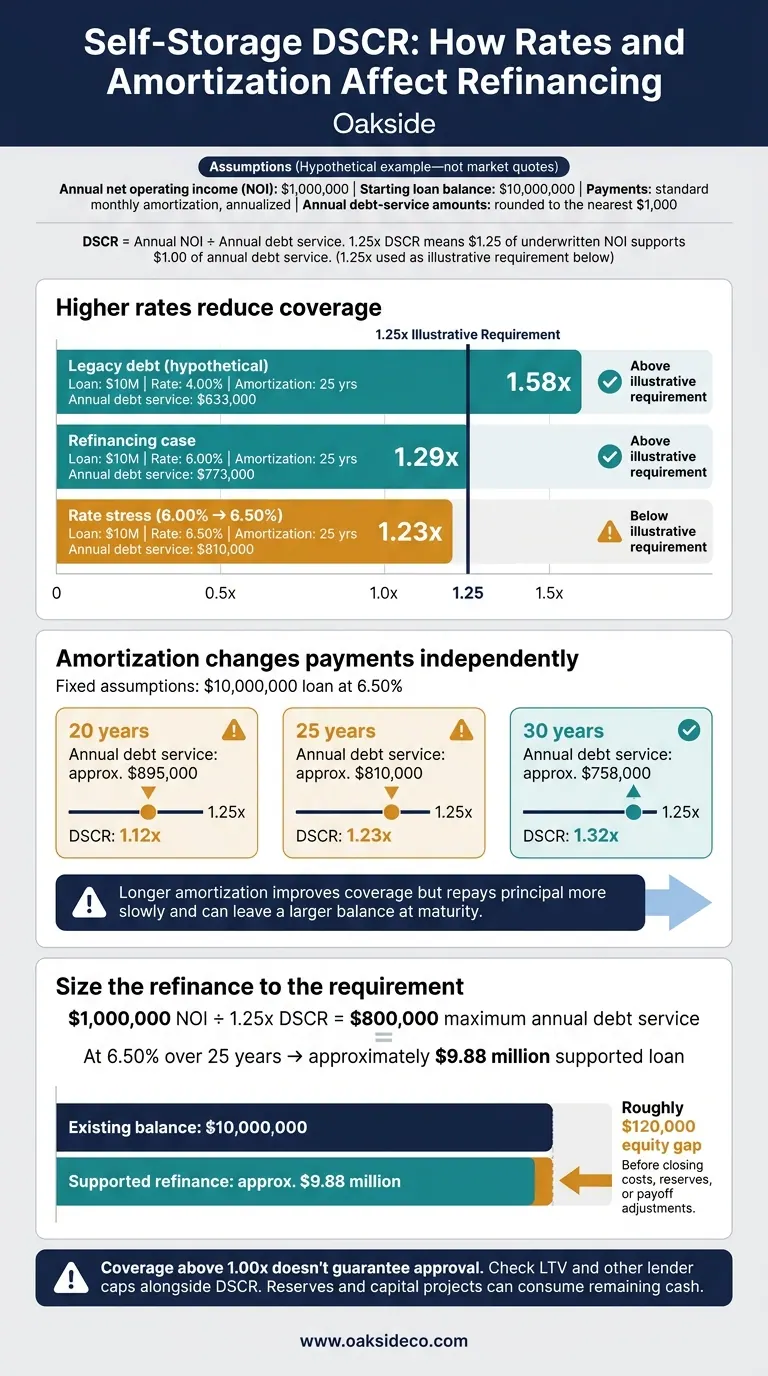
Self-Storage DSCR: How Rates and Amortization Affect Refinancing
Higher rates are tightening DSCR-based borrowing capacity in 2026, sometimes forcing borrowers to bring cash to a refinance. A 1.25x DSCR means $1.25 of underwritten NOI supports $1.00 of annual debt service. Many self-storage lenders target roughly 1.20x–1.40x DSCR, while conventional financing is often modeled around 1.25x–1.40x.
Rate and amortization determine how much debt a property can support. Verified NOI is the next constraint: the same income can support very different loan amounts at different rates.
Hypothetical example - not market quotes: A stabilized self-storage facility has $1,000,000 in annual NOI and a $10,000,000 loan balance. Payments use standard monthly amortization, annualized, rounded to the nearest $1,000.
Scenario Loan proceeds Rate Amortization Annual debt service DSCR Legacy debt (hypothetical) $10,000,000 4.00% 25 years $633,000 1.58x Refinancing case $10,000,000 6.00% 25 years $773,000 1.29x Rate stress $10,000,000 6.50% 25 years $810,000 1.23x Amortization matters separately: Keeping the $10,000,000 balance and 6.50% rate unchanged, a 20-year amortization lifts annual debt service to about $895,000, producing 1.12x DSCR. A 30-year schedule lowers payments to about $758,000, producing 1.32x. Longer amortization improves coverage but amortizes more slowly, which can leave a larger balance at maturity. A lender’s willingness to offer longer amortization therefore directly affects refinance capacity.
Size the refinance to the lender’s requirement: At 1.25x DSCR, $1,000,000 of NOI supports $800,000 of annual debt service, or about $9.88 million at 6.50% over 25 years; that still leaves a roughly $120,000 equity gap before closing costs, reserves, or payoff adjustments.
Coverage above 1.00x doesn’t guarantee approval. The stressed loan generates enough income to cover debt payments, but it still falls short of the lender’s requirement. Reserves and capital projects can use up the cash left over; taxes, insurance, and management should already be included in NOI. Before committing equity, check LTV and other lender caps alongside the DSCR limit.
Keep reported NOI, lender-adjusted NOI, and projected stabilized NOI separate. Small shifts in collections or concessions can move DSCR more than headline occupancy. Start with monthly statements, rent rolls, collections reports, and bank deposits that reconcile for the same period.
Physical occupancy counts occupied units. Economic occupancy measures collected revenue. A full property doesn’t guarantee full collections - which is why lenders look beyond occupancy.
Hypothetical sensitivity - not market averages or lender requirements. Each case starts with $1,300,000 in annual gross potential rent before the stated rent-growth assumption. For simplicity, occupied units have equal rental value. “Middle-case underwriting” describes a planning case, not a universal underwriting standard.
Assumption or result Conservative Middle-case underwriting Sponsor-optimistic Physical occupancy 86% 90% 94% Year-one rent growth 0% 2% 5% Gross potential rent after growth $1,300,000 $1,326,000 $1,365,000 Concessions, % of gross potential rent 4% 2% 1% Collections after concessions and bad debt 97% 98% 99% Effective rental revenue $1,034,020 $1,143,542 $1,256,756 Operating expenses $430,000 $405,000 $375,000 NOI $604,020 $738,542 $881,756 Annual debt service $600,000 $600,000 $600,000 DSCR 1.01x 1.23x 1.47x Revenue equals gross potential rent × occupancy, net of concessions, then multiplied by collections. Bad debt is already embedded in collections. No ancillary revenue is assumed; dollar results are rounded.
Compare T-12 with annualized T-3 instead of automatically replacing it. Annualized T-3 equals the latest three verified months × 4.
Illustratively, $720,000 in T-12 NOI versus $816,000 in annualized T-3 NOI is a $96,000, or 13.3%, increase.
Use dated rent rolls and collections to explain that gap. When available, review at least 24 months of monthly occupancy, effective rents, concessions, and move-ins and move-outs. A strong summer quarter may not reflect a full year. In 2026, lenders will discount unverified seasonal strength unless collections prove it.
Underwrite documented gains, not projections. Collected rent increases and sustained occupancy gains carry more weight than asking rents or planned lease-up. A higher current rent roll without collection history is only partially verified.
Likewise, keep a proposed $40,000 payroll reduction outside base NOI until staffing records, contracts, or operating history support it.
Normalize recurring operating costs and any nonrecurring items that distort run-rate NOI.
The table’s DSCR is a planning output, not the lender’s test. Apply the lender’s current DSCR and reserve rules to the accepted NOI case, then use that case as the baseline for the bank, CMBS, debt-fund, and agency comparisons that follow.
A banking relationship can help you get better terms, but it won’t make up for weak cash flow. Using the verified NOI baseline from the prior section, banks and credit unions generally size loans to the lowest amount supported by DSCR, LTV, and sponsor credit or guarantor strength. Adjusted NOI - not headline value, asking rents, or projected lease-up - usually determines proceeds.
Deposits, repayment history, and treasury-management activity may help you negotiate pricing concessions or more flexible prepayment terms. Lenders also review sponsor liquidity, net worth, experience, and other debt obligations. Submit personal and business financial statements, tax returns, bank statements, entity debts, and proof of post-closing reserves. For credit unions, check membership eligibility, geographic limits, and loan-size limits early.
Recent survey data points to tighter LTV and DSCR standards across CRE, though bank terms still vary by market and borrower profile. Local market risk also affects lender appetite and pricing, along with geographic lending limits and portfolio concentration. In self-storage submarkets with heavy supply, insurance pressure and occupancy swings can mean lower proceeds, higher spreads, or additional guarantees. Provide achieved rents, occupancy history, planned supply, and property-specific insurance details.
Compare fixed-rate loans with floating-rate loans tied to SOFR or prime. Check whether DSCR sizing uses the initial coupon or a stressed refinance rate, and whether the lender tests coverage during the loan term. Review the index, spread, floor, reset frequency, amortization, and rate-cap cost. Don’t stop at the first payment: model the balloon payment and refinance proceeds under higher rates and lower NOI.
Weigh recourse alongside the rate. Full or partial recourse can wipe out a relationship-pricing advantage on a storage acquisition or refinance. Compare payment and carry guarantees, environmental obligations, carve-outs, liquidity tests, and written conditions for release or burn-off. Review fees, reserves, collateral, prepayment charges, and extension tests alongside the coupon.
Banks price loans partly around the borrower relationship. CMBS pricing centers on standardized execution. CMBS relies on stabilized cash flow, standardized loan sizing, and debt-yield tests. Indicative self-storage sizing often falls around 1.20x–1.40x DSCR and 9%–10% debt yield. Using the same verified NOI, debt yield - NOI divided by the loan amount - can cap proceeds even when interest-only payments leave enough room to meet DSCR requirements. Heavy local supply or volatile rents can lead to higher coverage requirements and lower leverage.
Stabilized assets are the best fit for CMBS. Submit at least 12 months of operating history, a unit-level rent roll, and monthly occupancy and rent trends. Lease-up assets often need bridge debt before refinancing into CMBS because projected stabilization doesn't provide enough trailing income. Loan structure matters as much as the coupon.
The quoted rate isn't final until pricing or rate lock. Treasury movements and credit spreads can change the coupon before closing. A delayed lock can reduce proceeds even if the loan met DSCR requirements at application. After closing, fixed payments protect against floating-rate increases, but falling NOI still weakens DSCR.
When coverage tightens, cash control can matter as much as rate. Lockboxes and cash-management provisions can trap cash before a payment default if DSCR, occupancy, or debt yield drops below trigger levels. Review how these restrictions affect distributions and access to reserves, plus your cure rights and the conditions for releasing trapped cash.
Match the loan term to your hold period. CMBS usually requires yield maintenance or defeasance rather than a simple step-down penalty. Factor that prepayment cost and the contractual open-prepayment period into your capital stack and exit plan, since exit timing affects the actual cost of the debt.
Debt funds fill the gap when CMBS is too rigid for lease-up or execution risk. They offer more flexibility in timing, structure, and execution - but less cost certainty. For stabilized storage, they may fit borrowers who put speed, limited recourse, or custom terms ahead of the lowest rate. For lease-up, expansion, or conversion projects, they can underwrite the business plan and provide future funding. Many debt-fund loans use bridge structures to fund execution, not just stability.
With debt funds, DSCR depends on the business plan, not just current income. Projected NOI is not lender-accepted NOI. Model in-place, underwritten, and stabilized NOI separately. Then test debt yield, loan-to-cost, and break-even occupancy. Back up projections with achieved rents, lease-up history, and a detailed budget. Heavy local supply or weak rent growth usually lowers projected NOI. Lenders account for that forecast risk through lower proceeds, larger reserves, or higher spreads.
Sponsor liquidity needs to cover more than closing equity. Show how you'll pay for lease-up delays, overruns, and operating deficits once reserves run out. Reserved proceeds are not free cash. Review completion and carry guarantees, draw conditions, and whether unused reserves come back to you. Reserves and accessible sponsor cash determine whether the plan can hold up after closing.
Because these loans usually have floating rates, build rate stress into DSCR planning from day one. Test higher benchmark rates, slower benchmark declines, and rate floors alongside weaker operating results. Confirm whether the lender calculates DSCR using actual interest expense or an underwriting rate. Include cap premiums, renewals, minimum interest, exit fees, and extension costs in the total cost.
Treat extensions as conditional, not guaranteed. Require written terms covering fees, DSCR or debt-yield tests, an updated valuation, cap coverage, and paydowns. Extension rights only help if conservative DSCR-based permanent financing can repay the balance through a refinance or buyer-funded sale. Base the exit on measurable property improvement, not rate relief.
Check eligibility before sizing debt. For self-storage, the borrower, property, and use of proceeds must fit the program. When bank or CMBS loan sizing is tight, government-backed programs may lower costs through longer amortization or lower rates, which can improve coverage. But strict eligibility limits apply. Confirm borrower eligibility, property use, ownership structure, and the purpose of the proceeds first.
SBA 7(a) can finance real estate and operating needs for an eligible operating small business. Loans can reach $5 million, with real estate maturities generally up to 25 years. Longer amortization can ease DSCR pressure, but lenders negotiate rates within SBA limits. The SBA guarantee does not mean a fixed rate or fixed cost. For most loans above $150,000, the guarantee covers up to 75%; the borrower remains liable.
SBA 504 requires owner-occupancy testing before you model any coverage gains. Current SBA guidance requires at least 51% occupancy by the applicant or operating company and excludes passive rental-real-estate investment. Zoning or ownership alone does not establish eligibility. Ask the Certified Development Company to confirm how the storage operation meets current rules.
USDA Business & Industry may fit a qualifying rural commercial business if the written financing terms support coverage. Check rural eligibility, business activity, collateral, and job impact - a rural address alone is not enough. Before modeling DSCR, get the guarantee percentage, personal-guarantee requirements, rate structure, and repayment schedule in writing.
SBA and USDA rules do not set a single DSCR floor for every loan. Request both the program test and the lender’s added requirements in writing. Confirm how each treats business cash flow, cross-obligations, and add-backs. Compare all quotes using the same operating assumptions, and model DSCR, amortization, guarantees, and prepayment together.
When permanent debt is hard to secure, bridge and mezzanine financing can fill the gap - but both add carrying costs and refinance risk. Bridge debt covers a short-term funding gap; mezzanine debt adds leverage. Bridge loans typically offer short-term senior financing, often with interest-only payments, for acquisition, renovation, lease-up, or stabilization. Mezzanine financing sits behind the senior loan and is generally secured by ownership interests in the borrowing entity, rather than a second mortgage on the property. It usually costs more and may include control rights, cash sweeps, or equity remedies.
Indicative 2026 bridge terms are 9%–12% interest-only, with maturities of 12–36 months. Interest-only payments reduce near-term cash needs, but the principal remains due at maturity. Model total interest, origination fees, exit fees, and subordinate financing costs. The senior rate alone won't tell you the full carrying cost.
Underwrite debt-stack DSCR against all current debt service. Model accrued mezzanine interest separately because it increases the refinance payoff. Track preferred returns and fees separately to assess how much cash remains. Before closing, stress-test slower lease-up, higher interest rates, and lower appraised values.
Size reserves for delayed lease-up - not the planned stabilization date. Some programs include 6–12 months of interest reserves. Confirm who covers shortfalls, how reserves are released, and which guarantees put your personal assets at risk. With thin reserves, refinance proceeds must cover the full debt stack and exit costs, not just the senior loan.
Treat extension options as temporary relief, not a refinance plan. An extension may require roughly 1.20x DSCR, a 0.25%–0.50% fee, a new rate cap, and adequate reserves. The loan documents set the terms. Calculate the net operating income (NOI) and property value needed to repay both debt layers and closing costs. Even if the property's value rises, a lack of income growth can still force an equity paydown at refinance.
Local supply can affect DSCR as much as interest rates. Yardi Matrix’s January 27, 2026 outlook described a gradual, uneven recovery. Meanwhile, September 2026 advertised rents fell 1.8% year over year. Size loans using verified NOI - not expected rent growth. These conditions first affect proceeds, reserves, and how lenders set spreads.
The comparison below uses evidence available through November 7, 2026. The categories are illustrative: metro data does not determine property-level results. Financing entries describe underwriting tendencies, not quoted terms.
| Lending consideration | Constrained urban | Balanced suburban | High-supply growth | Secondary markets |
|---|---|---|---|---|
| Market evidence informing lender caution | Limited supply or supportive demand favored Boston, Chicago, Minneapolis, New York City, and Washington, D.C. | Submarket conditions vary; property-level evidence controls. | Tampa–St. Petersburg and Orlando faced expected inventory growth of about 6% in PwC’s 2026 outlook. Phoenix’s under-construction inventory reached 6.6% of existing stock through July 2026. | Liquidity and exit depth vary by submarket; assess each separately. |
| Absorption risk and leverage | Resilient occupancy may support proceeds. | Softer rents can limit leverage even when occupancy holds steady. | Slower absorption usually lowers leverage and extends stabilization. | Thin exit liquidity can limit proceeds. |
| Supply-driven NOI adjustments | Limited deliveries may support less conservative rent assumptions. | Achieved rents determine underwriting adjustments. | Heavy deliveries usually lead to larger underwriting haircuts and delay DSCR stabilization. | Competing deliveries and concessions determine adjustments. |
| Stabilized assets: lender appetite | Reliable cash flow may attract more permanent lenders. | Conventional financing may be available when local evidence supports it. | Lenders examine concessions, exit liquidity, and debt-service reserves more closely. | Fewer lenders and greater appraisal sensitivity may apply. |
| Transitional assets: proceeds and reserves | Property-specific support is still needed. | Conservative proceeds and reserves are more likely. | Lower leverage, added reserves, interest-only flexibility, or bridge financing may be needed. | Options depend on sponsorship and exit depth. |
Do not assume spread premiums without a matching quoted deal. Compare spreads against the same documented benchmark. Match quote dates and use similar rate type, maturity, amortization, leverage, DSCR, debt yield, recourse, sponsorship, and stabilization status. Available evidence does not establish comparable local spreads. A stabilized asset is not a pricing comparable for a lease-up deal.
Where supply is heavy and absorption is slow, lenders usually offer lower leverage, require stricter reserves, and allow less flexibility in execution. The same verified NOI can produce very different proceeds after lenders account for local supply, exit liquidity, and their appetite for the deal.
Use local quote dates and lender terms to test DSCR, LTV, and debt yield against the same property-level case. Stress-test rates, occupancy, expenses, taxes, insurance, and exit cap rates at closing and at the expected sale or refinance. For taxes and insurance, use assessor data and insurance quotes - not national averages.
Size proceeds by the lowest of the DSCR, LTV, and debt-yield limits, then subtract holdbacks, fees, escrows, and reserves. Compare usable proceeds with total capital needs and available equity to find the funding shortfall.
How much DSCR cushion should I target in 2026?
In 2026, lenders typically require a 1.20x–1.35x debt service coverage ratio (DSCR) for stabilized self-storage assets. Aim for 1.35x–1.50x to leave room for income swings, seasonal demand, and rising insurance and tax costs.
Stress-test the loan with net operating income 10%–20% below your pro forma and interest rates 100–200 basis points above current levels. If DSCR drops below 1.25x under those conditions, the loan is likely over-leveraged.
What can I do if my refinance proceeds fall short?
Recheck lender requirements: DSCR targets often range from 1.25x to 1.35x, with LTV limits around 60%–65%. Lenders may size loans based on collected NOI - not physical occupancy alone.
To close the gap, assume less debt and a lower LTV, add equity, or reduce underwriting risk by documenting more consistent collections and bringing expense ratios in line with the market range of 30%–45%. If DSCR falls short under stress, loan terms typically tighten. Improve NOI before renegotiating the loan structure.
How can I improve my property's appeal to lenders?
Show steady cash flow and disciplined property management. Focus on economic occupancy, factoring in move-in specials and delinquencies. Keep expenses in check to support strong NOI margins, and target a DSCR of 1.35x–1.50x for a safety buffer.
Base projections on hyper-local data, and document the sponsor’s liquidity and track record. For lease-up properties, lay out a clear path to stabilization, backed by verifiable milestones and contingency capital.