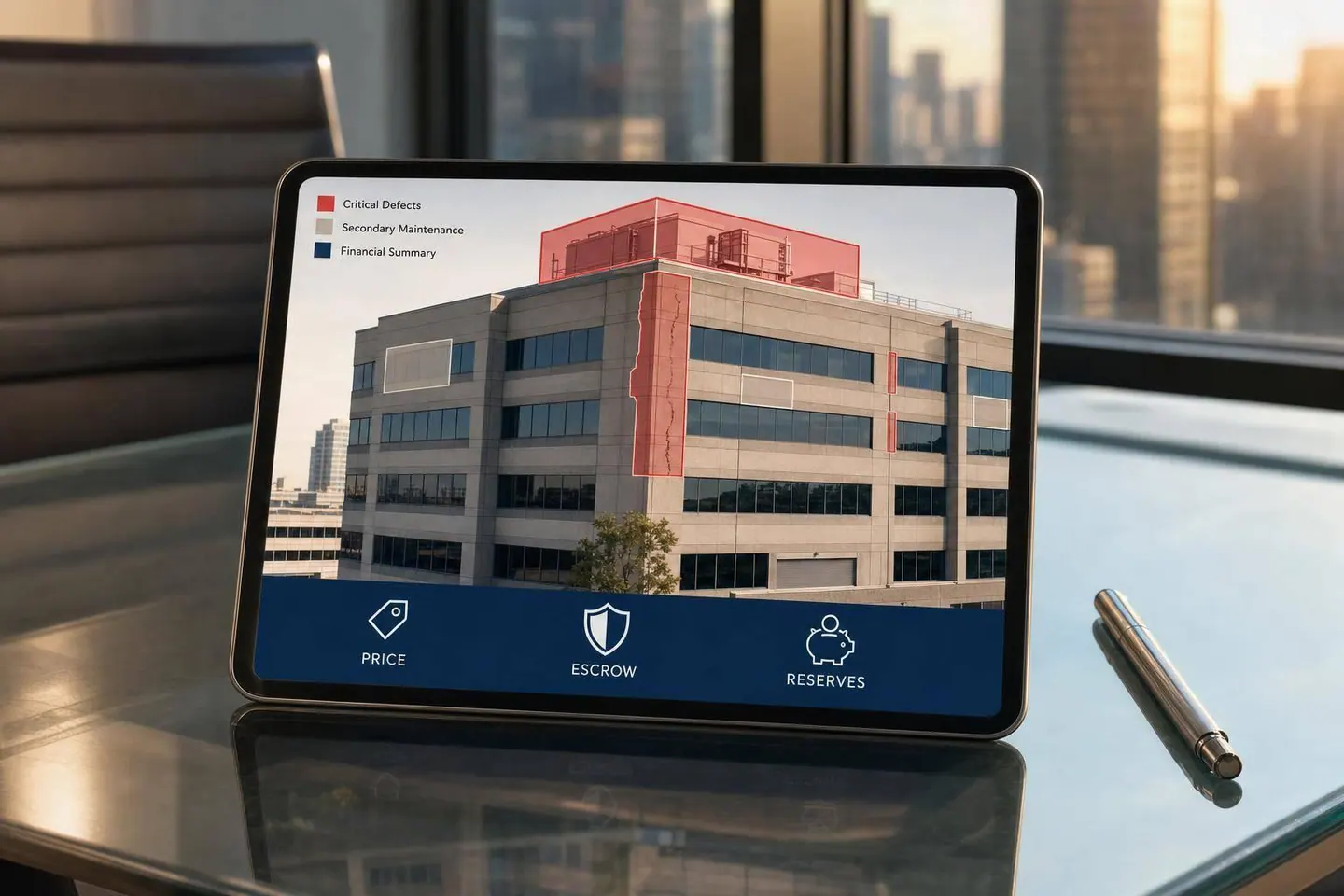

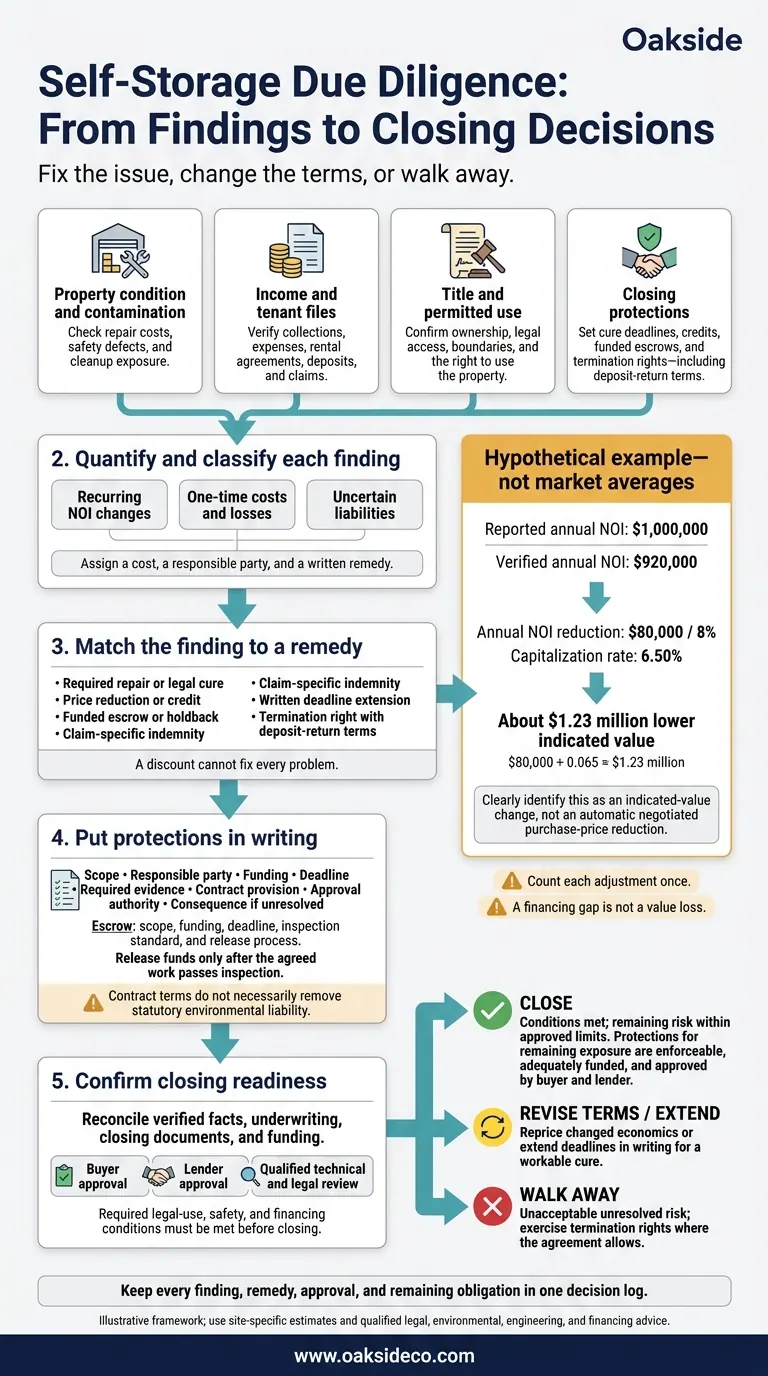
My rule for self-storage due diligence: fix the issue, change the terms, or walk away. Before closing, I want every finding tied to a cost, a responsible party, and a written remedy.
I focus on four areas:
- Property condition and contamination: Check repair costs, safety defects, and cleanup exposure.
- Income and tenant files: Verify collections, expenses, rental agreements, deposits, and claims.
- Title and permitted use: Confirm ownership, legal access, boundaries, and the right to use the property.
- Closing protections: Set cure deadlines, credits, funded escrows, and termination rights - including deposit-return terms.
The numbers matter when calculating self-storage valuations. In the article’s hypothetical example, an 8% drop in annual net operating income - from $1,000,000 to $920,000 - cuts indicated value by about $1.23 million at a 6.50% capitalization rate.
But a discount cannot fix every problem. I separate known costs from uncertain liability, avoid counting the same loss twice, and <u>put each agreed remedy in writing before funding</u>.
Self-Storage Due Diligence: From Findings to Closing Decisions
Physical defects and environmental findings are often the first issues to change closing terms. They can lead to required repairs, funded escrows, or closing delays.
Check Property Systems and Repair Costs
Order a property condition assessment (PCA) using ASTM E2018 as a reference. Translate physical defects into repair costs, downtime, and lender risk. Separate immediate safety, code, and operational defects from near-term repairs and future replacements.
Inspect roofs, drainage, paving, security systems, electrical and mechanical systems, fire protection, and emergency access. Check unit counts and square footage against the site plan, permits, certificates of occupancy, inspection records, warranties, service contracts, and open code violations.
An active leak near wiring is a closing issue; an aging but functional roof is a pricing issue.
Require written contractor scopes that specify quantities, permits, schedules, exclusions, and contingency allowances. Set aside reserves for future replacements separately.
For boat and RV storage, check turning clearances, access, drainage, and usable spaces against approved plans. Budget for blocked spaces, access limits, and lost rent - not just construction. Layout defects can reduce usable spaces and revenue. Also confirm whether defects affect lender approval or insurance coverage.
Investigate Contamination Before Closing
Order the Phase I environmental site assessment early and separately from the PCA. ASTM E1527-21 is recognized under EPA’s All Appropriate Inquiries framework.
A Phase I reviews site history and current conditions; it cannot clear contamination. A recognized environmental condition can trigger Phase II sampling and agency review.
Treat environmental findings as closing conditions and liability-allocation issues, not just disclosures. The table below links findings to deal remedies. Have environmental counsel review liability protections: contract terms do not necessarily remove statutory environmental liability.
Choose Credits, Holdbacks, or Required Repairs
Choose the remedy based on how well the scope and cost are known.
The amounts below are hypothetical, not market averages. Replace them with site-specific estimates before negotiating.
Condition Estimated cost Repair timing Seller obligation Closing treatment Remaining buyer risk Active roof leak over occupied units $35,000 Before closing Repair; deliver invoice and warranty Required repair; buyer re-inspects Concealed damage or shortened roof life Gate and access-control failure $18,000 Before closing or within 30 days Replace controller and damaged hardware Credit or funded escrow Downtime; compatibility; security gaps Failed fire-alarm component $12,500 Before closing Correct and obtain inspection sign-off Required repair; closing conditional on approval Additional code work identified by inspector Deteriorated RV drive-aisle paving $150,000 Within 6–12 months Fund defined paving scope Price reduction or escrow Soil, drainage, and traffic-control overruns Phase II confirms localized petroleum impacts $225,000; subject to regulatory scope Timing determined by regulator Investigate, remediate, or fund approved plan Extension, escrow, indemnity, or termination right Statutory liability, delay, and unknown conditions
For unfinished work, the escrow must specify the scope, funding, deadline, inspection standard, and release process. Release funds only after the agreed work passes inspection.
Financial findings affect price, reserves, financing, and closing conditions. Revenue gaps change valuation, tenant liabilities shape who bears the risk, and missing records can change closing requirements.
Verify Revenue, Expenses, and Occupancy
After pricing physical and environmental issues, check whether the cash flow still supports the deal.
Request 24–36 months of financial statements, rent rolls, bank records, tenant ledgers, tax bills, invoices, and ancillary-income contracts. Reconcile management software reports with bank deposits, accounting for timing differences, processing fees, and prepaid rent. Match unit counts to the inventory.
Measure physical occupancy separately from economic occupancy. Define economic occupancy as collected rent divided by gross potential rent for the same period. Check concessions and delinquency, and confirm that rent increases were collected - not just entered into the system.
Normalize payroll, utilities, repairs, insurance, management fees, and post-closing property-tax exposure. Keep projected improvements out of verified recurring NOI.
Review Rental Agreements and Tenant Liabilities
Have counsel reconcile executed agreements and tenant ledgers with state lien-sale notices, deadlines, and procedures. Review aging reports, prepaid rent, deposits, discounts, complaints, insurance obligations, and abandoned-property files.
Identify missing agreements and any notices or consents required before closing. Check non-storage leases for assignment requirements and continuing obligations. Access logs can support the review, but inactivity alone does not prove vacancy.
Assign responsibility for pre-closing claims. Don’t assume the buyer’s insurance will cover them.
Turn Financial Gaps Into Deal Adjustments
Keep recurring NOI changes, one-time receivable losses, and tenant liabilities separate. Match each finding to a price cut, escrow, indemnity, extension, or revised debt terms.
The hypothetical figures below use a 6.50% valuation capitalization rate. Receivable and tenant-liability adjustments are not already included in verified NOI.
Item Reported performance Verified performance Underwriting adjustment Purchase-price effect Remedy Annual recurring NOI $1,000,000 $920,000 Reduce annual NOI by $80,000 About $1.23 million lower indicated value Price reduction; revise financing Aged receivables $75,000 balance $25,000 expected collection $50,000 one-time reserve $50,000 reduction if transferred at reported value Credit, collection escrow, or exclude receivables Prepaid rent Not separately identified $30,000 attributable to post-closing periods No NOI reduction $30,000 credit to buyer Closing proration Tenant claim Not disclosed $100,000 asserted pre-closing claim No automatic NOI reduction - Claim-specific indemnity; negotiated escrow
Don’t count a receivable loss twice. Define who owns the receivables and receives later collections. Credit the buyer for transferred deposit obligations and post-closing prepaid rent.
If verified NOI weakens debt-service coverage, reset loan proceeds, equity, or reserves. A financing gap is not a value loss.
Require financial-accuracy representations covering rent rolls, concessions, deposits, claims, and lien-sale records. Set deadlines for updated rent rolls, ledgers, and bank reconciliations. If records remain unresolved, negotiate more time for reconciliation or make resolution a closing condition. Specify post-closing adjustment procedures, indemnity survival periods, and claim-specific escrow release terms.
With cash flow reconciled, the next review covers title, zoning, and contract protections.
Check Ownership, Access, Boundaries, and Uses
After financial diligence, check the rights that allow the asset to close, operate legally, and qualify for financing. Title and zoning issues can affect all three.
Review the title commitment, survey, and recorded documents together. Confirm that the property can be conveyed with insurable access and that every improvement sits on the legal parcel. Review exceptions, deeds, liens, easements, restrictions, access agreements, leases, and financing documents.
Compare the ALTA/NSPS land title survey with the title commitment and site plan. Require recorded rights for off-parcel improvements and access that supports customers, emergency vehicles, and deliveries - not just a driveway. For new surveys, confirm the February 23, 2026 standards with the surveyor, title company, and lender.
Require written zoning confirmation and acceptable certificates of occupancy, building and sign permits, site-plan approvals, variances, fire or life-safety approvals, and stormwater permits. Assign responsibility for resolving any outstanding violations.
Check self-storage and outdoor boat/RV uses separately. Confirm whether approvals transfer and whether any legal nonconforming use survives casualty or vacancy. For additional construction, require documented approvals or a confirmed approval path. Permission to operate today does not establish a right to expand.
Assign Title and Use Cures Before Closing
Give each defect a responsible party, a required document, and a completion deadline.
| Title or use issue | Legal impact | Cure responsibility | Insurance treatment | Closing requirement |
|---|---|---|---|---|
| Unreleased mortgage or lien | Could impair clear title or lender priority | Seller obtains payoff, release, or satisfaction | Title insurance does not replace a known material lien release | Recorded release or funds held under an approved escrow |
| Boundary or ownership discrepancy | May affect parcel size, improvements, or collateral | Seller provides corrective deed, affidavit, boundary agreement, or new survey | Survey or location endorsements may help but do not transfer disputed ownership | Resolve before closing if material |
| Access or utility easement defect | Could prevent legal operation or services | Seller records or amends easement and obtains required consents | Access endorsements may be available only if the insurer accepts the record evidence | Recorded rights and lender approval required |
| Encroachment or restrictive covenant | May trigger removal, litigation, or restricted use | Seller removes improvement, obtains encroachment agreement, or secures acceptable rights | Specific coverage may be available; enforcement risk can remain | Title-company and lender approval required |
| Missing certificate, permit, or approval | Could expose buyer to fines, closure, or required reconstruction | Seller obtains confirmation, retroactive approval, or final inspection | Title insurance generally does not insure regulatory compliance | Written municipal confirmation or escrow acceptable to buyer and lender |
Title insurance does not legalize an unpermitted use or create missing access. Obtain the proposed policy, endorsements, exceptions, and escrow instructions early enough for counsel and the lender to approve them.
Use an escrow for a defined cure that can be completed - not an unresolved question about whether the property can operate lawfully. Keep negotiated termination rights for unacceptable ownership, access, permitted-use, or insurability defects. Put each cure in the purchase agreement before lender deadlines expire.
Put Remedies in the Purchase Agreement
Turn each identified title or zoning defect into a specific closing condition, cure deadline, or termination right.
Work with transaction counsel to separate mandatory seller cures from optional ones. Set deadlines for title objections, seller responses, and cures. Make title, survey, and zoning defects closing conditions; reserve price changes for minor, measurable issues.
Keep title, survey, zoning, environmental, financing, and appraisal contingencies separate. Require specific disclosure schedules, representations about ownership and authority, and closing conditions covering approved title, lawful use, and required consents.
Tie failed title or zoning cures to explicit termination rights and deposit-return terms, including notice methods and deadlines. For title or permit escrows, specify the amount, agent, evidence needed for release, deadline, dispute process, and who pays the costs. For related indemnities, define covered losses, control of the defense, survival periods, caps, and baskets.
Obtain lender approval of credits and holdbacks before contractual deadlines expire. A promise to cure, by itself, does not protect the deposit or satisfy underwriting.
Complete the Closing Checklist
Once the property, financials, title, and tenant records are reconciled, work through the closing checklist to catch omissions and double-counting.
Compare the underwritten model against verified facts: price, sources and uses, occupancy, income, expenses, capital needs, and title and legal assumptions. Quantify each change and assign a remedy. Count each adjustment once. Don’t use price cuts, credits, and escrows to cover the same cost more than once.
| Item | Responsible party | Required evidence | Deadline | Consequence if unresolved |
|---|---|---|---|---|
| Title and survey | Seller, title company, buyer’s counsel | Updated commitment, endorsements, and ALTA/NSPS survey | Before the title-objection deadline | Cure, accept exception, escrow, or terminate |
| Permitted use | Seller and buyer’s counsel | Written approvals and permits | Before closing | Cure or delay closing |
| Site reports | Buyer’s engineer and environmental professional | Final reports, testing, repair scope | Before diligence expires | Investigate or revise closing conditions |
| Financials | Buyer and seller | Rent roll, collections, expenses, tax records | Before statement approval | Revise underwriting |
| Tenant files | Seller and property manager | Leases, deposits, delinquency and claims schedules | Before closing | Resolve discrepancies or allocate liability |
| Repairs | Seller and buyer’s inspector | Completion evidence, invoices, lien waivers | Before final inspection | Require completion or agreed protection |
| Escrows | Buyer, seller, lender, escrow agent | Funding confirmation and signed instructions | At closing | Withhold funding |
| Payoffs | Seller and title company | Payoff letters and releases or approved release arrangements | At closing | Withhold funds or postpone |
| Assignments | Seller and buyer | Executed transfers and required approvals | Before ownership transfer | Obtain replacement agreement or delay |
| Prorations and closing statement | Buyer, seller, closing agent | Approved statement and adjustment register | Before funding | Correct amounts before disbursement |
For every open item, establish a specific cure, escrow, price change, or termination right before funding.
Check that contracts, warranties, permits, and licenses can transfer. Obtain consent or replacement agreements where needed, and verify every proration and adjustment on the final statement.
Assign Final Decisions and Follow-Up
Close only when conditions are met and remaining risk falls within approved limits. Revise terms when income, expenses, or capital needs have changed for the long term. If a workable cure needs more time, extend deadlines in writing. Require completion before closing for required legal-use, safety, or financing conditions.
Close with protections only when the exposure is measurable, the protections are enforceable and adequately funded, and both buyer and lender approve. Otherwise, exercise termination rights where the agreement allows.
Oakside Co supports self-storage and boat and RV transactions through data-driven analysis and transaction management. Its services do not replace legal, tax, engineering, environmental, or site-assessment advice. Assign economic approval to the buyer’s authorized decision-maker, financing approval to the lender, and technical review to qualified professionals.
Keep findings in one decision log that records the issue, source document, original underwriting assumption, verified fact, quantified impact, proposed remedy, responsible party, required evidence, deadline, contract provision, approval authority, status, and consequence if unresolved. Before closing, document each accepted risk, who bears it, how it is funded or protected, and any post-closing obligation.
How much extra funding should a repair escrow include?
Set the repair escrow to cover the estimated cost of all required capital repairs, including work needed to meet lender requirements and restore property performance.
Physical defects can warrant a discount that exceeds the repair bill. Deferred maintenance affects buyer trust, financing, and long-term net operating income (NOI), so a dollar-for-dollar credit rarely does enough to protect value.
What if financial discrepancies surface after closing?
Financial discrepancies found after closing can be hard to resolve. Due diligence is the main window to adjust the price or terms. After closing, the buyer’s ability to recover losses often depends on protections in the purchase agreement, including survival periods for representations and warranties and clearly defined indemnity provisions.
That makes thorough underwriting and planning before closing a priority. Without explicit post-closing protections, the buyer often bears the risk.
Which due diligence risks should make me walk away?
Walk away when due diligence reveals risks that threaten the asset’s core value, financial viability, or your ability to sell it later. Warning signs include false or misleading financial information, physical defects that can’t be fixed, zoning or title issues that block your intended use, and an inability to meet debt requirements.
Also consider stepping back if the cost to fix problems exceeds the deal’s value - or if either party won’t share information, provide supporting records, or agree to needed price adjustments for defects found during due diligence.