

A balloon note sets repayment terms; an installment sale sets tax timing. Your deal can use both - but neither guarantees payment. I’d test whether the buyer can keep paying after a 10%–20% drop in property value and still fund the final payoff.
For self-storage and boat/RV sellers, I’d check three things before agreeing to terms:
- Cash flow: Can collections cover debt payments, repairs, reserves, and seasonal shortfalls?
- Recovery: What could you collect after senior liens, legal fees, and selling costs?
- Taxes and exit plans: Have advisers review gain, interest, depreciation recapture, and default remedies. Begin balloon-payoff planning 12–18 months before maturity.
Quick Comparison
| Factor | Balloon note | Fully amortizing note | Installment-sale treatment |
|---|---|---|---|
| Main purpose | Sets payments with a final balance due | Spreads principal repayment through the term | Generally spreads eligible gain across principal collections |
| Payment pressure | Usually lower interim payments | Usually higher periodic payments | Depends on the note’s terms |
| Main risk | Missed payments plus an unpaid balloon | Missed payments throughout the term | Tax deferral does not prevent collection losses |
| What I’d verify | Refinance or resale plan | Cash flow through payoff | Eligibility, recapture, and tax reporting |
My bottom line: <u>tax deferral is not credit protection</u>. I’d choose terms based on the buyer’s cash flow and what the collateral could return - not the tax savings alone.
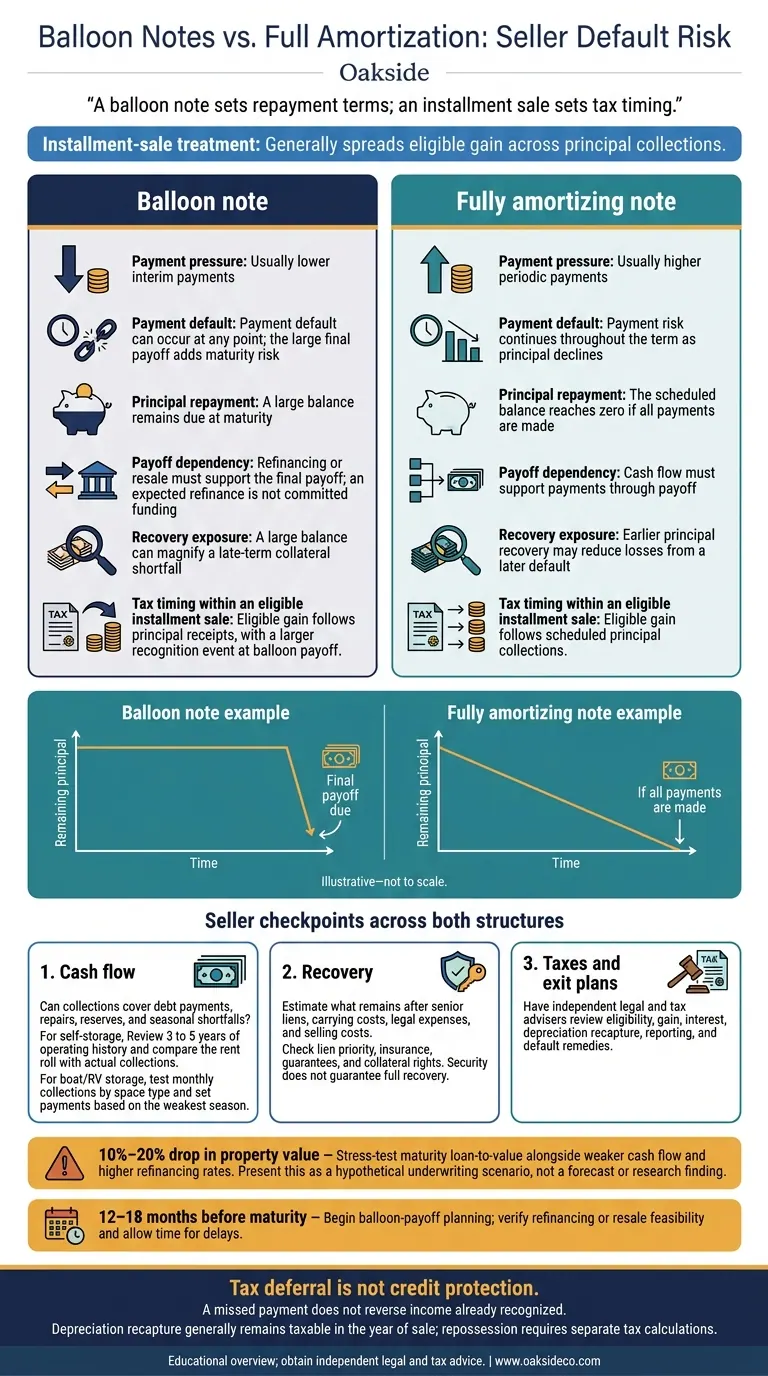
Balloon Notes vs. Full Amortization: Seller Default Risk
Once tax deferral is in place, the next question is whether the buyer can make payments and eventually pay off the debt. Default risk has two tests: staying current on payments and paying the remaining balance at maturity.
| Risk category | Balloon note | Fully amortizing note |
|---|---|---|
| Periodic-payment default | Lower initial payments can ease cash flow, but weak operating results can still lead to default. | Typically higher payments put more pressure on monthly cash flow. |
| Maturity default | A large balance remains due. | The scheduled balance reaches zero if all payments are made. |
Balloon Notes: Refinancing Risk at Maturity
With balloon notes, repayment risk centers on the maturity date. Underwrite the exit, not just the buyer’s ability to make current payments. Review historical and projected net operating income, debt-service coverage, buyer liquidity, equity contribution, and capital needs.
Stress-test the loan-to-value ratio at maturity using a 10%–20% drop in value and higher refinancing rates. Check whether the deal would meet a lender’s coverage, leverage, reserve, and property-condition requirements. Determine how much repayment depends on refinancing or resale. An expected refinance is not committed funding.
| Balloon-note advantage | Related risk or protection to evaluate |
|---|---|
| Lower initial payments | Keeping cash available for operations does not prove the buyer can repay principal at maturity. |
| A defined payoff date | A large collection obligation falls on one date. |
| Time to improve operations before refinancing | Higher rates, weaker income, or a low appraisal can prevent refinancing. |
| Collateral-backed repayment | Check lien priority, insurance, guarantees, and collateral rights. Security does not guarantee full recovery. |
Installment Sales: Collections and Tax Timing
For installment sales, attention shifts from the repayment schedule to actual collections. Track principal collected, basis recovery, taxable gain, and interest separately. Eligible gain is generally recognized as principal comes in, but tax deferral does not ensure payment. Depreciation recapture generally remains taxable in the year of sale, even when collections are limited. Form 6252 generally reports qualifying installment sales.
A missed payment does not reverse income already recognized. A delinquent note calls for collection efforts; a worthless note requires separate tax treatment. Repossession also requires separate tax calculations for the reacquired property and the unpaid obligation.
Balloon vs. Full Amortization: Seller Risk
Within an otherwise eligible installment sale, compare payment schedules without assuming they settle every deal term. Review the down payment, interest rate, lien priority, guarantees, and buyer capitalization separately.
For self-storage, test occupancy, delinquency, rent growth, taxes, insurance, maintenance, and capital spending. For boat/RV storage, also test seasonal cash flow, weather exposure, and how easily the property could be resold.
The main difference is payment size - and when the seller faces repayment risk.
| Seller consideration | Installment sale with a balloon | Fully amortizing installment sale |
|---|---|---|
| Default timing | Payment default can occur at any point; the large final payoff adds maturity risk. | Payment risk continues throughout the term as principal declines. |
| Tax timing | Eligible gain follows principal receipts, with a larger recognition event at balloon payoff. | Eligible gain follows scheduled principal collections. |
| Payment stability | Fixed interim payments can stay steady, but the final payment jumps. | Payments can remain more predictable through payoff. |
| Collateral rights | Depend on documents and lien priority; collateral must support the balloon balance. | Depend on the same protections; declining debt may improve coverage. |
| Loss severity | A large balance can magnify a late-term collateral shortfall. | Earlier principal recovery may reduce losses from a later default. |
Once you understand the default risk, choose a repayment term the asset’s cash flow can support.
Self-Storage: Cash Flow and Capital Needs
Review 3 to 5 years of operating history to test whether collections can cover payments and support refinancing at maturity. Compare the rent roll with actual collections before counting on revenue growth.
Base payments on cash flow after taxes, insurance, and reserves. Reserves use cash even when they sit below NOI in the financial model, so test payment affordability after those deposits.
For improvements, require an approved budget, a deadline, and a final inspection. Schedule completion before balloon maturity so repayment doesn’t depend on unfinished work.
| Property profile | Balloon fit and required protections | When full amortization may be preferable |
|---|---|---|
| Stabilized self-storage | Steady collections and limited capital needs; buyer equity and a maturity stress test required | Limited refinancing capacity |
| Self-storage needing improvements | Work funded and scheduled before maturity; reserve controls and completion sign-off required | Principal reduction without relying on improvements |
| Boat/RV storage | Seasonal cash flow supports payoff; monthly tests, reserves, and resale timing required | Narrow resale market; affordable off-season payments |
Boat/RV assets need a separate test because seasonal swings can hide a shortfall at maturity. Compare self-storage and RV storage returns to understand how these different risk profiles impact your exit strategy.
Boat/RV Storage: Seasonality and Resale Risk
Test monthly collections by space type rather than relying on annual averages. Set payments based on the weakest season. A balloon works only if resale or refinancing is realistic.
Don’t count on a quick sale to fund the balloon. Build realistic resale timing into default management, with enough reserves to cover a delayed exit.
Review roofs, pavement, drainage, gates, and covered structures. Require proof of insurance, paid property taxes, and regular maintenance. Fund repairs and operating shortfalls in advance so the collateral stays insured and doesn’t lose value through neglect.
Full amortization helps only when off-season cash flow covers the payment. Otherwise, require more buyer equity or revise the terms. A shorter balloon needs a supportable earlier payoff plan - not just a closer deadline. If off-season cash flow can’t carry the debt, test a shorter balloon or an amortizing balance against those same payment and payoff requirements.
Once payment terms are set, focus on two questions: Can the buyer pay, and what can the seller recover if they don’t?
Buyer Financial Review and Collateral Rights
Review financial statements, tax returns, and debt schedules to verify the buyer’s liquidity, net worth, and debt load. Check whether guarantor assets can be converted to cash, are already pledged, qualify for exemptions, or could be depleted. Each can affect installment payments or recovery of the balloon balance.
Base the down payment and loan-to-value limit on a supported valuation and stressed debt service coverage ratio (DSCR) - not the buyer’s requested terms.
Have counsel confirm lien priority through title and UCC searches, then record and perfect the security instruments. Set reporting deadlines and covenants covering cash flow, insurance, taxes, maintenance, new debt, and transfers.
Careful underwriting only goes so far. The documents must also give the seller enforceable remedies.
Payment Terms and Default Remedies
Document interest, payment dates, amortization, maturity, the balloon balance, prepayment rights, late charges, cure periods, acceleration, and guarantor liability. Distinguish payment defaults from reporting breaches, and spell out notice requirements.
Before signing, have a tax adviser confirm installment-method eligibility and compliance with applicable federal rate (AFR), imputed-interest, and original-issue-discount (OID) rules.
Have counsel familiar with the state’s laws review foreclosure, deficiency claims, guaranties, and lawful default charges. Contractual remedies can improve recovery, but they don’t guarantee it. Senior liens, bankruptcy stays, legal costs, property deterioration, and state foreclosure procedures can reduce recovery or delay it. Check enforceability before closing - not after a missed payment.
Exit Options and Downside Scenarios
Start planning for the balloon payoff 12 to 18 months before maturity. This leaves time to respond if refinancing falls through, collateral loses value, or a sale or foreclosure takes longer than expected.
Estimate net recovery after senior debt, carrying costs, legal expenses, and any discount from selling the note. For self-storage, test maturity proceeds using lower occupancy and higher capital needs. For boat/RV storage, account for seasonal collection gaps and resale timing. Include vehicle or vessel depreciation only if those assets serve as collateral.
If signs of default or trouble at maturity appear, define the exit path before you need it. Installment tax deferral does not ensure collection. Have independent legal and tax advisers review any transfer, modification, or enforcement action, including recognition, basis, interest, and reacquisition consequences.
| Exit option | Role before or at maturity | Recovery constraint |
|---|---|---|
| Prepayment | Collect an early payoff if permitted | Future interest ends; premium provisions may apply |
| Note sale or assignment | Convert the remaining obligation to cash before maturity | Discounts, recourse, and liability for documentation defects can reduce proceeds |
| Buyer refinancing | Fund the payoff at maturity | Appraisal, rates, coverage, and lender approval determine whether it closes |
| Property resale | Use net sale proceeds to retire the note | Allow time for marketing and confirm that proceeds cover the debt |
| Restructuring | Revise payments or extend maturity to preserve collections | Longer exposure and poorly drafted changes can weaken remedies |
| Foreclosure | Enforce collateral rights after an uncured default | Recovery depends on senior claims, enforcement costs, and eventual disposition |
Accept a balloon payment only if the payoff source holds up under weaker cash flow, higher refinance rates, and lower collateral values. Weigh tax deferral strategies, payment timing, and default exposure against your liquidity needs.
A balloon note sets payment timing; installment-sale treatment sets tax timing. Choose installment treatment only when the tax deferral outweighs the added credit and collateral risk. Tax deferral is not credit protection.
Oakside Co can help with transaction analysis and disposition planning for self-storage and boat/RV sales. Before committing, use independent legal and tax advisers to confirm eligibility, documentation, and enforceable default remedies.
How much down payment should I require to limit default risk?
To reduce default risk in an installment sale, require a down payment that covers your first year’s tax liability before finalizing the note. Seller notes typically account for 10% to 30% of the total purchase price.
Before agreeing to terms, carefully review the buyer’s ability to pay. Check that the down payment also provides enough security to cover potential tax obligations from the sale.
How can I structure payments around seasonal storage income?
Keep larger operating reserves to cover fixed expenses when seasonal revenue drops and maintain a strong debt service coverage ratio. Look for financing that offers payment relief or interest-only periods during lower-income seasons.
Nolen Masserman, Managing Director at Oakside, stresses starting tax planning and capital structuring years before a sale. Planning ahead can help keep unexpected financial hurdles from disrupting your closing or long-term investment goals.
Could extending a balloon deadline affect my installment-sale taxes?
Extending a balloon payment deadline generally doesn’t trigger an immediate tax bill under IRC Section 453, which spreads capital gains recognition over installment payments. But the revised terms must still meet IRS requirements, including keeping interest at or above the Applicable Federal Rate to avoid Original Issue Discount rules.
An extension can also change your cash flow and delay when you receive your tax-free return of basis.