

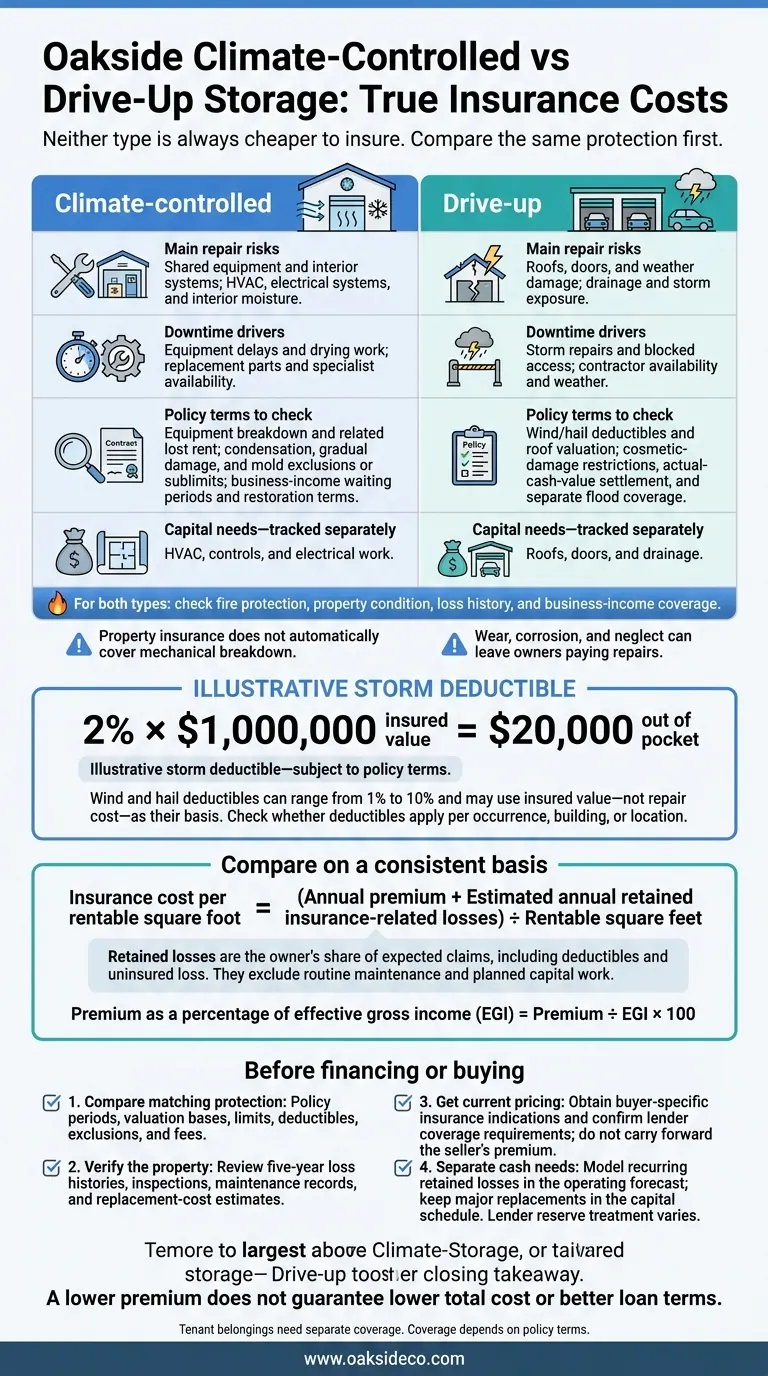
Neither climate-controlled nor drive-up storage is always cheaper to insure. I compare matching coverage and owner-paid losses - not just premiums. For example, a 2% storm deductible on $1 million of insured value means $20,000 out of pocket, subject to policy terms.
Here’s what I check before choosing between them:
- Property risks: HVAC, electrical systems, and interior moisture versus roofs, doors, drainage, and storm damage.
- Coverage gaps: Equipment breakdown, flood, mold, fire protection, and lost rent.
- Total cost: Premiums plus expected owner-paid losses per rentable square foot, with maintenance and major replacements tracked separately.
- Loan and purchase costs: Current quotes, five-year loss records, lender requirements, and repair reserves. Tenant belongings need separate coverage.
Quick Comparison
| What I compare | Climate-controlled | Drive-up |
|---|---|---|
| Main repair risks | Shared equipment and interior systems | Roofs, doors, and weather damage |
| Downtime | Equipment delays and drying work | Storm repairs and blocked access |
| Policy terms to check | Equipment breakdown and related lost rent | Wind/hail deductibles and roof valuation |
| Capital needs | HVAC, controls, and electrical work | Roofs, doors, and drainage |
My rule: <u>compare the same protection first</u>. Then weigh property condition, downtime, and cash needed after a loss.
Climate-Controlled vs Drive-Up Storage: True Insurance Costs
Premium is only part of the cost. Limits, deductibles, retentions, and exclusions determine how much of a loss the owner pays. Owners also remain responsible for inspections and preventive maintenance. The question is which storage subtype leaves fewer uninsured losses per premium dollar. Compare repair costs, downtime, and losses the policy won’t cover.
Climate-Controlled: HVAC, Electrical, and Interior Systems
A central system failure can affect many units at once. HVAC, electrical systems, elevators where installed, and interior fire protection all add repair exposure. Property insurance does not automatically cover mechanical breakdown. Mold, wear, and gradual deterioration may have limited coverage - or none at all.
| Building system | Main loss exposure | Coverage questions | Supporting records |
|---|---|---|---|
| HVAC and humidity controls | Compressor failure, condensation, moisture damage | Does equipment-breakdown coverage include these components, resulting water damage, mold remediation, and lost rent? | Equipment schedules showing model, age, capacity, and replacement cost; service logs; humidity records |
| Electrical and backup power | Short circuits, fire, surges, shutdowns | What events trigger electrical-breakdown and utility-service-interruption coverage? | Electrical inspections, load studies, generator tests |
| Elevators and access controls | Breakdown, restricted access, liability | Does equipment-breakdown coverage include elevators, gates, controls, security systems, and related business income? | Inspection certificates, maintenance contracts, incident logs |
| Sprinklers, plumbing, and interiors | Accidental discharge, smoke, water damage | What limits apply to discharge, freezing, leak detection, fire department charges, interior finishes, debris removal, and code upgrades? | Sprinkler and alarm tests, leak records, replacement-cost estimates |
More systems mean more possible claims, downtime, and coverage gaps. Get written confirmation of equipment-breakdown and related business-income coverage, including waiting periods and restoration terms. Match those terms to equipment delivery times, drying needs, and repair schedules.
Keep servicing, sensor checks, leak response, and fire-protection testing up to date. Insurance does not replace those responsibilities.
Drive-Up: Roofs, Doors, and Weather Risks
Drive-up properties have fewer complex mechanical systems but more exposure to weather. Roofs, roll-up doors, exterior wiring, and electrical panels need attention, as do fire access, drainage, and delayed repairs. A worn roof is a maintenance issue; sudden storm damage is an insurable loss, subject to policy terms. Wear, corrosion, and neglect can leave owners paying repair costs themselves.
| Drive-up exposure | Coverage questions | Supporting records |
|---|---|---|
| Roof age, wind, and hail | What valuation terms, cosmetic-damage restrictions, and percentage deductibles apply? | Roof assessment, age, warranty, repair invoices |
| Roll-up doors and gates | Are wind, impact, vandalism, and related lost rent covered? | Door inventory, maintenance logs, incident records |
| Electrical panels and fire access | Which electrical exclusions, code-upgrade limits, or fire-access requirements apply? | Electrical inspections, panel records, fire-lane and hydrant-access plans |
| Flood and drainage | What separate flood coverage, limits, and waiting periods are needed? | Flood-zone information, drainage inspections, five-year loss runs |
Drive-up facilities may have fewer mechanical claims, but roof and storm losses can be larger and harder to predict. Check whether storm deductibles apply per occurrence, building, or location. Wind and hail deductibles can range from 1% to 10% and may use insured value - not repair cost - as their basis. That can erase much of the premium savings. If several buildings suffer damage, the policy wording may require a separate deductible for each.
Risk differences become cost differences when a policy accounts for repairs, fire protection, and downtime.
Building Systems, Electrical Load, and Fire Protection
Electrical condition matters more to insurability than load alone. Compare peak demand with service capacity. Then check installation quality, overloaded circuits, connections made without approval, and combustible contents.
More interconnected systems can make claims larger and repairs harder, reducing insurance cost efficiency. But a well-maintained climate-controlled facility may still be easier to insure than a neglected drive-up property.
| Cost driver | Subtype cost signal | Underwriting question |
|---|---|---|
| Equipment repair complexity | Climate-controlled: higher equipment-related exposure; drive-up: lower mechanical exposure | How much rentable area depends on shared systems? |
| Electrical fire exposure | Premium and loss exposure depend on maintenance and inspection results | Do inspection reports show adequate capacity and sound wiring? |
| Fire spread and containment | Both: effective protection can limit fire loss severity | Does fire protection match the building layout and use? |
| Weather repair severity | Drive-up: greater exterior exposure can increase owner-paid storm losses | What do current condition reports suggest about the likely repair scope? |
| Shared access systems | Climate-controlled: higher equipment-loss exposure; both: liability depends on safe access and maintenance | Can customers and emergency responders maintain safe access? |
Fire protection matters for both subtypes, but its effect on cost depends on system condition and impairment history. Treat sprinkler performance as a core underwriting issue. Check policy requirements, past impairments, and corrective actions. Protection that's out of service can increase fire loss severity and affect coverage. NFPA lists shutoff, damage, and inadequate maintenance among the causes of sprinkler failure.
Repairs, Downtime, and Coverage Gaps
Coverage gaps become clearer when you compare how fast each subtype can recover after a loss. Frequency, severity, and downtime measure different parts of that loss.
Review the last five years of event dates, affected square feet, gross repair costs, insurance recoveries, and days unavailable. Drive-up properties may have fewer systems but still leave owners paying more when severe weather damage meets percentage or per-building deductibles.
| Repair or loss | Main downtime driver | Coverage gap to test |
|---|---|---|
| Climate-control equipment failure | Replacement parts, specialist availability, and affected-unit count | Equipment-breakdown coverage and related business-income protection |
| Interior moisture damage | Drying, testing, demolition, and remediation | Condensation, gradual damage, and mold exclusions or sublimits |
| Drive-up roof, door, or storm damage | Contractor availability, weather, and blocked access | Wind/hail deductibles, cosmetic-damage restrictions, and actual-cash-value settlement |
| Fire or code-triggered rebuilding | Structural review, permits, and required upgrades | Replacement-cost limits and ordinance-and-law coverage |
| Partial closure or utility outage | Restricted access and delayed restoration | Business-income waiting periods, restoration limits, and utility-service endorsements |
Insurance Cost per Rentable Square Foot
Use (annual premium + estimated annual retained insurance-related losses) ÷ rentable square feet. Also calculate premium as a percentage of effective gross income (EGI). This shows insurance expense relative to the property's revenue capacity.
| Worksheet line | Climate-controlled | Drive-up |
|---|---|---|
| Annual premium | Actual annual premium | Actual annual premium |
| Estimated annual retained losses | Expected owner-paid insurance-related losses | Expected owner-paid insurance-related losses |
| Rentable square feet | Verified rentable area | Verified rentable area |
| Insurance cost per rentable square foot | (Premium + retained losses) ÷ rentable area | (Premium + retained losses) ÷ rentable area |
| Premium as a percentage of EGI | Premium ÷ EGI × 100 | Premium ÷ EGI × 100 |
Retained losses are the owner's share of expected claims, including deductibles and uninsured loss. They don't include routine maintenance or planned capital work.
Use five-year loss histories and compare matching policy periods, valuation bases, limits, deductibles, exclusions, and fees. Base replacement cost on actual rebuilding needs - not a flat per-square-foot assumption.
Insurance savings matter most when they affect loan sizing, reserves, and purchase assumptions.
A lower premium does not guarantee better loan terms. Lenders assess insurance risk through coverage limits, retained losses, and required repairs - not just the premium.
Request an underwriting bridge from reported NOI to lender NOI that separates insurance expense, reserves, and one-time acquisition costs. Confirm whether the lender deducts reserves when calculating DSCR; treatment varies.
Lender Coverage and Property Requirements
Before loan approval, provide the policy, endorsements, five years of loss runs, replacement-cost valuation, inspection reports, and proof of insurance. Check limits, deductibles, exclusions, business-income terms, and mortgagee wording against the lender’s requirements.
| Review item | Climate-controlled | Drive-up |
|---|---|---|
| Premiums and coverage | Check equipment coverage and business-income coverage for outages. | Check roof age, condition, and storm deductibles. |
| Systems complexity | Review HVAC uptime, service contracts, electrical capacity, utility history, and outage exposure. | Review roofs, doors, panels, drainage, and storm exposure. |
| Capital needs | Separate replacement needs for HVAC, controls, insulation, and electrical systems. | Separate replacement needs for roofs, doors, paved areas, and drainage. |
| Fire protection | Confirm sprinkler, alarm, monitoring, and inspection records. | Confirm fire access, hydrants, electrical condition, and applicable protection systems. |
| Claims history | Investigate unresolved mechanical, water, electrical, and interruption claims. | Investigate repeated storm, roof-leak, fire, and water-intrusion claims. |
| Record quality | Reconcile equipment inventories, maintenance logs, utility bills, and inspections. | Reconcile roof inspections, repair invoices, storm records, and electrical reports. |
Premiums, utilities, and routine maintenance generally reduce NOI. Major replacements belong in capital planning, not the insurance expense line.
DSCR equals underwritten NOI divided by annual debt service, subject to the lender’s reserve treatment. Higher normalized premiums reduce debt-service coverage. Required repairs or reserves may also limit loan proceeds, even though they are not insurance expenses.
Buyer Insurance Assumptions and Capital Reserves
After lender review, update the pro forma using the buyer’s own coverage, deductibles, and capital plan.
Do not carry the seller’s premium into the acquisition model. Get a current, property-specific insurance indication based on the buyer’s intended coverage and the lender’s requirements. Apply the same scrutiny to drive-up properties: simpler buildings may cost less to operate, but aging structures and deferred repairs can erase that advantage.
| Acquisition assumption | Climate-controlled | Drive-up |
|---|---|---|
| Current insurance indication | Price intended equipment and business-income coverage at current replacement values. | Price intended roof, storm, and liability coverage with explicit deductibles. |
| Retained-loss estimate | Identify owner-paid outage, equipment, and moisture exposure. | Identify owner-paid storm, water-intrusion, and roof-related exposure. |
| Documented capital needs | Schedule HVAC, controls, and electrical work by expected replacement date. | Schedule roof, door, drainage, and repaving work by expected replacement date. |
Include recurring retained losses in the operating forecast. Keep major replacements in the capital schedule, and account for deferred work through closing adjustments, escrow, or equity requirements. Test higher premiums and deductibles separately from capital spending so the model distinguishes NOI reductions from additional cash needed for the acquisition.
Drive-up properties usually carry fewer mechanical risks. But property condition, loss history, and policy terms can wipe out either subtype’s apparent insurance cost advantage.
After reviewing those risks, compare equivalent coverage. Look at the net operating impact after deductibles, retained losses, downtime, and reserves - not just the premium. This requires a sensitivity analysis to understand how expense shifts impact the bottom line.
For buyers and sellers using this comparison in a transaction, Oakside Co offers data-driven underwriting support for self-storage and boat/RV assets, including insurance assumptions and capital needs. It is not an insurance provider and does not promise premium savings, valuation results, or lender approval.
How do I estimate retained losses with limited claims history?
When claims history is limited, use documented property conditions as a stand-in for risk when estimating retained losses. Keep an auditable record of site inspections, maintenance logs, and sensor data, including leak detection, HVAC readings, and gate activity.
Consistent records show insurers and lenders how you oversee the property, especially at sites with high weather exposure. Organized records and clear maintenance histories can also limit surprises during due diligence and build confidence.
Which upgrades could improve my storage facility’s insurability?
Prioritize smart locks, CCTV, and advanced gate access controls to improve security, support higher rates, and potentially lower insurance costs. Add leak, temperature, and humidity sensors to help manage the risks of water damage and HVAC failures. These sensors also help document maintenance for buyers, lenders, and insurers.
Catch up on deferred maintenance for roofs, doors, and pavement to reduce risk and help secure better insurance terms and coverage.
How should I compare insurance for a mixed storage facility?
Compare coverage by asset type and get property-specific quotes early. Don’t rely on past costs. Climate-controlled units cost more to replace and carry more utility-related risks than drive-up units because of their HVAC systems and specialized insulation. Account for regional exposure to hurricanes, floods, and storms, too.
Lenders and buyers look closely at insurance and utility costs. Keep maintenance, climate-monitoring, and leak records organized to limit surprises during due diligence and build buyer confidence.